Showing posts with label masterpiece. Show all posts
Tuesday, May 28, 2019
Monet at the de Young, 2019
I just squeaked in a visit to "Monet: The Late Years" at the de Young Museum in Golden Gate Park, San Francisco, and I am so glad I did. The exhibit, as the title suggests, focused on his later work once he was established at Giverny and had created his beloved water lily pond, and the later additions of the Japanese foot bridge and trellis.
It was an appropriately wet and moody day when I visited and the courtyard entrance window featured a wonderful reproduction of one of his many water lily pond paintings.
While several pieces came from private collections and the permanent collections of museums here in the United States, the bulk of the exhibit came from the Musée Marmottan Monet, a museum in Paris dedicated to the works of Monet. At over three hundred pieces, the museum is the largest collection of the work of this Impressionist master. We are lucky that they decided to share the genius of this man. I have seen Monet's works in museums all over the world and there is nothing like standing in front of one of his canvases, seeing the image and comprehending that it is of, perhaps, a pond, or a foot bridge over a pond, but seeing the dichotomy of the colors and brushstrokes, the wild scribbling and glorious caked-on pigments that go to create such an image. It is always staggering to me to see the free flowing colors, and I get lost in the swirl and play of the palette of each painting. You can see some close-ups of some of the pieces interspersed with my photos below.
Via the audio tour (which was peppered with beautiful French Impressionist musical pieces), I learned that the pond at Giverny initially did not exist and he had petitioned the local council to divert water from another source to create it. He was an avid gardener and kept up the grounds of Giverny himself but the growing gardens eventually demanded more attention than he could give, so he hired eight full time gardeners to look after not only the plots and beds and trees and flowers but also the pond itself and the precious water lilies. Men would daily skim the pond and dunk the lily pads to wash off whatever dust or dirt might have accumulated on them. Monet also suffered from cataracts and at one point, his vision was down to only 10%--a devastating debilitation for a painter. But he was persuaded to have surgery and much of his eyesight returned. He spent his final years in a prolific flurry of activity, creating ambitiously large and breathtakingly beautiful canvases.
Of course Impressionists are known as "painters of light" and like many Impressionists, Monet painted the same subject again and again but at different times of day and thus in different light, resulting in almost completely different paintings. I love these four view of a weeping willow tree, but depending on whether the light was indirect or direct, during the morning, afternoon, or at dusk, the feeling and colors change dramatically.
And the same goes for these four views of the main house at Giverny, whose top (seen at left) barely peeks up over the shrubs and climbing roses.
https://deyoung.famsf.org/exhibitions/late-monet
https://www.marmottan.fr/en/
Labels:
art,
de Young,
exhibit,
france,
Giverny,
impressionism,
landscape,
masterpiece,
Monet,
Musée Marmottan Monet,
museum,
painter,
painting,
paris,
post-Impressionism,
san francisco,
water,
water lilies
Thursday, August 16, 2018
Now You Can Sleep On A Masterpiece!
A collaboration between London's National Gallery and English bed-maker Savoir Beds (first created for The Savoy Hotel in London in 1905) has yielded the possibility of sleeping on any piece of artwork in The National Gallery's collection!
Savoir Beds says:
"Adorn a Savoir bed with one of the world’s finest paintings from the prestigious National Gallery in London. In an exclusive collaboration, Savoir Beds and The National Gallery have joined forces to deliver an inspiring approach that takes art in interiors to another level.
Housing over 2300 pieces of art dating from the mid-13th century to the 1900s, The National Gallery showcases paintings by the world’s greatest masters, including Botticelli, Leonardo da Vinci, Rembrandt, Monet and Van Gogh. Now Savoir’s clients can create their own masterpiece to treasure. Working closely with our design and upholstery specialists, we can incorporate and customise any National Gallery owned painting.
Once commissioned, the design is specially printed in the UK, by Andrew Martin, using the latest technology on a selection of three fabrics – lustrous velvet, textured linen viscose and versatile cotton. Finished with a bespoke plaque detailing the portrait and artist, every commission will be personally approved by The National Gallery to guarantee the design preserves the essence and integrity of one of the greatest art institutes in the world. The fine art of sleeping beautifully.
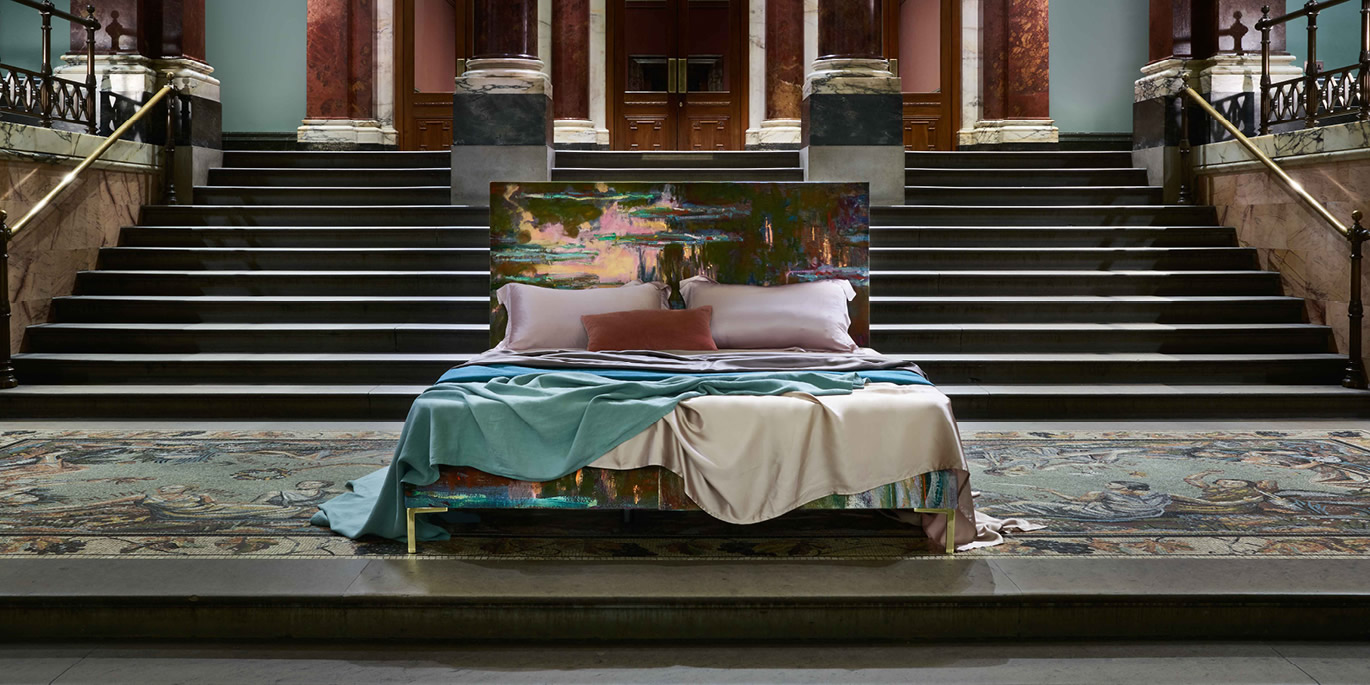
A design from our collaboration with one of the world’s greatest art institutes, The National Gallery, this Harlech No 2 features Claude Monet’s, Water-Lilies, Setting Sun. With the vast number of paintings in the National Gallery to consider, Monet was a destined choice, considering our historic connection to the iconic artist. In 1899, 1900 and 1901, he stayed at The Savoy, on a Savoir bed and it is from the fifth floor he would spend his mornings painting the sun rising over London. We’ve worked with the National Gallery closely to apply the artwork to the design, with the calming water lilies in the sunset, flowing from the headboard down to the base in a beautiful velvet specially printed in the UK, by Andrew Martin. The detail is incredible with the brushstrokes in a range of deep purple and rich pink hues, complemented by the simple bed design. Finished with a bespoke plaque detailing the portrait and artist, this bed has been personally approved by The National Gallery.
A design from our collaboration with the prestigious National Gallery, the Felix No 4 features Gherardo di Giovanni del Fora’s, The Combat of Love and Chastity. Part of a series illustrating the ‘Triumphs’ by the poet Petrarch, our design and upholstery specialists worked closely to perfectly incorporate and position the painting on the Savoir Felix design to create maximum impact. This commission is specially printed in the UK, by Andrew Martin, using the latest technology on a luxurious cotton fabric. In this exclusive collaboration, we’ve joined forces with The National Gallery to deliver an inspiring approach that takes art in interiors to another level.
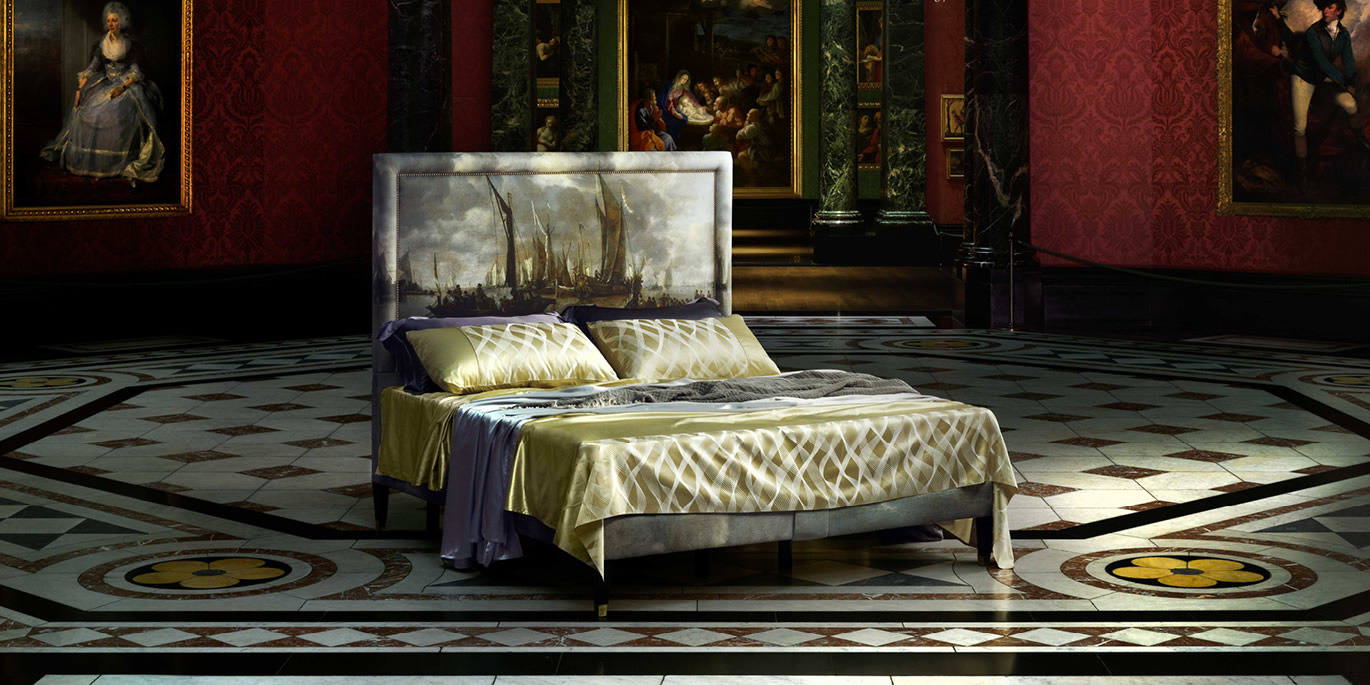
The Felix No 4 with Van de Cappelle’s, A Shipping Scene with Dutch Yacht firing a Salute, is a design from our collaboration with The National Gallery. A painting that is a notable example of a calm seascape with billowing clouds is the perfect scene to be upholstered on to a Savoir bed. Savoir’s skilled design team worked closely with The National Gallery to carefully take elements of the painting and incorporated them in to the Felix design, ensuring the headboard revealed the mood of the scene and the base featuring the calming clouds. The painting has been specially printed in the UK, by Andrew Martin, in a cotton fabric, which shows the minute detail of the painting. Our skilled craftsmen then being their magic, upholstering the headboard, ensuring the exactly placement and hand tapping every nail.
https://www.savoirbeds.co.uk/our-story/national-gallery-collection/
https://www.nationalgallery.org.uk/
https://www.andrewmartin.co.uk/
Tuesday, October 26, 2010
BEAUTY: Painting--Giovanni Boldini
A masterpiece portrait was recently discovered in a Paris flat that had been locked up for the last 70 years. Since then, the painter of the piece, Giovanni Boldini, has been brought into renewed focus for us here in the 21st century. In fact, the lost masterpiece sold at auction for €2.1 million.
Boldini (1842-1931), born in Italy, was a celebrated portrait painter who worked in Paris from 1872 until his death. He was a friend of Edgar Degas, whose influence, I believe, can be seen in Boldini's swishing, flourishing, near-Impressionistic style. I love how the realist portrait style for the faces dissolves into random jagged backgrounds. His work looks like ribbons of color unfurling in a breeze.


Top to bottom: Portrait Of A Young Man; Count Robert de Montesquiou; Portrait of the Artist Lawrence Alexander "Peter" Harrison; Portrait Of Marchesa Luisa Casati With A Greyhound; Walking In The Bois de Boulogne; John Singer Sargent (Standing); La Divina; Spanish Dancer At The Moulin Rouge
http://www.giovanniboldini.org/
Labels:
art,
beauty: painting,
Giovanni Boldini,
italian,
masterpiece,
painter,
painting
Subscribe to:
Posts (Atom)