Showing posts with label Africa. Show all posts
Tuesday, May 31, 2022
BEAUTY: Photography--Omar Victor Diop
Fine art photographer Omar Victor Diop created his Allegoria series to invite us to think critically about environmental justice, anthropocentricism, and our collective and individual responsibilities in securing more viable, liveable futures. His self portraits show him with species that are extinct or will certainly be in the next few decades, as well as referencing landscapes (and food) that are in peril. The artist's website says his work's "dramatic renditions borrow openly from different genres that include classical painting, universal religious iconography, and mid-century West African photographic studio portraiture, as well as Japanese ukiyo-e woodblock compositions from the Edo period—'pictures of the floating world.'"
https://www.omarvictor.com/
Monday, June 21, 2021
BEAUTY: Clothing--Tokyo James
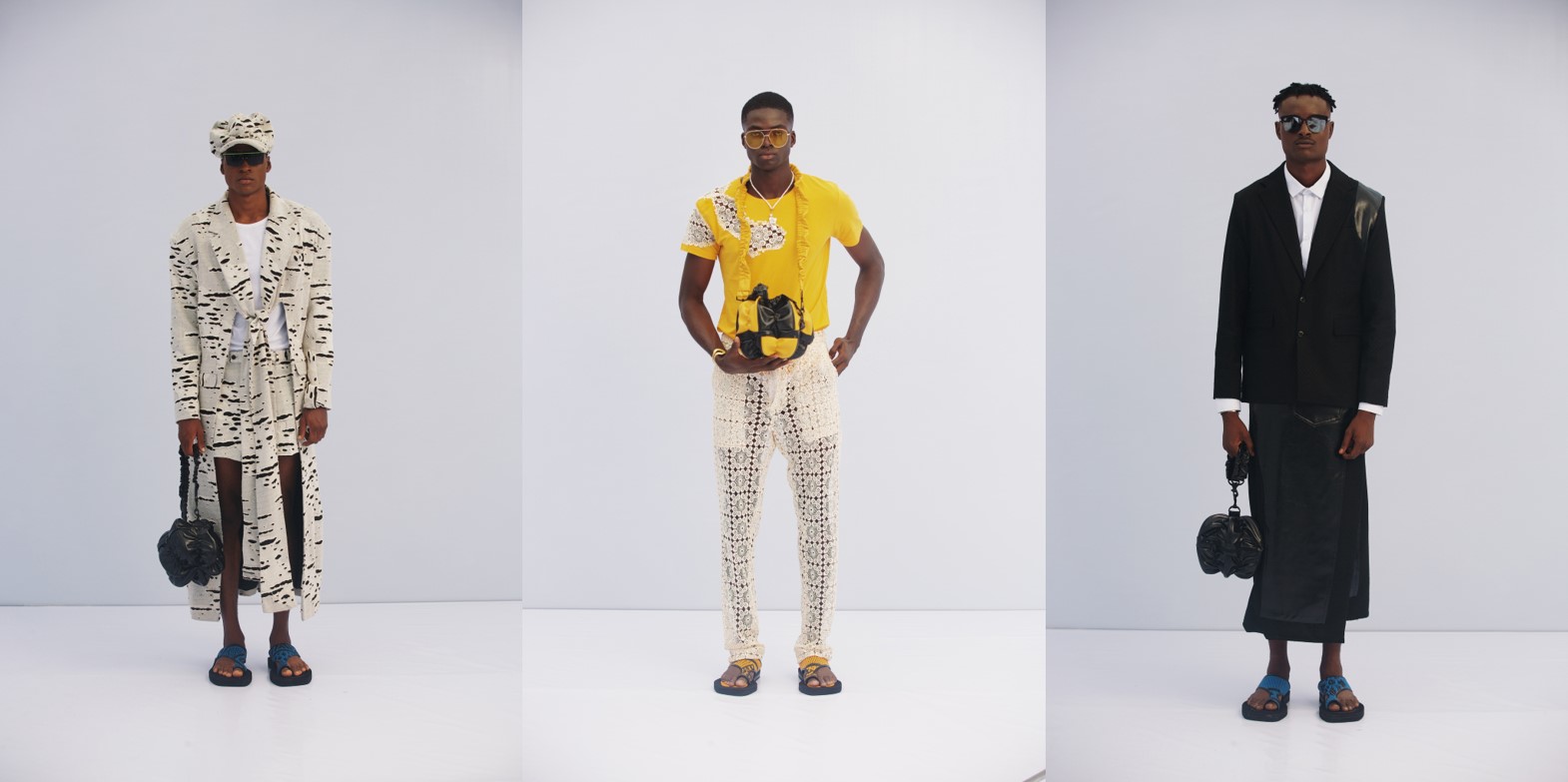
The Spring Summer '22 collection Tokyo James created for Milano Moda Uomo seems to be simple, summery beach wear but something about it wouldn't let me click past. Fashion journalist Steff Yotka wrote it best for Vogue:
"The cellular signal inside Iniye Tokyo James’s Lagos atelier isn’t so great, so he has to take his Ata Rodo bags and button-up shirts outside for a better connection. Even with the occasional moments of glitching, the conversation is one of the best of virtual Fashion Week. Rarely do I see the actual space clothing is designed in; it’s rarer still to meet the people who make it. As James stands on his porch, his colleagues act as de facto models, trying on a wrap skirt with leather trouser panels and an inset leather blazer. It’s a human moment amidst the fashionable façades our very phygital Fashion Week provides.
James’s warmth and heart translate to his garments. This season he started thinking about the Osu caste system used by the Igbo people of eastern Nigeria. Osu—or outcasts—are shunned by society and looked down on; James saw them as representative of outcasts around the world. A collection that wafts through ideas of lightness and porousness was his solution; something gentler and kinder. He made use of beautiful white and pink/red lace for collar shirts, blazers, and trousers and created similarly perforated white jackets from cord. Underneath, there are James’s first boxer shorts with a bold logo tag; there is also a cheeky graphic tee that reads 'Tokyo F*****g James.' It’s delivered as a saucy message of self-preservation. Suiting remains the core of James’s offering, and he has loosened up its form with his signature slash vents, ruched fronts, and a new suit-skirt inspired by traditional African wraps."
Monday, November 13, 2017
BEAUTY: Sculpture--Yinka Shonibare MBE
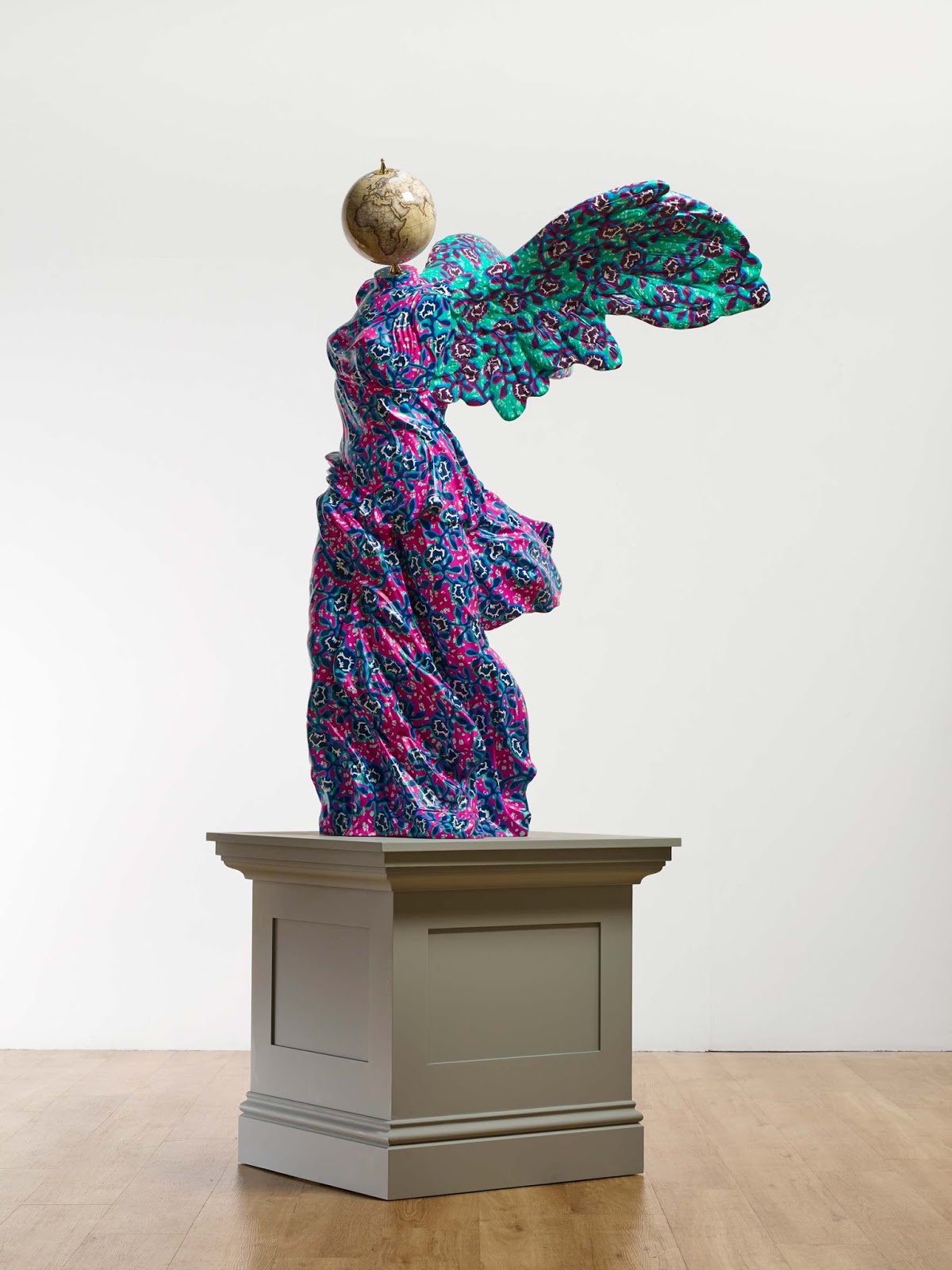
The dynamic work of artist Yinka Shonibare MBE speaks to his immersion in two different cultures...or three depending on how you count certain elements of his work.
Shonibare's website says:
"Yinka Shonibare MBE was born in 1962 in London and moved to Lagos, Nigeria at the age of three. He returned to London to study Fine Art, first at Byam School of Art (now Central Saint Martins College) and then at Goldsmiths College, where he received his MFA.
Shonibare’s work explores issues of race and class through the media of painting, sculpture, photography and film. Shonibare questions the meaning of cultural and national definitions. His trademark material is the brightly coloured ‘African’ batik fabric he buys in London. This type of fabric was inspired by Indonesian design, mass-produced by the Dutch and eventually sold to the colonies in West Africa. In the 1960s the material became a new sign of African identity and independence."
The cultural mash-up that results from cladding traditional European sculpture in this Dutch-African material is delicious.
Top to bottom: Apollo of the Belvedere (After Leochares); Butterfly Kid (Boy); Butterfly Kid (Girl) IV; David (after Michelangelo); Discus Thrower (After Myron); Mrs. Pinckney and the Emancipated Birds of South Carolina; Revolution Kid (Calf); Revolution Kid (Fox); Venus de Milo (After Alexandros); Winged Victory of Samothrace
And here are his Elemental figures:
http://www.yinkashonibarembe.com/home/
Shonibare's website says:
"Yinka Shonibare MBE was born in 1962 in London and moved to Lagos, Nigeria at the age of three. He returned to London to study Fine Art, first at Byam School of Art (now Central Saint Martins College) and then at Goldsmiths College, where he received his MFA.
Shonibare’s work explores issues of race and class through the media of painting, sculpture, photography and film. Shonibare questions the meaning of cultural and national definitions. His trademark material is the brightly coloured ‘African’ batik fabric he buys in London. This type of fabric was inspired by Indonesian design, mass-produced by the Dutch and eventually sold to the colonies in West Africa. In the 1960s the material became a new sign of African identity and independence."
The cultural mash-up that results from cladding traditional European sculpture in this Dutch-African material is delicious.
Top to bottom: Apollo of the Belvedere (After Leochares); Butterfly Kid (Boy); Butterfly Kid (Girl) IV; David (after Michelangelo); Discus Thrower (After Myron); Mrs. Pinckney and the Emancipated Birds of South Carolina; Revolution Kid (Calf); Revolution Kid (Fox); Venus de Milo (After Alexandros); Winged Victory of Samothrace
And here are his Elemental figures:
![]() |
| Earth |
![]() |
| Air |
![]() |
| Fire |
![]() |
| Water |
Monday, November 10, 2014
Sandibe Safari Hotel by Michaelis Boyd
Just completed by architectural firm Michaelis Boyd: The Sandibe Okavango Safari Lodge on the Okavango Delta in Botswana.
http://michaelisboyd.com/
http://www.andbeyond.com/sandibe-okavango-safari-lodge/
http://michaelisboyd.com/
http://www.andbeyond.com/sandibe-okavango-safari-lodge/
Labels:
&Beyond,
Africa,
architects,
architecture,
Botswana,
hotel,
lodge,
Michaelis Boyd,
safari,
Sandibe Okavango Safari Lodge
Subscribe to:
Posts (Atom)