
Renowned interior designer Michael S. Smith designed the interiors in close collaboration with the Obamas and the results were stunning. I adore the way Smith and the Obamas mixed very contemporary art to highlight, and contrast with the traditional antiques that populate such an historic building. Luxury materials like grass cloth wallpaper and Oushak carpets brought a sense of current style to the White House.
 |
The Family Sitting Room contains a Sean Scully artwork, a Roman Thomas sofa, a Baker floor lamp, and a Jasper side table.
|
Mayer Rus reported for Architectural Digest:
Considering the epochal achievements of the Obama administration—the Affordable Care Act, the legalization of same-sex marriage, the Recovery Act, the Paris Agreement on climate change, and so much more—it seems trivial to append a footnote that reads, “The President and First Lady have a pretty chic dining room, too.” But the fact is, they do. And for anyone who appreciates the power of design, Michelle and Barack Obama’s emendations to the White House speak volumes about the sea change in American culture the two have championed for the past eight years. Adorned with an unprecedented array of 20th- and 21st-century artworks, their private quarters remain an oasis of civility and, yes, refined taste in a political arena so often bereft of both.
“Because of Michael Smith, the private residence of the White House has not only reflected our taste but also upheld the proud history of this building. Above all, it has truly felt like a home for our family,” says Mrs. Obama in praise of the Los Angeles–based decorator, who has collaborated closely with the First Family during their tenure in Washington, D.C. Smith returns the compliment by describing his work as a response to the First Lady’s progressive spirit: “Mrs. Obama often talks about bringing new voices into the national conversation, and that idea informed many of the decisions we made,” he says. “We selected artists and designers who would never have appeared in the White House before.”
Smith was introduced to the Obamas by a mutual friend in Chicago following the 2008 election. “They were unbelievably charming, gracious, and thoughtful, and those qualities were reflected in the design of their home,” the decorator says. “It was very welcoming and comfortable, with books everywhere, and I immediately grasped the spirit of their family.”
With less than two months to make plans before the Obamas moved into the White House, Smith had to hustle. “The number one priority for the First Lady was getting Malia’s and Sasha’s rooms and her mother’s room set up,” explains Melissa Winter, who is the deputy assistant to the President and senior adviser to the First Lady. “The most important thing was ensuring the comfort and happiness of her family.”
The Smith-Obama collaboration progressed in much the same way as any typical designer-client relationship. Smith began by sending the Obamas various design books—his own included—which they notated extensively. “They’re very focused, and they laid out their preferences quite clearly,” he says. “They’re drawn to elegant, simple things.”
Still, for all the talk about the comfort and ease of a young family, the Obamas and Smith were acutely aware of the symbolic resonance of any changes they made to the White House. “To understand the context, I read every letter and note from Abigail Adams, Jacqueline Kennedy, Sister Parish, Stéphane Boudin, Kaki Hockersmith—anyone who had ever contributed to the history of this building,” Smith says. That immersion process extended to phone calls with Nancy Reagan and a lunch with Lee Radziwill, Mrs. Kennedy’s sister.
Smith had a more hands-on ally in William Allman, the curator of the White House. “Michael was sensitive to staying within the traditions of the White House while at the same time adding strategic modern touches,” Allman says. “He managed to introduce an array of abstract and contemporary artworks—particularly in the Obamas’ private rooms—without disrupting the gravitas and historic character of the building.”
That delicate balancing act comes to life with particular eloquence in the redesign of the State Floor’s Old Family Dining Room, which, at Mrs. Obama’s behest, was opened for public viewing in 2015 for the first time in White House history. There, alongside a stately early-19th-century mahogany dining table and a sideboard once owned by Daniel Webster, the First Lady selected several American abstract works that were donated to the White House permanent collection. They include two of Josef Albers’s signature nested squares, a 1998 piece by Robert Rauschenberg, and a 1966 canvas by Alma Thomas, the first African-American woman artist represented in the White House.
Art intended for the permanent collection goes through extensive vetting by Allman’s office as well as the Committee for the Preservation of the White House, an advisory board on which the First Lady serves as honorary chair. The works displayed in the residence and offices, however, are chosen at the discretion of the President and First Lady, and it is in those private spaces that the Obamas unleashed their desire for a more diverse art program that underscores the message of an inclusive administration and closely hews to their own particular tastes.
More than any of Smith’s soigné flourishes—the dreamy Oushak carpet in the Yellow Oval Room, the custom-stenciled abaca wall covering in the Treaty Room, the Peter Schlesinger ceramic urns in the West Hall Sitting Room—it is the art that rings the most clarion bell of modernity in the Obama White House. With many works borrowed from august Washington repositories—the National Gallery of Art and the Hirshhorn and Smith-sonian museums—the remarkable assortment includes pieces by contemporary artists Glenn Ligon, Sean Scully, Robert Mangold, and Pat Steir, as well as by Jasper Johns, Louise Nevelson, Sam Francis, and Hans Hofmann.
Lest any traditionalists start clutching their pearls over the influx of so much bold modern and contemporary art, it should be noted that the President and First Lady selected an unimpeachable nocturne painting by James McNeill Whistler to hang above the fireplace in their serene, monochromatic master bedroom. As Smith points out, "This is their sanctuary—private, elegant, and calm. You really want to make sure that the President of the United States gets a good night’s sleep."
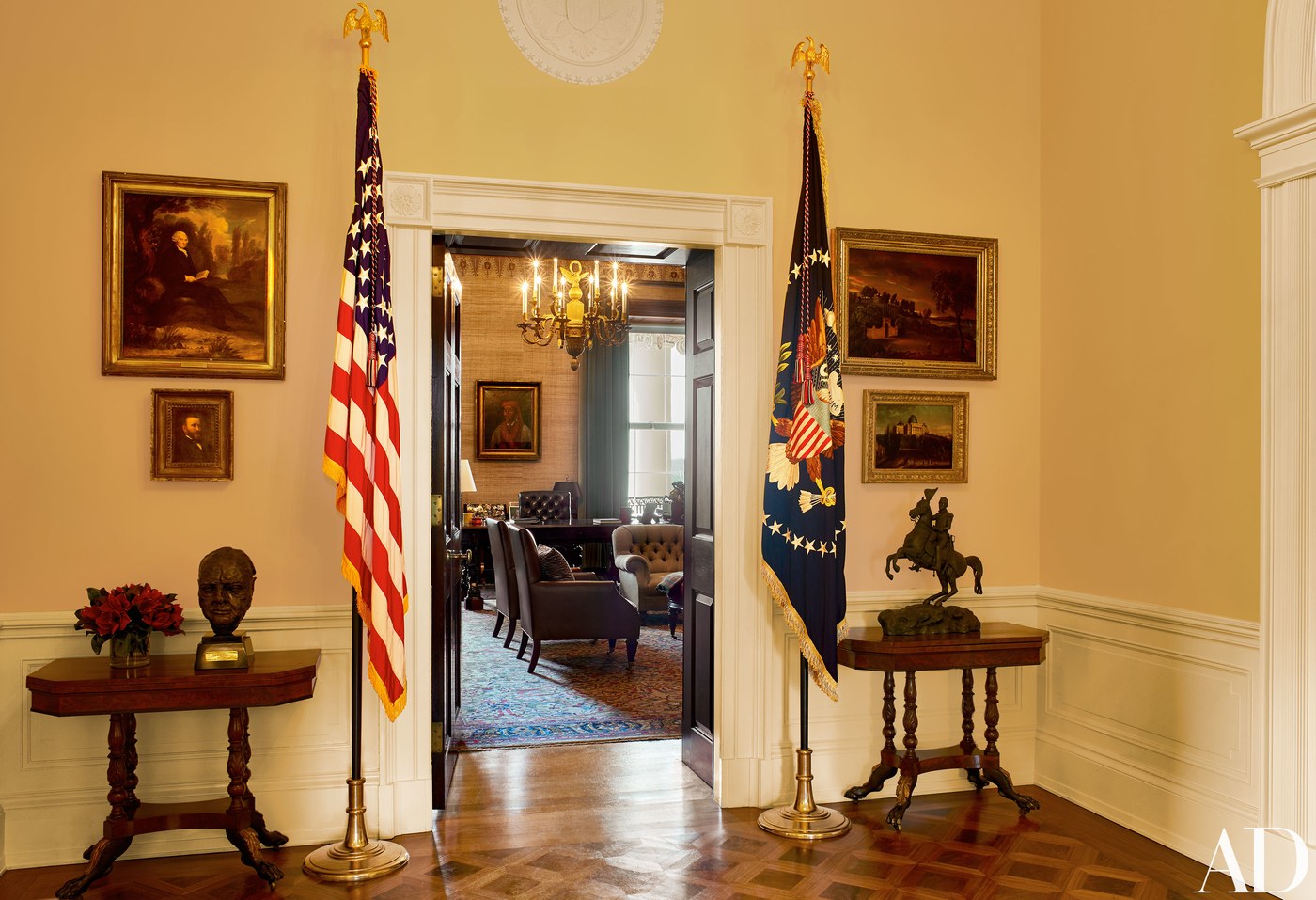 |
| At the Treaty Room entrance, Sir Jacob Epstein’s 1946 bust of Winston Churchill stands on a circa-1810 New York card table. |
 |
| The Treaty Room—filled with memorabilia including one of the President’s two Grammy Awards, family photos, and a personalized football—is where Mr. Obama often retreats late at night. He uses the room’s namesake table (far right), which has been in the White House since 1869, as a desk. George Catlin scenes of Native American life hang on walls covered in custom-stenciled Larsen abaca. Eighteen-fifties overmantel mirror; 1930s Hereke carpet. |
 |
| Smith mellowed the Yellow Oval Room with smoky browns, greens, golds, and blues. The 1978 Camp David peace accords were signed at the antique Denis-Louis Ancellet desk in the foreground. |
 |
In the West Hall, Alma Thomas’s 1973 Sky Light hangs above a circa-1895 English mahogany pier table.
|
 |
The Center Hall contains Peter Schlesinger urns (at rear, on pedestals) and paintings by Sam Francis (far right) and Hans Hofmann.
|
 |
| The Family Dining Room. |
 |
Late-1960s Robert Mangold works hang on the Family Dining Room’s Jasper-fabric-covered walls. The circa-1800 sideboard hosts Christopher Spitzmiller ceramic lamps.
|
 |
A view of the Family Sitting Room, with Glenn Ligon’s Black Like Me #2 (far right).
|
 |
Works by Robert Rauschenberg (left) and Alma Thomas make a modern splash in the Old Family Dining Room. Curtain fabric by George Spencer Designs; Anni Albers–style carpet by Scott Group Studio.
|
 |
| Luncheon is served in the White House’s Old Family Dining Room. |
 |
| The Solarium on the White House roof. |
 |
The master suite’s antique canopy bed is curtained with Larsen and Jasper fabrics and outfitted with Nancy Koltes bed linens. Mirrors and sofa fabric by Jasper.
|
 |
| In the master suite, Giorgio Morandi paintings meet a circa-1903 A. H. Davenport & Co. armchair. |
 |
| President Obama and his daughters, Malia (left) and Sasha, are seated in the Treaty Room under a painting by Susan Rothenberg. |
We truly miss the Obamas. Such caring, such humanism, such elegance, such class.
http://www.architecturaldigest.com/story/obama-white-house
http://www.michaelsmithinc.com/


