Showing posts with label surreal. Show all posts
Thursday, May 7, 2026
BEAUTY: Painting--Patrick Oates
I love the incongruous pink hooves, feet, and paws on the animals of Patrick Oates' dark, surreal portraits.
Top to bottom: I Can't Change that For You; Mother Crossing the Night; Something You'll Never Know; That Part Still Wanders; The Day You Were Handed The Secret; The Stars Often Fell Asleep on the Floor; We Always Left While The House Slept; You'll Find Me There, Always; You've Found a New Way to Make Stars
https://www.patrick-oates.com/
Top to bottom: I Can't Change that For You; Mother Crossing the Night; Something You'll Never Know; That Part Still Wanders; The Day You Were Handed The Secret; The Stars Often Fell Asleep on the Floor; We Always Left While The House Slept; You'll Find Me There, Always; You've Found a New Way to Make Stars
https://www.patrick-oates.com/
Labels:
animal,
art,
artist,
beauty: painting,
painter,
painting,
Patrick Oates,
portrait,
surreal
Tuesday, May 5, 2026
"From Persona To Mulholland Drive: When Cinema Replaces Narrative With The Logic Of Dreaming" by Thomai Tsimpou
I am a cinephile and have a lifelong interest in the topic of dreams, dreaming, and dream logic so this essay about dream logic in cinema hits me exactly right...
"From Persona To Mulholland Drive: When Cinema Replaces Narrative With The Logic Of Dreaming"
WHEN FILMS STOP RESOLVING AND BEGIN TO HOLD TENSION
What these filmmakers share is not a style, but their refusal to resolve time into sequence, identity into unity, or reality into a stable category, constructing films that operate through the same logic as dreaming, where images are connected by intensity, memory, and association, resulting in a different kind of viewing, that no longer questions ‘what is happening,’ but ‘how is this holding together at all.’ And the answer is, not through coherence, but through persistence. Images remain, return, and interfere with one another. Meaning never fully arrives. Cinema produces an unstable reality, and then leaves the viewer inside it, without the tools that would normally allow them to exit.
Link to original article:
https://www.designboom.com/art/persona-mulholland-drive-cinema-narrative-logic-dreaming-bunuel-lynch-bergman-kaufman/
![]() |
| "The Discreet Charm of the Bourgeoisie" by Luis Buñuel, 1972 |
"From Persona To Mulholland Drive: When Cinema Replaces Narrative With The Logic Of Dreaming"
by Thomai Tsimpou for designboom
CINEMA DRIFTING INTO DREAM
Cinema begins to shift when it no longer guarantees that one thing follows another for a reason. Narrative usually secures that relation. It tells us why something happens, what it leads to, who it belongs to. But there is a body of films where this chain loosens, to replace causality with association, recurrence, and displacement. In these films, meaning does not arrive through progression. It accumulates through proximity, stretching the plot until it begins to lose its shape and start resembling a dream state.
Across films by filmmakers such as Luis Buñuel, David Lynch, Ingmar Bergman, and Charlie Kaufman, this shift appears gradually, in the way scenes return without consequence, identities hesitate or overlap and reality becomes something that can no longer be clearly located.
BUÑUEL’S CIRCULAR TIME MEETS LYNCH’S UNSTABLE REALITIES
What changes first is time. Not in the obvious sense of flashbacks or jumps, but more subtly, in the way scenes relate to each other. A moment returns, but slightly altered, as if it had been remembered rather than repeated. The difference is small, but it cancels certainty. If the same event can occur twice without acknowledgment, then time is no longer moving forward. It is circulating. This is where Buñuel’s logic sets in: repetition without consequence. A situation restarts, but nothing has been learned or carried over. Cause and effect are not broken, they are simply no longer required.
But repetition does not behave the same way across these films. In Lynch, it produces instability. A scene feels familiar because it exists in more than one version at once. Identity follows the same pattern. A character does not change into someone else, they seem to occupy multiple positions simultaneously. The effect is not transformation, but overlap. The viewer is left holding two incompatible realities that do not resolve into one.
FROM BERGMAN’S DISSOLVING SELVES TO KAUFMAN’S RECURSIVE LOOPS
Bergman pushes this further by reducing the space in which identity can exist. When the frame tightens around the face, when silence stretches and language begins to fail, the boundary between one person and another starts to erode. In Persona, this happens through proximity. Two figures begin to mirror each other so precisely that distinction becomes difficult to maintain. The image fuses and identity is compressed until it becomes unstable.
Kaufman takes the same instability and turns it inward. Instead of overlapping realities, he constructs recursive ones. Memory, imagination, and present experience fold into each other. A scene may be remembered, invented, or happening, but these states are indistinguishable because they are structured the same way. What’s different is the level at which the image is being experienced.
ATMOSPHERE REPLACES CERTAINTY AS IMAGES REFUSE TO SETTLE
Across all of this, the boundary between reality and imagination becomes less useful. Not because films deliberately confuse the two, but because they refuse to mark the difference. As Susan Sontag observes in relation to Bergman, visions appear with the same weight and texture as anything ‘real.’ There is no visual cue that instructs the viewer how to read an image. Cinema does not shift into a dream. It was already operating there.
What holds these structures together is atmosphere. Sound plays a decisive role. A low hum continues across cuts, ignoring spatial logic. Silence expands until it feels like pressure rather than absence. Music enters without emotional justification, interrupting rather than guiding.
Spaces are composed with a precision that feels slightly excessive, producing environments that are both controlled and unreliable. A room appears stable, but its symmetry becomes oppressive. A face is held in close-up long enough to lose familiarity. Light isolates instead of revealing. These are not expressive choices in the usual sense. They are ways of reorganizing perception, of making the viewer aware that what they are seeing cannot fully settle into meaning.
CINEMA DRIFTING INTO DREAM
Cinema begins to shift when it no longer guarantees that one thing follows another for a reason. Narrative usually secures that relation. It tells us why something happens, what it leads to, who it belongs to. But there is a body of films where this chain loosens, to replace causality with association, recurrence, and displacement. In these films, meaning does not arrive through progression. It accumulates through proximity, stretching the plot until it begins to lose its shape and start resembling a dream state.
Across films by filmmakers such as Luis Buñuel, David Lynch, Ingmar Bergman, and Charlie Kaufman, this shift appears gradually, in the way scenes return without consequence, identities hesitate or overlap and reality becomes something that can no longer be clearly located.
![]() |
| "Mulholland Drive" by David Lynch, 2001 |
BUÑUEL’S CIRCULAR TIME MEETS LYNCH’S UNSTABLE REALITIES
What changes first is time. Not in the obvious sense of flashbacks or jumps, but more subtly, in the way scenes relate to each other. A moment returns, but slightly altered, as if it had been remembered rather than repeated. The difference is small, but it cancels certainty. If the same event can occur twice without acknowledgment, then time is no longer moving forward. It is circulating. This is where Buñuel’s logic sets in: repetition without consequence. A situation restarts, but nothing has been learned or carried over. Cause and effect are not broken, they are simply no longer required.
But repetition does not behave the same way across these films. In Lynch, it produces instability. A scene feels familiar because it exists in more than one version at once. Identity follows the same pattern. A character does not change into someone else, they seem to occupy multiple positions simultaneously. The effect is not transformation, but overlap. The viewer is left holding two incompatible realities that do not resolve into one.
![]() |
| "The Discreet Charm of the Bourgeoisie" by Luis Buñuel, 1972 |
FROM BERGMAN’S DISSOLVING SELVES TO KAUFMAN’S RECURSIVE LOOPS
Bergman pushes this further by reducing the space in which identity can exist. When the frame tightens around the face, when silence stretches and language begins to fail, the boundary between one person and another starts to erode. In Persona, this happens through proximity. Two figures begin to mirror each other so precisely that distinction becomes difficult to maintain. The image fuses and identity is compressed until it becomes unstable.
Kaufman takes the same instability and turns it inward. Instead of overlapping realities, he constructs recursive ones. Memory, imagination, and present experience fold into each other. A scene may be remembered, invented, or happening, but these states are indistinguishable because they are structured the same way. What’s different is the level at which the image is being experienced.
![]() |
| "Persona" by Ingmar Bergman, 1966 - Image: MUBI |
ATMOSPHERE REPLACES CERTAINTY AS IMAGES REFUSE TO SETTLE
Across all of this, the boundary between reality and imagination becomes less useful. Not because films deliberately confuse the two, but because they refuse to mark the difference. As Susan Sontag observes in relation to Bergman, visions appear with the same weight and texture as anything ‘real.’ There is no visual cue that instructs the viewer how to read an image. Cinema does not shift into a dream. It was already operating there.
What holds these structures together is atmosphere. Sound plays a decisive role. A low hum continues across cuts, ignoring spatial logic. Silence expands until it feels like pressure rather than absence. Music enters without emotional justification, interrupting rather than guiding.
Spaces are composed with a precision that feels slightly excessive, producing environments that are both controlled and unreliable. A room appears stable, but its symmetry becomes oppressive. A face is held in close-up long enough to lose familiarity. Light isolates instead of revealing. These are not expressive choices in the usual sense. They are ways of reorganizing perception, of making the viewer aware that what they are seeing cannot fully settle into meaning.
![]() |
| "Twin Peaks: Fire Walk With Me" by David Lynch, 1992 |
WHEN FILMS STOP RESOLVING AND BEGIN TO HOLD TENSION
What these filmmakers share is not a style, but their refusal to resolve time into sequence, identity into unity, or reality into a stable category, constructing films that operate through the same logic as dreaming, where images are connected by intensity, memory, and association, resulting in a different kind of viewing, that no longer questions ‘what is happening,’ but ‘how is this holding together at all.’ And the answer is, not through coherence, but through persistence. Images remain, return, and interfere with one another. Meaning never fully arrives. Cinema produces an unstable reality, and then leaves the viewer inside it, without the tools that would normally allow them to exit.
![]() |
| "Eternal Sunshine of the Spotless Mind" by Michel Gondry, 2004 - Image: Focus Features |
![]() |
| "The Seventh Seal" by Ingmar Bergman, 1957 |
![]() |
| "Mulholland Drive" by David Lynch, 2001 |
![]() |
| "Twin Peaks: Fire Walk With Me" by David Lynch, 1992 |
![]() |
| "Mulholland Drive" by David Lynch, 2001 |
![]() |
| "Persona" by Ingmar Bergman, 1966 - Image: Louis Huch © AB Svensk Filmindustri |
![]() |
| "Rabbits" by David Lynch, 2002 |
Link to original article:
https://www.designboom.com/art/persona-mulholland-drive-cinema-narrative-logic-dreaming-bunuel-lynch-bergman-kaufman/
Labels:
auteur,
cinema,
designboom,
director,
Dream,
dream logic,
essay,
film,
surreal,
Thomai Tsimpou
Tuesday, August 9, 2022
BEAUTY: Painting--Christopher Orr
English artist Christopher Orr creates absolutely stunning images combining the sense of Dutch Old Masters, some Turner, and a dose of dream logic where memories and illusions of people and places get superimposed and collaged onto each other. The results are quietly beautiful, a little disturbing, and even a bit romantic. A group of people waist deep in a river hold hands, dozens of inexplicably unattended campfires burn in a landscape, an art salon melts into a meadow, a man pets a calf whose head is visible while the body disappears, a tiny figure obliviously passes an abduction or a rescue...
Top to bottom: A Gathering of Shadows; A Gathering, You Cannot Hear Us; All Of Your Nothings; An Unvisited Vastness; An Unsettled Encounter; Anthems In Eden; Departing Summer; Half Hidden From The Eye; Little We See In Nature That Is Ours; Nature yet remembers; Stumbling Across A Numinous Landscape; Those Shadowy Recollections; Where The Long Shadows Fall; Your Silent Face
https://www.christopherorr.co.uk/
Labels:
beauty: painting,
Christopher Orr,
figurative,
landscape,
old master,
painter,
painting,
surreal
Wednesday, March 10, 2021
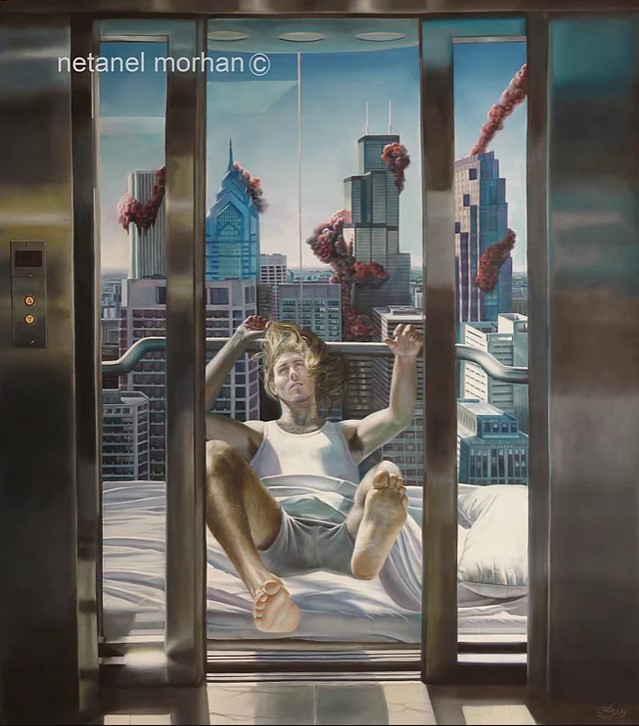
BEAUTY: Painting--Netanel Morhan
I have been fascinated with dreams all my life. I have kept a dream journal since I was a teenager. And the art of Netanel Morhan explores this alternate state of reality. We mostly see dreamers in their beds surrounded by their own dream imagery projected outward for us to see. But we also see some lucid dreaming, and situations of extreme dream logic (which of course never seems extreme when one is in a dream!).
https://netanelmorhan.wixsite.com/netanelpaintings
Labels:
beauty: painting,
Dream,
Dreams,
flying,
lucid dream,
Netanel Morhan,
painter,
painting,
surreal,
surrealism
Friday, March 5, 2021
BEAUTY: Painting--Benny Dröscher
What an extraordinary view Danish artist Benny Dröscher presents to us in his paintings--we lie under a slender birch or elm, looking up the long trunk to the sky. But the view is peppered, like a dream, with floating mushrooms, branches, feathers, lines, and random color patches.
https://www.instagram.com/benny_droscher/
Labels:
beauty: painting,
Benny Dröscher,
Danish,
Denmark,
landscape,
painter,
painting,
surreal,
trees
Subscribe to:
Posts (Atom)