Wednesday, November 14, 2012
BEAUTY: Painting--Jennifer Cronin
American artist Jennifer Cronin paints haunting portraits of women encountering some very odd phenomena. Lights and forms that may or may not be sentient and may or may not be malevolent interact with these women who seem to be unsuspecting yet slightly curious. The suspense and ominous foreboding are palpable.
Top to bottom: Untitled No. 1 (A New Set Of Worries); Untitled No. 4 (A New Set Of Worries); Untitled No. 1 (from the peculiar manifestation of paint in my everyday life); Shelter; Memory Of A Place I Never Knew
http://www.jennifercronin.com/
Top to bottom: Untitled No. 1 (A New Set Of Worries); Untitled No. 4 (A New Set Of Worries); Untitled No. 1 (from the peculiar manifestation of paint in my everyday life); Shelter; Memory Of A Place I Never Knew
http://www.jennifercronin.com/
Labels:
art,
beauty: painting,
Jennifer Cronin,
painter,
painting
BEAUTY: Interior--Rawlins Calderone Design
John Rawlins and Athena Calderone of Rawlins Calderone Design collaborated with Bates Masi Architecture to create a stunning weekend beach house in Amagansett, New York.
I like how the vocabulary of the interior materials and finishes references a beach house/cottage, but it is all done in such a subtle and sophisticated way. And the detail of the woven jute rope on the ceiling is a brilliant touch. Look how it comes down behind the mirror in the master bath and across the window over the tub. I can't help but wonder how the house fared through Sandy... and how it will fare through all the upcoming storms of the same--or worse--magnitude.
http://rawlinscalderone.com/
http://batesmasi.com/
BEAUTY: Installation--William Forsythe
William Forsythe has an impressive CV as a dancer and choreographer. He danced with the Joffrey Ballet and later the Stuttgart Ballet, where he was appointed Resident Choreographer in 1976, and was also director of Ballet Frankfurt from 1984 to 2004. Since then he has helmed The Forsythe Company, a dance and performance troupe. Through that venture, he branched out into performance art pieces, as well as art installations that tangentially relate to the idea of choreography, occupying space, and changing the space one inhabits through movement.
His project Scattered Crowd has been installed in public spaces across Europe, in Korea, and in Canada. It entails filling each space with thousands of suspended and tethered white and clear balloons that respond to the stillness or movement of any participant. It must be like walking through a dream of pearly bubbles...
Frankfurt's Bockenheimer Depot will host Scattered Crowd in March of 2013.
But I particularly love his piece Bouncy White Castle. It seems that at least two or three times a year in my neighborhood, some child with a birthday gets a raucously fun bouncy house in his front yard. "Why oh why don't they make them for adults?" I always moan as I drive by. In 2007, Forsythe created an enormous bouncy house, which, judging by its enormous size, clearly holds adults. The element of choreography here is actually a type of anti-choreography: the piece relies on a soft unsupported floor and the corresponding physical instability of participants. The resulting movements cannot be predicted.
http://www.williamforsythe.de/
http://www.theforsythecompany.com/
Tuesday, November 13, 2012
Ideas, Awe, and Euphoria
By Jason Silva for CNN
Can ideas get you high?
My approach to creating content is focused on pulling people out of their intellectual comfort zones. I'm interested in presenting ideas in unique ways that challenge people to question their assumptions.
My mode of presentation is short-form video -- basically I create fast cut, impassioned "idea explainers" that explode with enthusiasm and intensity as they distill how technology is expanding our sphere of possibility.
I want big ideas to have aesthetic relevance. I want to tickle people's intellectual sensibilities and instill a sense of wonder. I think big ideas should get people high!
My short videos, which I call shots of philosophical espresso, are trailers for these ideas. They are not a substitute for a book or academic paper -- they are instigators. My work is simply another way for wider audiences to engage with these ideas.
My goal is for those who might not be inclined toward heady discourse to find a way still to connect to these ideas.
Psychologist Nicholas Humphrey coined the term "the biological advantage of being awestruck" to describe his theory on why our unique ability to be enthralled was, somehow, biologically selected for in a Darwinian sense. He believes this quirk of our consciousness imbues our lives with a sense of cosmic significance that over the course of history has resulted in a species that works harder not just to survive but to flourish and thrive. To "awe" gives us a "raison d'etre." A reason for being. You can learn more about Humphrey's idea in my video "A Movie Trailer for Awe."
Humphrey says being enchanted by the magic of experience, rather than being just an aid to survival, provides an essential incentive to survive.
"We relish just being here," he says. "We feel the yen to confirm and renew, in small ways or large, our own occupancy of the present moment, to go deeper, to extend it, to revel in being there, and when we have the skill, to celebrate it in words. ..."
As pop philosopher Alain De Botton wrote in "The Art of Travel," "There is an urge to say: I was here, I felt this, and it matters!"
And this sense of cosmic awe continues to manifest itself in the age of technology, as Erik Davis wrote in his book "TechGnosis":
"Collectively, Human societies can no more dodge sublime imaginings or spiritual yearnings than they can transcend the tidal pulls of Eros. ...
"We are beset with a thirst for meaning and connection that centuries of skeptical philosophy, hardheaded materialism cannot eliminate. ... Today we turn to the cosmic awe conjured by science fiction, or the outer-space snapshots of the Hubble telescope as it calls forth our ever-deeper, ever-brighter possible selves."
Terence McKenna, in his book "Food of the Gods," wrote about the origins of human language: this unique, often ecstatic expression of consciousness that bursts forth as morsels of meaning encoded as vocal patterns.
He believes the origins of language stem from our early use of psychedelic compounds, which caused a sort of "ontological awakening" of our species and thus acted as an early catalyst for religion, cosmic feelings of awe and a desire for transcendent experiences.
These experiences, to borrow the words of Tim Doody, re-contextualize oneself as a marvelous conduit in a timeless whole, through which molecules and meaning flow, from nebulae to neurons and back again. Early shamans, Davis wrote in "TechGnosis," became ecstatic technicians of the sacred.
Regardless of whether you buy McKenna's theory, he does provide a compelling case for the relationship between "cosmic, out-of-body euphoria" and the cognitive leaps to which it can give rise.
Some of our greatest poets, scientists and other thinkers have attributed some of their greatest inspiration to the use of these psychedelic chemicals and their resulting out-of-context perspectives.
But it's not necessarily the chemicals themselves I'm interested in, but rather what they do to our sense of perspective and our reference points. My focus is the subjective experiences they seem "to occasion."
Tom Robbins explains:
"The plant genies don't manufacture imagination, nor do they market wonder and beauty -- but they force us out of context so dramatically and so meditatively that we gawk in amazement at the ubiquitous everyday wonders that we are culturally disposed to overlook, and they teach us invaluable lessons about fluidity, relativity, flexibility and paradox. Such an increase in awareness, if skillfully applied, can lift a disciplined, adventurous artist permanently out of reach of the faded jaws of mediocrity."
In my mind the key idea here is that of being forced out of context. We don't necessarily require psychedelics for this, although they might offer a shortcut.
What we require is a bold new attitude and a sense of humility that accepts the ambiguity of many of our so-called truths, habitual thought patterns and cultural reality tunnels. By accepting the need to constantly de-condition our thinking to approach the world with new eyes, we can reconnect with our sense of awe and wonder.
As Michael Pollan wrote, "In order to see things as if for the first time, we must remember to forget." Bucky Fuller used to say "dare to be naive." Oftentimes, our sense of what we think we know is precisely what prevents us from approaching situations free of prejudice.
"Banality is a defense against being overwhelmed," Pollan wrote in his book "The Botany of Desire."
This makes perfect sense to me: In a world where disruption is the new normal, and technological change is happening at an exponential rate; a world where we are bombarded with media messages, and where "attention" is the new limited resource, it seems easier to recoil away from all the mindblowingness going on, and instead look for reasons to be bored. The mundane can be quite comforting for those terrified of leaving their comfort zone.
And this where I think my work serves the purpose of infecting people with wonderment. My short videos are "digital psychedelics" meant to "de-center" the self, dwindle the broadcast of the ego and provide people with a long view, "big picture" perspective on humanity, technology and how their symbiosis might make a dent in the cosmos.
As Alan Harrington wrote in "The Immortalist": "We must never forget we are cosmic revolutionaries."
Original article on CNN.com here.
http://thisisjasonsilva.com/
Do yourself a favor and watch these very short, very inspirational films. Silva talks fast, but stay with him... or just let it wash over you and feel it. His excitement is contagious.
Labels:
awe,
CNN,
imagination,
inspiring,
Jason Silva,
nature of reality,
reality,
universe,
video
Currently listening to...
...the charming, breezy and care-free "Lights Out, Words Gone" by Bombay Bicycle Club. I've had this on "repeat" most of the evening.
Although the video is cute enough, I don't think it does the song justice. The lyrics are not so breezy and care-free, and the images distract from the tension between the music and the meaning.
Keep your old and wasted word
My heart is breaking like you heard
But the town has always turned
these lies and made them all burn
Keep your old and wasted words
My heart is breaking like you heard
but the town has always turned
these lies and made them all burn
Let me be the one to put on
Let me be the one to try it on
Can you feel the leeches bite
That boy that she took out tonight
He's brave and walking sure
through all the spots you're working for
Keep your old and wasted words
My heart is breaking like you heard
but the town has always turned
these lies and made them all burn
Let me be the one to put on
Let me be the one to try it on
When the light is out
when the words have gone
let me be the one to try it on
http://www.bombaybicycleclubmusic.com/
"The Hitchhiker"
The Hitchhiker
In an alternate universe,
the hitchhiker has a gun to my head
while I go down on him.
I remember something like this before but
the door closes like it always does.
Before I left, Mama and Leslie said,
“Please don’t pick up hitchhikers, OK?” but
here we are again, his knife pressed
to my throat. It’s funny, he’s
going to and I’m running from.
In this universe, I think I have an oil leak and I see
the “I Love Baseball” bumper sticker on
the van ahead as I drive. He’s young, clean,
and we talk: he’s saving money
to move to Portland with his girlfriend,
his truck is in the shop so
he needs a ride to the next town
for a job interview at his buddy’s
father’s construction company and all I see
in the seat beside me is a figure with red hair.
Maybe he’ll kill me this time, maybe he won’t.
He says "Thank you," closes the door
and I watch him on the dirt road in
the rear view mirror.
He owns the world,
him and his kind.
And I drive
through it all.
©JEF 1998
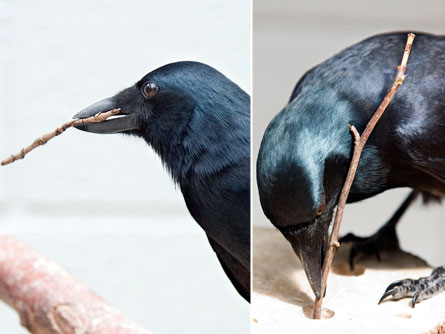
Crows Are Doin' It For Themselves
The New Caledonian crow, native to the French archipelago located in the Pacific Ocean 750 miles east of Australia, uses tools in daily life to perform tasks such as locating and retrieving food. The crows use plant material to create hooks or barbs for extracting grubs from inside logs and branches. But even more interesting, the New Caledonian crow (apparently capable of a degree of higher thinking and reasoning) is the only non-primate animal known to invent new tools to then modify existing tools in order to perform these tasks. Gavin R. Hunt and his research colleagues at the University of Auckland conducted an experiment which involved putting food in a box out of the crows' reach. They were given a stick too short to reach the food, but they could use this to retrieve a longer stick from another box. The longer stick was then used to retrieve the food.
In 2002, researchers at the University of Oxford who were observing a pair of crows named Betty and Abel noticed that "Betty's toolmaking abilities came to light by accident during an experiment in which she and Abel had to choose between a hooked and a straight wire for retrieving small pieces of pig heart, their favorite food. When Abel made off with the hooked wire, Betty bent the straight wire into a hook and used the tool to lift a small bucket of food from a vertical pipe. This experiment was the first time the crows had been presented with wire." The experiment was repeated. Out of ten successful tries, Betty bent the wire into a hook nine times.
Labels:
animal,
crow,
intelligent,
nature,
New Caledonian crow,
tool,
tool making,
University of Oxford,
video
BEAUTY: Sculpture--Christian-Pontus Andersson
It may or may not be true that Christian-Pontus Andersson wavered between a career in plastic surgery or art. But it is true that this Swedish artist creates amazing small and large scale sculptures and sculptural installations out of fiberglass as well as ceramic! Beyond the exquisite detail and care he exhibits in creating his work, he uses arresting, evocative names to continue or add to the mystery of the narrative of each piece.
Top to bottom: A Hairdresser; Leaving Gravity; Mother and Father (We Are waiting Till It Has Passed); Mother and Son-Farewell Eden; The Gatekeeper Rested His Eyes, an Unauthorized Person Snuck In; The Lamb's Lullaby, There were two infants seeking solice [sic] in each other
It is also fascinating to see how small some of these pieces are. My guess is that some stand around 24-30". You can gauge them next to the regular sized doorways in these shots of the pieces in a gallery setting.
But the piece that caught my eye is a startling installation in a common area at Uppsala University in Sweden. Seven life-sized male figures in white socks, gloves, and bubble helmets (which look like larger versions of the helmets Rudi Gernreich designed for the flight attendants in "2001: A Space Odyssey") hang suspended and rigid in the air with their arms stretched out to their sides. These gymnasts are either concentrating to stay up or willing themselves to take flight. The mind-boggling name for this installation is A Joyful Troop Of Perfection With Crying Sensitive Hearts.
Christian-Pontus Andersson is represented in Sweden by Christian Larsen gallery.
http://www.christianlarsen.se/artists/christian-pontus-andersson/
Labels:
art,
beauty: sculpture,
ceramic,
Christian-Pontus Andersson,
fiberglass,
sculpture
Monday, November 12, 2012
BEAUTY: Men--Kilt Style
Above: Modern kilts which feature pockets on the outside are sometimes referred to as "utility kilts." These urban-styled examples are actually quite fashionable, in worsted wool, camouflage, and leather.
There are many kilt accessories.
From left to right: 1) A kilt pin is usually worn at the bottom of the kilt, close to the hem. Kilt pins are generally a long, dagger-like shape and can be made of various metals, sometimes with semi-pecious jewels, or they can even be made of antler. 2) A "flash" is a little notched piece of fabric attached to a garter which holds up the kilt "hose." The top of the hose or sock is folded down to cover the garter so only the fabric is visible. 3) A belt with a buckle--often featuring a clan crest--can be added to the kilt. 4) The lace-up shoes specific to a Scottish kilt are called "Ghillie Brogues." A brogue shoe is a classic men's shoe which includes wingtips and spectators but the "Ghillie Brogue" is only worn with a kilt. 5) An optional kilt accessory is the sgian dubh (pronounced "SKEEN-dhu"), a small knife worn tucked into the top of the right sock, or hose, with only the hilt visible. The knife position descends from the ancient practice of revealing any hidden weapons (tucked into armpits or jackets and cloaks) when entering a home or dwelling as a peaceful guest. Knives were displayed in the hose to show that there were no hidden intentions. In Gaelic, sgian means "knife," while dubh means "black," or in this case, "hidden."
And of course, the most traditional accessory is the "sporran," or pouch worn in front of the kilt. These can be made of leather, hair on hide, fur, or any combination thereof...with or without tassels. Many include elaborate silver work featuring Celtic knots or designs. Sporrans, of course, come in handy since kilts have no pockets! When I wear my kilt, my wallet, keys, and cellphone go in my sporran.
The above kilt and tartan are by venerable Italian men's tailoring company ISAIA, who have created bespoke suits for men since the 1950s. The tartan was created in 2010 for presentation at Pitti Uomo 2011, and is on record at the Scottish Register of Tartans.
There are many kilt accessories.
From left to right: 1) A kilt pin is usually worn at the bottom of the kilt, close to the hem. Kilt pins are generally a long, dagger-like shape and can be made of various metals, sometimes with semi-pecious jewels, or they can even be made of antler. 2) A "flash" is a little notched piece of fabric attached to a garter which holds up the kilt "hose." The top of the hose or sock is folded down to cover the garter so only the fabric is visible. 3) A belt with a buckle--often featuring a clan crest--can be added to the kilt. 4) The lace-up shoes specific to a Scottish kilt are called "Ghillie Brogues." A brogue shoe is a classic men's shoe which includes wingtips and spectators but the "Ghillie Brogue" is only worn with a kilt. 5) An optional kilt accessory is the sgian dubh (pronounced "SKEEN-dhu"), a small knife worn tucked into the top of the right sock, or hose, with only the hilt visible. The knife position descends from the ancient practice of revealing any hidden weapons (tucked into armpits or jackets and cloaks) when entering a home or dwelling as a peaceful guest. Knives were displayed in the hose to show that there were no hidden intentions. In Gaelic, sgian means "knife," while dubh means "black," or in this case, "hidden."
And of course, the most traditional accessory is the "sporran," or pouch worn in front of the kilt. These can be made of leather, hair on hide, fur, or any combination thereof...with or without tassels. Many include elaborate silver work featuring Celtic knots or designs. Sporrans, of course, come in handy since kilts have no pockets! When I wear my kilt, my wallet, keys, and cellphone go in my sporran.
Labels:
beauty: men,
fashion,
ISAIA,
kilt,
men,
men's fashion,
Scottish,
sexy,
tartan
Subscribe to:
Posts (Atom)