Monday, May 6, 2019

San Francisco Decorator's Showcase 2019

Regular readers know that I attend the San Francisco Decorator's Showcase every May and I always look forward to seeing what marvelous, inventive interiors my fellow designers have come up with and to find new and exciting products and materials I can use in projects of my own. Showhouses are unique opportunities for designers since we can let our imaginations run free. But I must confess that the past few years of the SF Decorators' Showcase, while full of competent designers who did very nice jobs, were on the whole a bit, um, underwhelming. But with this, the SF Decorator's Showcase's 42nd year, we are back to the splendor of year's past.

The house itself helps this along greatly. Located at 3800 Washington Street in the Presidio Heights area of The City, this grand, breathtaking mansion--at nearly 18,000 square feet with eight fireplaces and over twenty rooms--is named Le Petit Trianon. Started in 1902 and completed in 1904, the house was commissioned by Corinne Koshland (née Schweitzer), wife of millionaire Marcus Koshland and a millionaire heiress in her own right, after a family trip to France where she fell in love with the original Petit Trianon, completed in 1768 for Louis XV, on the grounds of Versailles. Architect Frank S. Van Trees, with guidance from Mrs. Koshland, created Le Petit Trianon San Francisco. Take a look at the photos below: the top one is Le Petit Trianon here in San Francisco, and the next one is the original in France. Aside from the curved staircases up to the entrance, the San Francisco version is a near-exact copy.


The main entrance rotunda is flanked by two curved areas designer Elan Evans titled "Secret Gardens." She used  a cloudy ombre paint finish to create a distant horizon seen behind foliage and painted, cut paper flowers and vines.


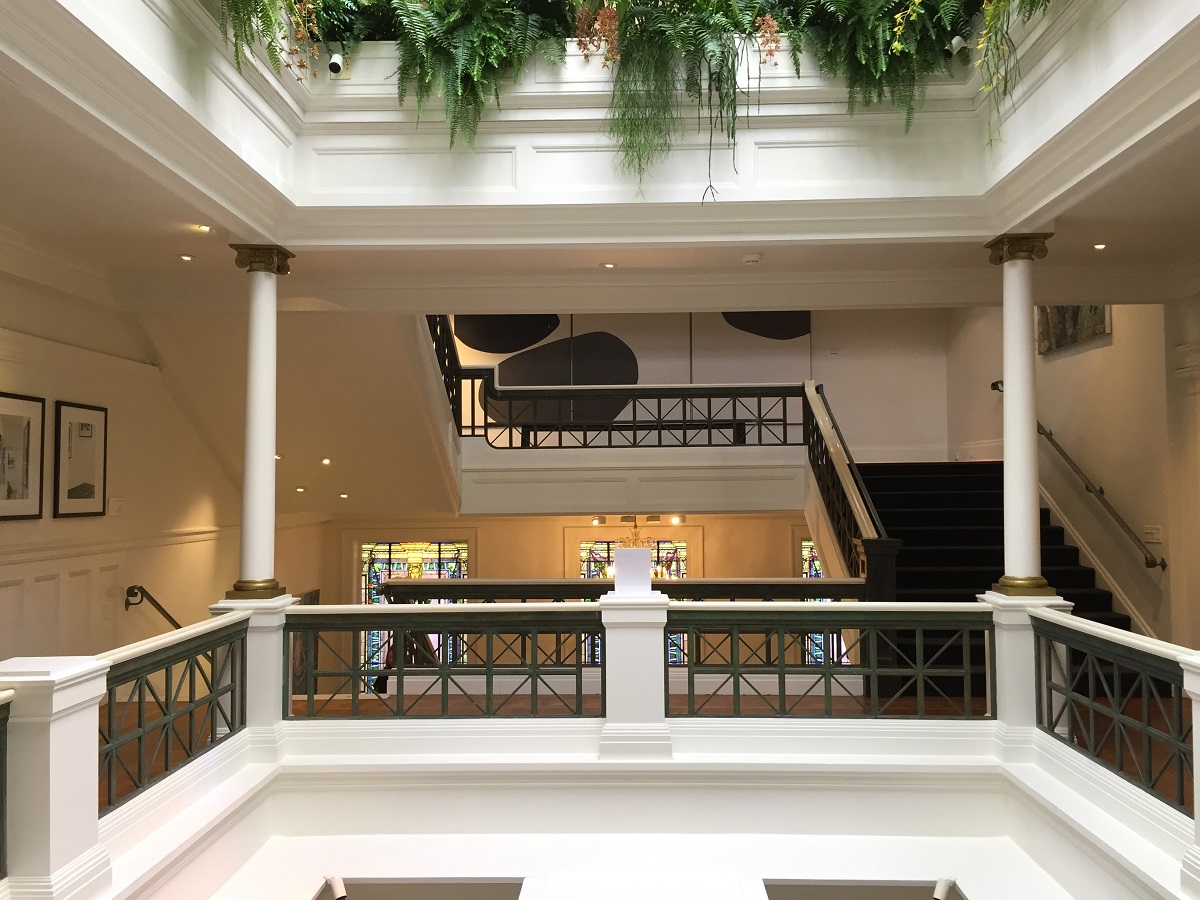
Entering the home, one is presented with a very impressive open atrium. Looking up, the landings above are visible, allowing one to get a complete sense of the scale of the home.


The first space on the tour is Heather Hilliard's "L'Appartement," an homage to iconic French designs both antique and modern. The room is mostly minimal--a lovely Vladimir Kagan-esque curved sofa and flower-petal cocktail table by India Mahdavi from Ralph Pucci are topped with the hefty Anneau light fixture by Studio Eric Schmitt in Paris--but the French tapestry and antique Chinoiserie commode offer a glimpse into the past. Of interest: the floors are original to the house and were simply given a sanding, and it works beautifully.


A butler's pantry connects "L'Appartment" to the first floor "Petit Kitchen." In Kari McIntosh Dowdy's hands, the pantry and the connecting atrium (the side entrance to the home from the car port) became the "Fleur et Orangerie Butler's Pantry and Atrium," a flower arranging station with an adjacent hot house that is stuffed with antique McCoy pottery. The dark color scheme is wonderful (vivid floral colors show up so well against a charcoal background), as is the verre églomisé backsplash, but I particularly loved the apropos insect wallpaper!


As I mentioned, the butler's pantry connects to the first, smaller kitchen designer Greg De Meza calls the "Petit Kitchen" (it's in the Petit Trianon after all!). He took a cue from an existing stained glass window showing wisteria vines and used plum appliances from Hestan (made right here in Northern California in Napa Valley!), a lilac-veined marble backsplash, and a lavender-colored floral wallcovering. The result is fresh and inviting.


What follows is perhaps my favorite space in this year's Showcase. "The Haute Hideaway: A Tribute To Connoisseurship" is a gloriously layered and textured maximalist space that is hypnotizing. I wanted to study each object, each detail, each finish and color. Inspired by Pierre Bergé and Yves Saint Laurent and their passion for collecting and travel, The Wiseman Group transformed the former dining room of this home into a 21st century haute Bohemian hideaway. A connoisseur's enclave of treasured objects, the space showcases elements from various periods and styles with a unique collection hand-selected by Paul Vincent Wiseman. There is a clear Morrocan tone to this space, a nod to Villa Oasis, the home in Marrakech that Bergé and Yves Saint Laurent shared for decades.

An antique Oushak rug and zebra hide (also antique and long dead) cover the floor. The original crystal chandelier was simply cleaned up but the fireplace received a facing of custom Moroccan star-patterned tiles. Upper windows are covered with colored film, adding to the Marrakech vibe. An Edwin Luytens octagonal dining table with fitted chairs, a folding screen based on the work of Klimt, silk panels in the coffered ceiling, and a Noguchi hanging light fixture add character. Finally, my eyes spotted references to another iconic French artist: a book of the work of Jean Cocteau, plates and ceramics featuring his designs, and an authentic autographed drawing by Cocteau were tucked away amongst the objets.


Moving across a small hall at the rear of the atrium to the next room, I noticed some fascinating modern tapestries lining this transitional space. Made by Andy Diaz Hope, The Conflicts is a series of tapestries created collaboratively with Laurel Roth Hope and loosely based on the 3 major conflict themes in literature--human against nature, human against his/herself, human against human. They were completed over a period of 5 years. The third tapestry of the triptych, and one of the tapestries on display here, Allegory of the Prisoner's Dilemma was completed during a year long artist fellowship at the de Young Museum in SF.

Allegory of the Prisoner's Dilemma by Andy Diaz Hope and Laurel Roth Hope
Allegory of the Infinite Mortal by Andy Diaz Hope and Laurel Roth Hope

From maximalism to a cool, soothing minimalism... Chris Weir and Susan Collins Weir painted a grand drawing room all white, installed mirrors by tall windows to double the light and views of greenery, and planted a monumental sofa, undulating marble cocktail table carved to look like rippling water made by the phenomenal sculptor Mathieu Lehanneur, and a startlingly oversized chandelier in the center of the space. Their statement says, "The balance of form and space, style and view, bring forth the spirit of a Parisian salon that may have hosted the likes of Serge Gainsbourg and Jane Birkin."


I spent a bit of time speaking with the delightful designer Deniece Duscheone who graced the downstairs rest rooms with some wonderful materials and pieces. A sexy, dark wallcovering by the Scottish company Timorous Beasties (previously here) wraps the sink area, a fascinating, organic chandelier drips overhead, and anthracite black toilets by Kohler are computer-programmable.


Dutch designer Martin Kobus envisioned another of the home's first floor salons as a recital hall, paying homage to the original owners, the Koshlands, who were huge patrons of the arts. Corinne Koshland was founder of the San Francisco Symphony Association and one of the first directors of the San Francisco opera Company. Igor Stravinsky, Jascha Heifetz, and Leonard Bernstein all played in the central atrium of Le Petit Trianon, while Yehudi Meuhin and Isaac Stern both had their childhood musical debuts in this home. Kobus covered the ceiling in this Recital Room with a de Gournay wallcovering called, appropriately enough, Symphony. The central light fixture designed by Kobus to resemble written musical notes was custom-made in Marrakech (I'm sensing a theme). And once again, the original wood floor was simply given a light sanding


Walking up the grand staircase was a wonder in itself. The first landing features three gorgeous Art Nouveau stained glass windows created in 1904 for the home by Bruce Porter, a native San Franciscan who was a great proponent of the Arts and Crafts movement. Contemporary paintings by the fabulous artist Julie Heffernan flank this space.


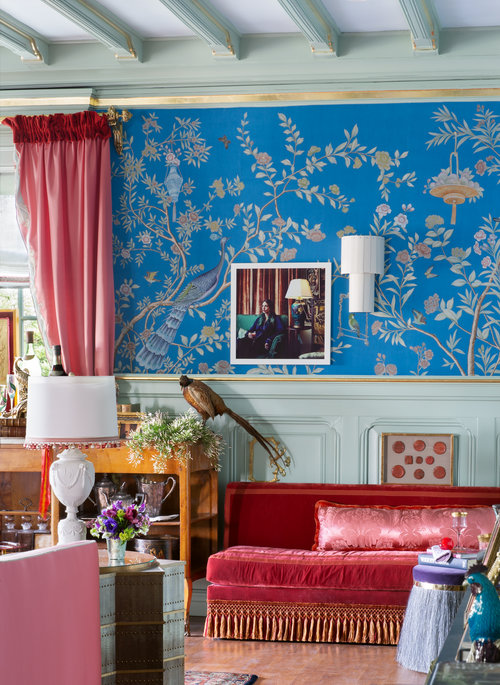
The first room on the second floor tour is Jonathan's Rachman's staggering "Houghton Hall Reimagined." Inspired by the real life Houghton Hall, designer Rachman was invited last September 2018 by the Marchioness of Cholmondeley and Claud Cecil Gurney of de Gournay to a candle-lit dinner for 80 guests at the Hall, a country house in the parish of Houghton in Norfolk, England (a few miles from Sandringham where the Royal Family spend their Christmas) which was commissioned by the first British Prime Minister, Sir Robert Walpole in 1722. This marks yet another breath-takingly maximalist space at this year's Showcase, and Rachman's attention to detail in this room is tireless. Stuffed to the gills with objects, framed photos (some of Rose Hanbury, the Marchioness of Cholmondeley, some of the inspirational candle-lit dinner, one of Lauren Bacall and Humphrey Bogart atop a marble-capped bar which belonged to the Hollywood pair!), taxidermied pheasants, an army of intaglios, busts, trophy cups, ceramics, and art work that all references--directly or indirectly--the idea of Britain, its monarchy, and titled families and descendants. The branch-like appendages of a very special glass chandelier in the center of this space symbolize a family tree of said titled families and descendants. The coffered ceiling is painted to resemble day and night--night is gathered close around the family tree light fixture with daylight and flying swallows spinning out toward the edges of the room. And the walls above the wainscoting feature an antique wallcovering the Marchioness discovered in the attic of Houghton Hall, recently recreated for this space by de Gournay.

The little side room for resting or lounging was given the same love and attention to detail by Rachman. He painted the entire room a deep, somnolent blue-purple and furnished it with two antique sleigh beds. Wasp nests dipped in gold adorn the ceiling and a picture of Houghton Hall at night sits on a table between the beds. A tiny balcony off this room was dressed as well.


In another nod to Versailles, Jane Richardson Mack and John Romaidis' "The Miniature Hall of Mirrors" featuring églomisé panels of Eastern and Western astrological symbols connects "Houghton Hall Reimagined"...


...to "The Exercise and Relaxation Room" by Annaliese Nicodemo and Kelly Cassidy. I loved the huge scribbled florals on the walls.


The "Master Bathroom Spa" is a sprawling space by Alexis Humiston. Her statement says: "This spa is a romantic and nostalgic respite for Eloise,the granddaughter of Le Petit Trianon's original owner, Cora [Corinne] Koshland. While Cora hosted many parties at the historic home, a particularly sentimental occasion was the butterfly-themed debutante ball for her granddaughter...As a tribute to the gardens and lifestyle of Eloise's family, the spa is wrapped in a Spring 2019 custom de Gournay wallpaper entitled 'Paradise Lost'." Beautiful faceted glass sinks sit on a chunky counter top of marble but a detail I truly loved is the the paned enclosure for the double shower.


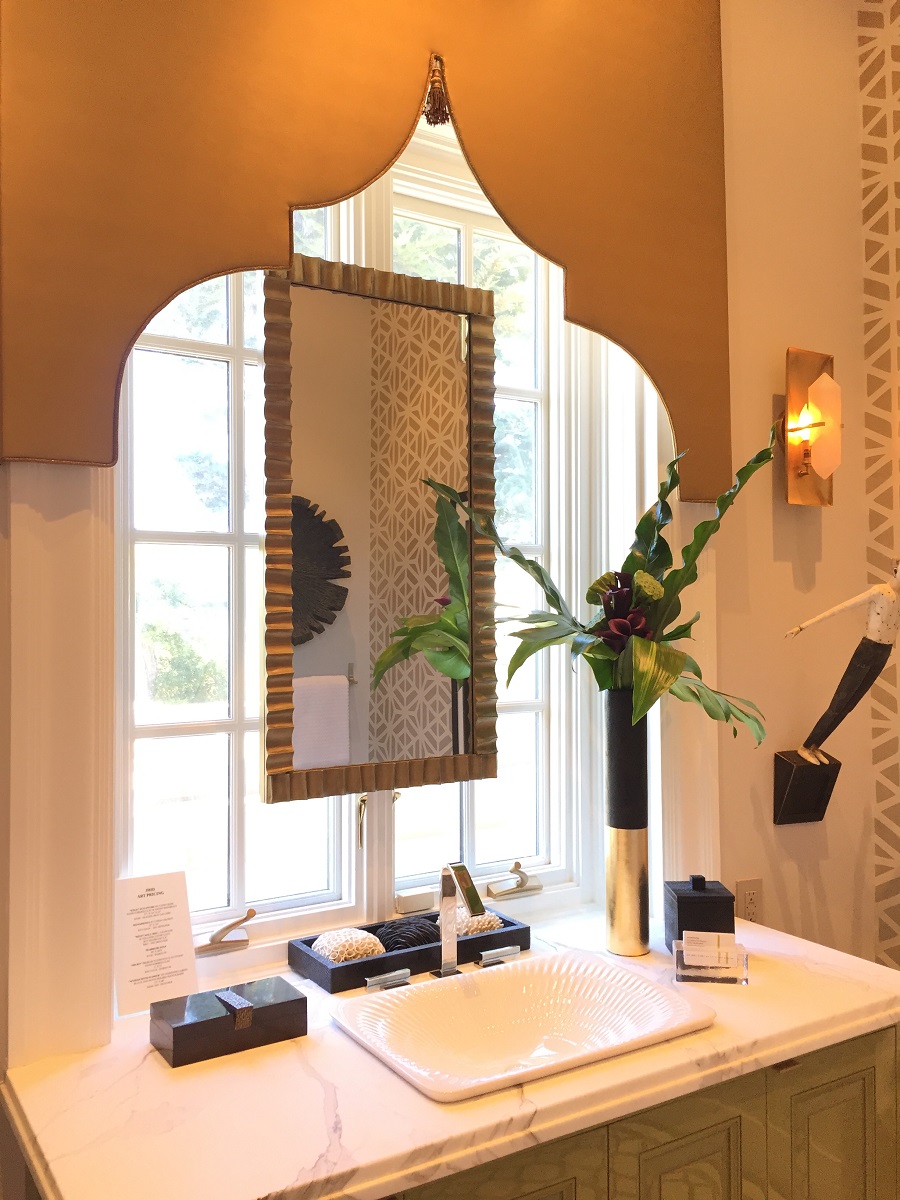
And here comes Yves Saint Laurent and Morocco again in Jo Ann Hartley's "Luxe Bath: Tangier Mix." This time it is Saint Laurent's home in Tangier, Villa Mabrouka, that served as inspiration. The Modern Moroccan theme is seen in the mosaics, the glints of gold, and the wonderful Moorish cornice box framing the window.


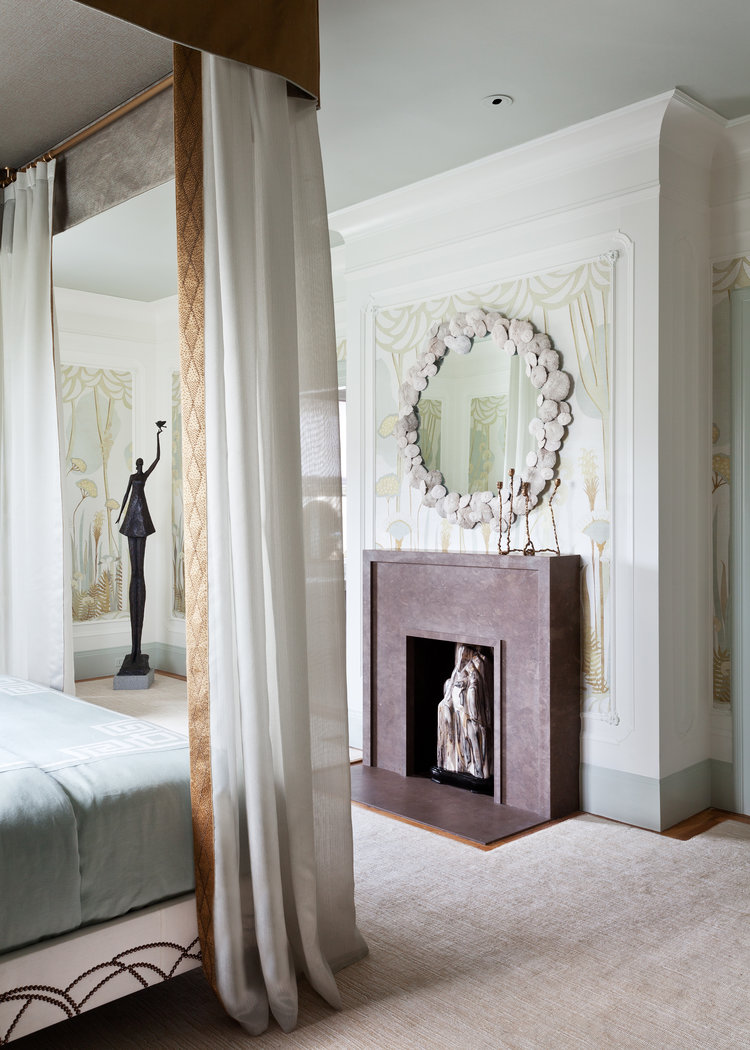
Dina Bandman is our returning champion, having appeared in the last four Showcases and this bedroom might be her best work yet. She calls this room "Marie's Magnolias", which is an ode to Marie-Antoinette, the queen who resided in the original Petit Trianon in France. A de Gournay wallpaper with white magnolias on a mauve ground seem to come alive with a 3D plaster treatment of branches and blossoms.


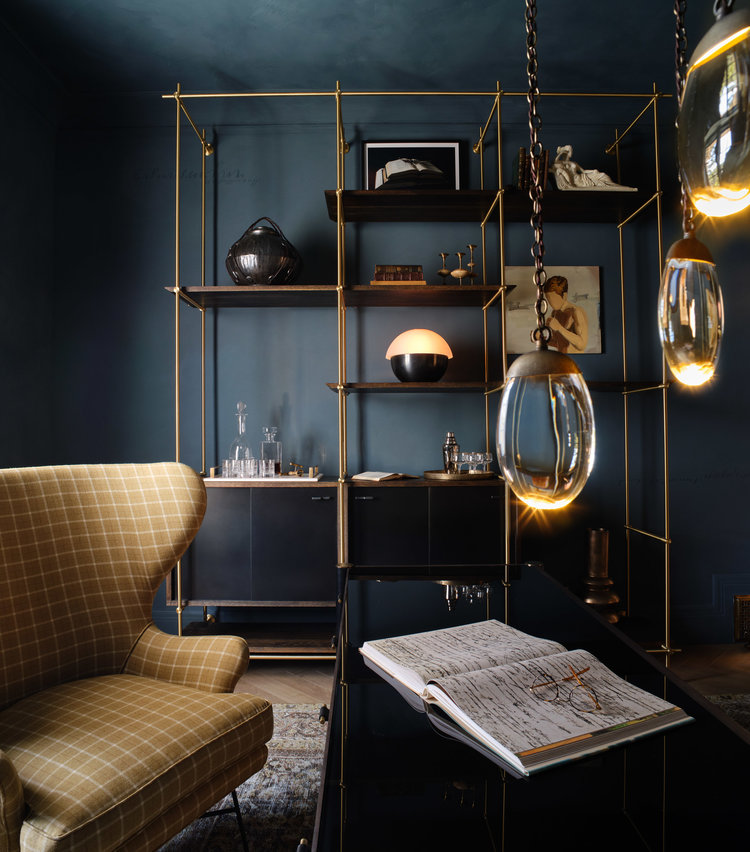
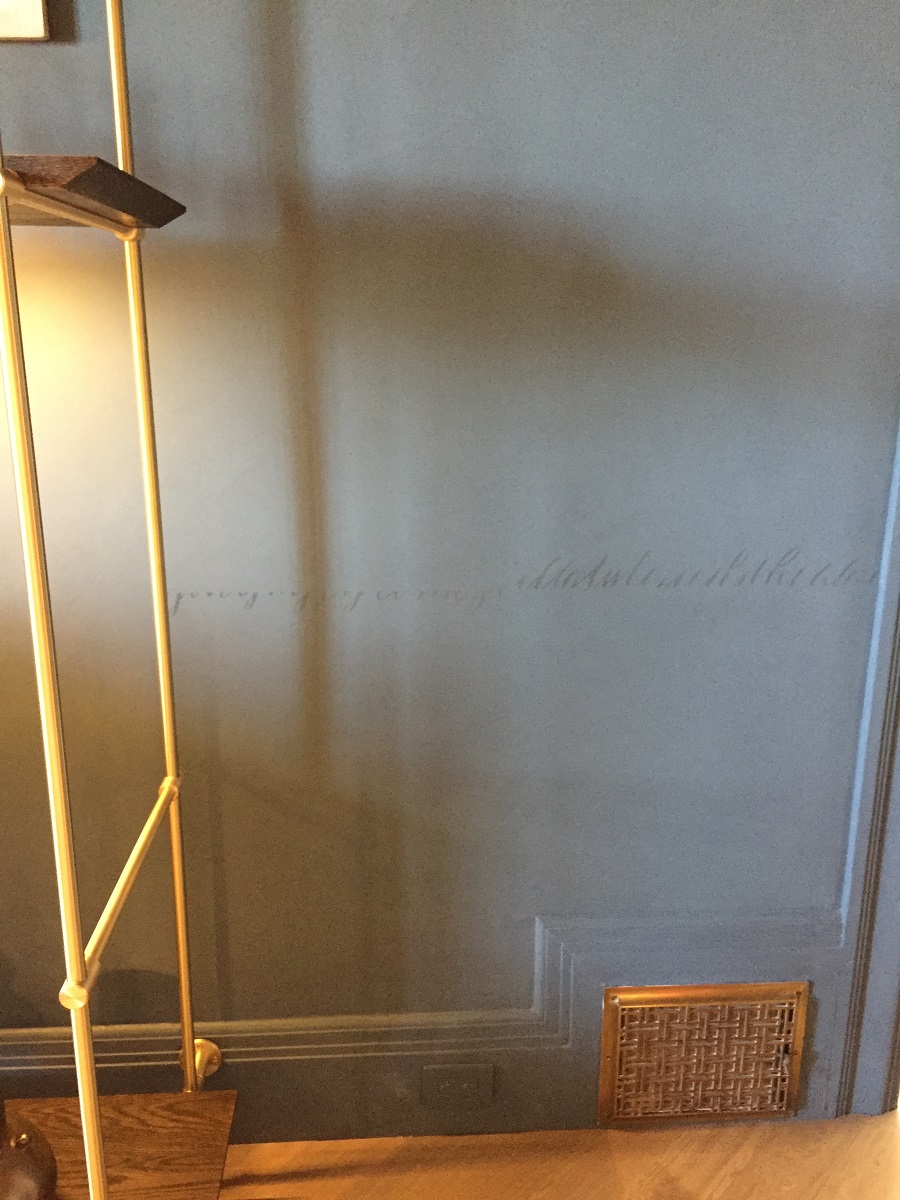
Since I so rarely get to create dark, cocooning spaces for clients (most people are very afraid of dark colors), I revel in the dark rooms at every Showcase. "Le Salon d'Ecriture" is a writer's room featuring felted wool silk, sumptuous velvet, and an oxidized walnut and burnished brass desk by Kristen Peña. It took me a little bit for my eyes to spot the half-obscured paint detail on the walls: ghostly lines of script float here and there, at the periphery of the room!

As I said earlier, this is one of the best Showcase houses in recent years. Absolutely every space is a success, and designer Lauren Berry exemplifies this brilliantly. Given a very small, closet-like space on the second floor tucked away amongst all the bedrooms, she created an "En Suite Espresso and Cocktail Bar" that is sweet and lively. Cabinetry in blackened charcoal and walnut finishes, European white oak floor and wall tiles made in the Netherlands, beautiful hand-painted terra cotta tiles, a sink inlaid with Mother-of-Pearl (!), luxe gold bronze fixtures,and exquisite lighting from Johnathan Browning make this otherwise forgettable space quite memorable!


"The Garden of Eden" was the inspiration for Kathleen Navarra's sumptuous master bedroom and bathroom of the same name. I appreciated how she kept the color palette and visuals calm and soothing without sacrificing any sophistication or interest. A mix of soft, earthy tones and materials in bronze, wood, and velvet won't keep anyone up at night but they are glorious to see and experience during the day. The Garden of Eden wallpaper mural from Aux Abris is stunning. And I love the completely open shower and incised clay vessel sinks in the bath.

Landscape designer Brandon Pruett said that his "Balcony Garden" on the third floor is meant to be seen from the atrium on the ground floor, but it is delicious up close too.


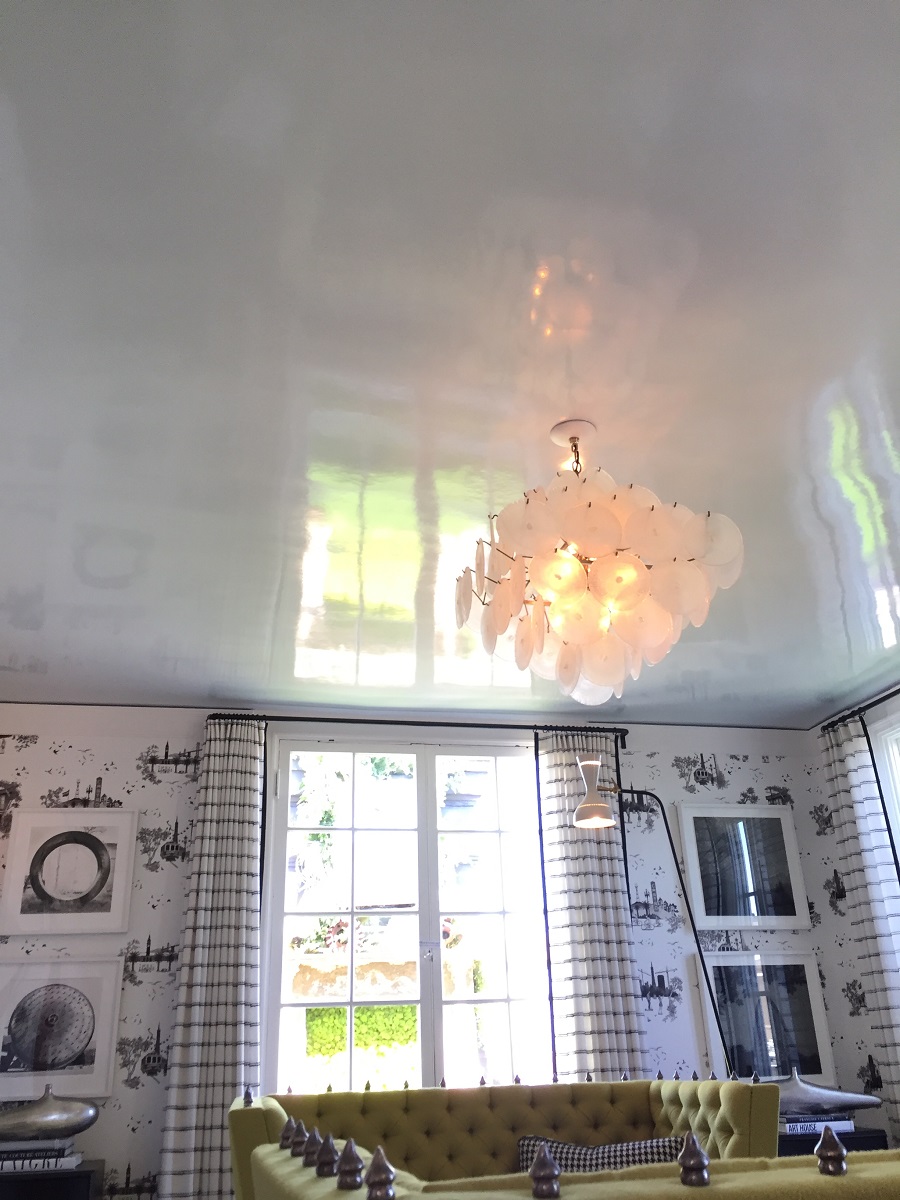
I am so glad Willem Racké is back for this year's Showcase. His paint and finish work is always gorgeous but this year he unveiled a very special product for his "Rooftop Rendez-vous Retreat." Inspired by the French spirit of the house, Racké concocted a modern-day toile wallpaper featuring scenes of San Francisco which is so much fun! He and design partner Susan Lind Chastain did a marvelous job with a restrained color palette of black, white, and greens. And of course, I cannot resist a high gloss ceiling (it plays into the rooftop idea and bounces light)!


Studio Heimat created a delightful, eye-popping bedroom for twin 13-year-old girls who, according to their imaginary brief, recently relocated from Singapore. The team say, "During the great life transition into their teen years, we wanted to give them comfort from their past home, while providing them a place to just be themselves...you'll find relics of colonial Singapore, vibrant energy, and elements of tropical flora and fauna from their homeland." The saturated pink is energizing and of course I just love the iridescent beetle wallpaper in the vestibule to this room. Most subtle element of all: the whispering cloud wallpaper on the ceiling by Fornasetti from Cole and Son.


Envisioned as a French modernist salon, the "Artist-In-Residence Retreat" by Lindsay Anyon Brier is smooth and sophisticated.


And of course the Artist-In-Residence who is being sponsored by the owner of Le Petit Trianon needs a beautiful spa bathroom for relaxing. "L'Espace Tranquille" by Julie Rootes was inspired by classic historical hotel bathrooms throughout Paris such as the Ritz-Carlton and the Hotel Le Meurice.


"The Bizibots Bedroom" is some lucky little boy's ultimate dream. Architect Virginie Manichon hand crafted every wood element and wooden toy in this fun and engaging room. Manichon says, "From a rocket room divider , galaxy ceiling and Da Vinci murals to a 'Makerie' stocked with popular STEM workbooks and tools, the bedroom is a fun-filled laboratory for youthful discovery and exploration." And let's admire for a moment that galaxy ceiling: it features a special effect of shooting meteors using LED lights (see video below!).


Here is another example of a space that could have been too small to do anything with, but Sindhu Peruri carved "The Oak Room" out of a little pass through area. This wine tasting room is a modern mix of natural elements and earthy textures which give it tremendous warmth. I was taken with the interlocking squares of the wonderful, custom-made open shelving over the counter area. But the centerpiece of the room is the nearly-impossibly crystal clear resin bar in which is embedded a piece of centuries-old fossilized wood sourced in the Italian Alps!


Eche Martinez turned a bright, corner room at the top of the house into a lovely "Breakfast Room." Oversized palm trees reference the "Palm Court" tradition of Palace Hotels all over the world and enliven original wood paneling which has been magically transformed by Willem Racké to mimic the look of an old-world, limestone-clad veranda with coffered ceilings. I love the motif of leather strapping and buckles that appears on the chairs, at the table, and on the window coverings.


"The Wabi Sabi Soak Room" with its wood slat-clad furo by Clara Bulfoni is your moment of Zen.


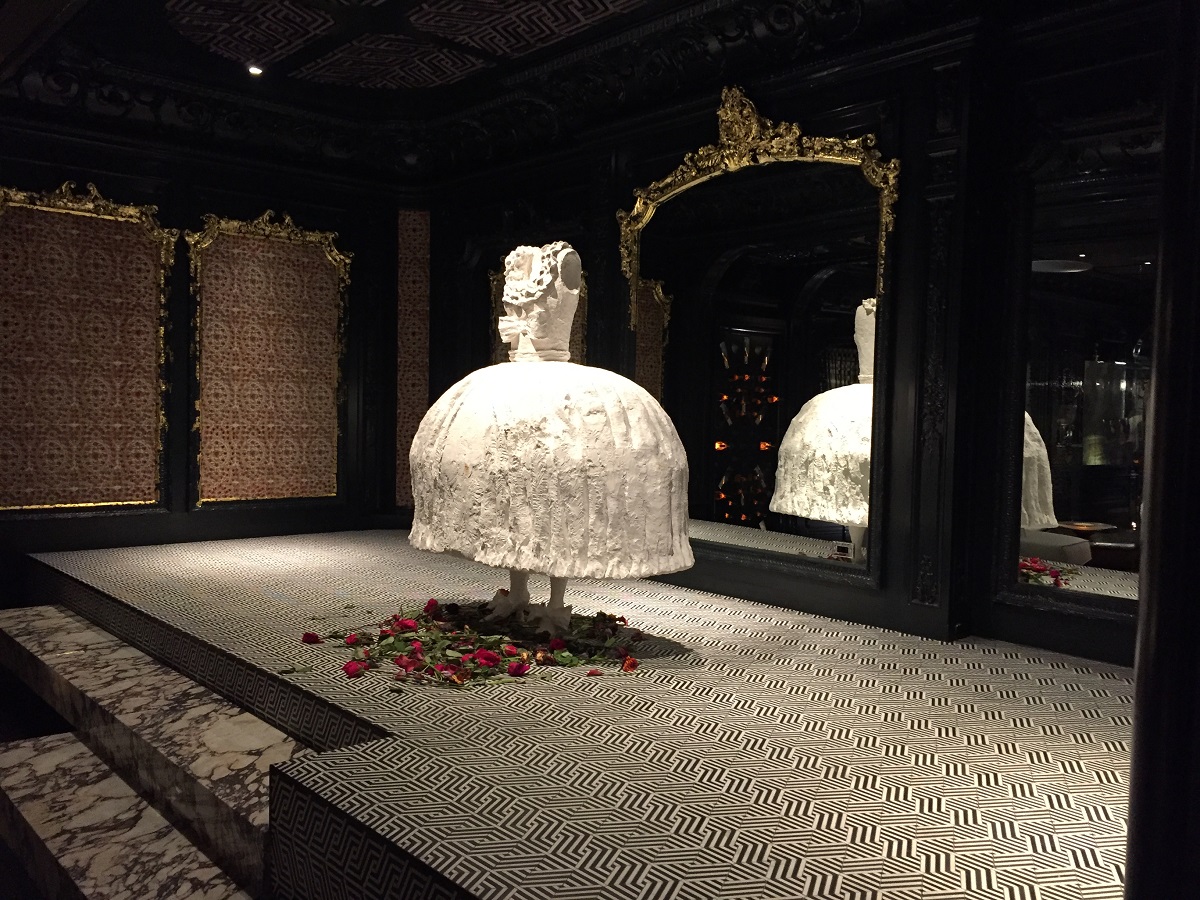
What grand mansion in the 21st century would be complete without a basement nightclub? Applegate Tran transformed the former ballroom into a cavernous VIP lounge nightclub by painting it all black. Jaw dropping. A stage anchors one end of the ballroom (which currently features an art installation of a French court dress with panniers) while a bar and lounge seating below mirror panels that discreetly spell "W O W" await dancers at the other end. In between are pieces of charred wood suspended in the shape of columns, a Muppet-y version of a tiger rug which tickled me greatly, and various trompe l'oeil art works on glass.


The "Petit Kitchen" on the ground floor is, presumably, for the casual cook to make small meals, but when the owners are in full-on party mode, the "Main Catering Kitchen and Butler's Pantry" in the basement is where the true action is. This enormous space by David Armour and Jamie Belew of Armour Architecture embraces the home's French spirit with all-natural limestone wall cladding with recessed panels and a marble-topped island with hand-carved pedestal legs that looks like it could have come from the original Petit Trianon. The Butler's Pantry features a dumb waiter to the upper floors, and a luxurious adjacent "Service Lounge" pampers a catering team so they never want to work anywhere else.


The youngest designer to ever participate in a Showcase House is this year's 27-year old Scott McMahan, creator of the engaging "Classically Modern Hallway." Once again, a pass through space that could have been forgettable was made into a jewel box by McMahan who used modern and antique elements to create an intriguing tension. A chevron floor is laid in oak and patinated steel panels. Very slim lines of the same patinated steel were also used as a material to outline the wall panels. And a high gloss black ceiling adds drama. These photos are well lit, but in person, the room is softly glowing and quite sexy (see bottom photo by me)...


Last but certainly not least is Kelly Hohla's "Wo-Man Cave," designed as a retreat for a busy executive. Hohla says, "As noted in Virginia Woolf's iconic essay, 'A Room of One's Own,' women need spaces (preferably perfectly appointed) of their own to think, relax, and gather inspiration. Bright and joyful abstracted wallpaper anchors the space. In contrast, the rest of the room revises traditional ideas of what a woman wants with pieces that are a little edgy and dark, with furniture that is lounge-y, comfortable, chunky and generally less precious." One of my favorite elements in the room is the gauzy floral of the wallcovering by Trove, previously here.The future is female!


The backyard was given a gorgeous make-over by Jarrod Baumann of Zeterre Landscape Architecture. The parterre features a design that is a replica of a parterre in the Orangerie at Versailles. At the center is a monumental sculpture by artist Yoko Kubrick, while many of her smaller pieces flank the far sides of the garden.


This year's 2019 San Francisco Decorator's Showcase House will be open through May 27. Visit the Decorator's Showcase site below for more info. Tickets can be purchased on-line or at the door. If you are in or near San Francisco, I strongly urge you to attend: it's such a treat to be exposed to so much good design, color, art, texture, and pattern all at once.

https://decoratorshowcase.org/

Sunday, May 5, 2019

Wim Wenders at the Grand Palais

I wish I could have been in Paris a few weeks ago to see this amazing installation at the Grand Palais by the filmmaker Wim Wenders. The Palais website says:

"Every evening from the 18th to the 22nd April 2019, Wim Wenders will present an «Unidentified Plastic Object», a monumental cinematographic installation based on his entire film work, projected on the interior structure of the Nave of the Grand Palais.
Neither a work of video art nor an artist’s film, this cinematographic visual creation is an original and spectacular proposal to « exhibit » Wim Wenders’ cinema as first and foremost an artistic object – in the sense that Henri Langlois spoke of cinema « as a plastic art and not a dramatic art ». The plastic aspect of cinema is in the editing. The unique work that Wim Wenders has created for this event is thus an unprecedented montage based on images from his own films, free from any narrative framework and focused on his aesthetics. The white screen of the cinema will be replaced by the grand architecture of the Nave of the Grand Palais: watching a film becomes an immersive experience rather than a two-dimensional one.

During these exceptional evenings spectators will wander through the Nave during these exceptional evenings and contemplate Wim Wenders’ images as they are projected to monumental scale using size by a « mapping» projection system, which consists of twelve 4K (ultra-high definition) projectors covering a large part of the Nave’s structure (along its entire width and to 270°). A unique device in Europe, designed and patented by ATHEM studio, scenographer of this event. A cinematographic kaleidoscope acts as an immersive experience and permits the viewer to contemplate in a new way the visual universe of one of the greatest contemporary filmmaker and his poetic yet universal language.

The themes of this cinematographic installation, projected in several loops to music chosen by the artist, are « in movement » and « the search for lost meaning ». All of Wim Wenders’ cinema is stylistically based around movement. Characters and camera are always and essentially on the road, travelling, rambling, roaming, crossing landscapes and destinies, sometimes roaming. Deeply European, Wim Wenders includes in this artistic experience a reflection on borders and freedom of movement, topics of concern to Europeans at the moment.

The projected film is both a brand new work, because it is based on an original montage, and also an opportunity to rediscover, like in flashes of memory, images from key works in Wim Wenders’ oeuvre, from Alice in the Cities to Wings of Desire. Dreamlike and aesthetic, this poetic and artistic experience is a way for the visitor to come and « live » in Wim Wenders’ cinema by taking a walk through the 13,500 sq.m Nave of the Grand Palais."

Wenders directed one of my all-time favorite films, the spiritually transcendent "Wings of Desire"--it must have been a very special, goose-bump moment to see images from that film projected, so large, on the walls of the Grand Palais.


http://www.wim-wenders.com/
https://www.grandpalais.fr/en/event/emotion

Saturday, May 4, 2019

"Maestà Soffrente" by Gaetano Pesce

Italian designer Gaetano Pesce created a special gigantic version of his iconic UP5 and 6 Chair, also known as the "Donna" Chair for last month's Milan Design Week.

Gaetano Pesce originally created his chair for B&B Italia (then known as C&B Italia) in 1969 out of polyurethane foam and a jersey stretch fabric. Primarily an architect, Pesce is also an industrial designer working on creating chairs with organic forms. His UP5 and 6 Chair--5 is the chair and 6 is the attached ottoman--is also known as the "La Mama Chair" or the "Donna Chair" (donna being the Italian word for woman) because the form is unmistakably female. The chair is still in production through B&B Italia who describe the chair this way:

"The chair is a metaphor of a large comfortable womb and recalls ancient statues of fertility goddesses. However, it has something extra: a spherical ottoman tied to the armchair. Therefore, the image of comfort and convenience is combined with a more figurative image of a woman with a ball and chain on her foot. Gaetano Pesce explains the project as follows: 'At that time, I was telling a personal story about my concept of women: I believe that women have always been unwilling prisoners of themselves. This is why I decided to give this armchair the shape of a woman with a ball and chain, a traditional image of a prisoner.'"

Perhaps what Pesce more accurately means is that women, by being themselves, have always been prisoners of men.


So to mark the 50th anniversary of the chair, and to highlight the ongoing struggles that women around the world face on a daily basis, Pesce revisited his Donna Chair, creating a 26-foot high version pierced with arrows to bring attention to violence against women. Titled "Maestà Soffrente," or "Suffering Majesty," the piece was shown from April 7 t0 14, 2019 in the Piazza del Duomo, in front of the Milan Cathedral.


Photos of "Maestà Soffrente" by Matteo Piazza

Friday, May 3, 2019

"Landline" by Matt Houghton

In 2010, Keith Ineson, a chaplain from Cheshire set up a helpline for gay farmers. "Landline" journeys into the world of the people who called.

SYNOPSIS
Landline is a short documentary about the only helpline in the UK for gay farmers. Through a series of recorded telephone conversations and reconstructive visuals, the film uses the helpline as a lens through which to view the experiences of LGBTQ people in the British farming community.

In a world that prizes traditional masculinity and in which ideas of ancestry are fundamental, being gay can be isolating. Suicide rates are extremely high in both young farmers and gay men in particular, and combining these can be a recipe for tragedy. But there are also thriving gay scenes in the most rural of towns, stories of unexpected friendships and relationships, and moments so unlikely that they could only happen in real life. Candid, intimate and shocking, Landline is a snapshot of a group of people bound together by circumstance but so often isolated from each other.

DIRECTOR'S STATEMENT
I have always been drawn to ideas surrounding shared experience. Speaking to a good friend Rupert Williams one evening, we got talking about what it was like for him growing up in a farming family as a queer man, and the unique sense of isolation that he felt. As we researched further, we began to understand the extent to which being an LGBTQ farmer was so heavily wrapped up in ideas of identity. Keith Ineson’s helpline seemed a unique lens through which to explore these ideas. Over the course of about a year, we collected stories and experiences from LGBTQ farmers who have at one time or another called the helpline. A series of recorded telephone conversations emerged as the emotional centre of the film.

I work in both documentary and scripted film. In recent years I have become increasingly interested in making films that experiment with story structure and that blur the boundaries between fact and fiction. The idea with Landline was to create an active conversation where the stories of a group of individuals compound and react with each other to paint to broader picture. It is an experiential take on the documentary form with the helpline at its centre. It is the honesty and openness of our contributors that made this film possible. To me it is defined by its intimacy but in depicting the very personal, my hope is that it poses questions about much broader ideas surrounding community, family and masculinity.


http://www.landlinedocumentary.co.uk/
http://www.itsmatthoughton.co.uk/

Thursday, May 2, 2019

May Flowers

April showers bring May flowers! This is the floral work of photographer Travis Chantar.


http://www.chantarphotography.com/

Wednesday, May 1, 2019

Happy May Day 2019!

This Northern Hemisphere festival is a traditional spring holiday. May Day is an ancient observation related to Floralia (which was a festival for Flora the Roman goddess of flowers), the Celtic festival of Beltane, and the Germanic festival of Walpurgis Night. Rites and celebrations include the raising of and dancing around a Maypole, the crowning of a May Queen, gifts of May baskets (little baskets of candy and spring flowers), festive picnics, and bonfires (in certain counties in Ireland). It is a day to celebrate spring and the fastly approaching summer. Flowers, sunshine, and sweet treats for all!


HAPPY MAY DAY!

Tuesday, April 30, 2019

National Adopt A Shelter Pet Day with the Queer Eye Guys!

To celebrate National Adopt A Shelter Pet Day today, the Queer Eye guys visited a sweet pupper named Lacey. Her handler makes a good point in the video: when you adopt a shelter pet, you save not only the life of that pet, but you make room for the shelter to take in another animal. You save two lives by adopting a shelter pet!


https://www.americanhumane.org/blog/national-adopt-a-shelter-pet-day/
https://www.humanesociety.org/
https://theshelterpetproject.org/
https://www.netflix.com/title/80160037

Monday, April 29, 2019

"When Giving Is All We Have" by Alberto Rios

It's been a wonderful National Poetry Month, and I hope you have enjoyed it as much as I have enjoyed sharing these superb poets and their beautiful words. For our last post of the month, let's look at a profoundly tender piece by Albert Rios (previously here) called "When Giving Is All We Have."

When Giving Is All We Have
by Alberto Rios

One river gives
Its journey to the next.

We give because someone gave to us.
We give because nobody gave to us.

We give because giving has changed us.
We give because giving could have changed us.

We have been better for it,
We have been wounded by it—

Giving has many faces: It is loud and quiet,
Big, though small, diamond in wood-nails.

Its story is old, the plot worn and the pages too,
But we read this book, anyway, over and again:

Giving is, first and every time, hand to hand,
Mine to yours, yours to mine.

You gave me blue and I gave you yellow.
Together we are simple green. You gave me

What you did not have, and I gave you
What I had to give—together, we made

Something greater from the difference.


https://www.facebook.com/albertoalvarorios

Friday, April 26, 2019

"Orange"

In honor of National Poetry Month, I have posted work by myself each Friday; for this final Friday, here is "Orange," a piece from a recent series of color poems.

Orange

Because we were in high school and he was a friend of a friend,

Because his name was Martin and he was a drummer in a punk band and drove a beat up orange 1971 Ford Bronco that belonged to his dad since it was the only car they had that was large enough to fit his drum kit,

Because I invited him to my house that night when the harvest moon was full and orange, and the evening was still warm from the sweltering day,

Because he was nervous, smiling, darting eyes, in a ripped tee shirt and leather jacket, with a new buzz cut he wanted me to see,

Because Ray Bradbury’s book THE MARTIAN CHRONICLES had just been made into a television miniseries and because there was a free-from stucco apartment complex nearby that looked like the set of the film,

Because I suggested we take a walk there among the orange glow of the bug lights at every front door that made the open air walkways seem alien,

Because I started to sing—teasing at first but then softly-- “Are you lonesome tonight?” by Elvis Presley and because Pete Farndon from The Pretenders had Elvis hair and a leather jacket,

Because he let me touch his hand, his arm, his neck while he held his breath,

Because I could feel his heart beating and he didn’t say anything,

Because his eyes showed me he wanted to but he couldn’t bring himself to do it,

Because we got back to my house and he said, “Well, I gotta go, bye,” his eyes confused, reluctant, already departing,

Because we could have, should have kissed that night and because we saw each other many times after with friends but never had that chance again,

And for no other reason.

©JEF

Wednesday, April 24, 2019

The Poetry of Rock n' Roll: "This Is The House"

In honor of National Poetry Month, I have featured song lyrics that double as poetry, and for this final installment (until next year), let's read the lyrics to a highly enigmatic, beautifully mysterious song called "This Is The House" by Annie Lennox and Dave Stewart, better known as Eurythmics. Taken from their 1983 sophomore album "Sweet Dreams (Are Made Of This)"--several songs on that album are like little tone poem riddles, including the songs "Jennifer" and "This City Never Sleeps."

This Is The House
by Eurythmics

Esta es la casa (This is the house)
Este es el cerro (This is the hill)
Esta es la historia (This is the story)
Es algo chiquitito (It's a little thing)

This is the house
This is the hill
This is the story (it's a little thing)
A lock of hair
An invisible smoke trail
Nothing there but the dust and the rust
Oh, everything changes

This is your picture (it's in black and white)
This is the family having a party
There's a crack in the ceiling
And there's an open door
Nothing there but the dust and the rust
Oh, everything changes


http://eurythmics.com

Monday, April 22, 2019

"The Eighth Elegy" from THE DUINO ELEGIES by Rainer Maria Rilke

For national Poetry Month, here is "The Eighth Elegy" from Rainer Maria Rilke's epic THE DUNIO ELEGIES (previously here).

Started in 1912, but not completed until after the First World War, the ten ELEGIES are mournful and plaintive, like a traditional elegy. But there is also an anxiety present, a longing, a yearning, an élan toward… something. They are questioning, restless. The ELEGIES seem to be trying to find answers, searching for a truth about what is real—searching for a wider truth. They are searching for new ways of thinking and being.

The Eighth Elegy truly captures the difference between existence and EXISTENCE by exploring the perspective of an animal. Rilke shows that, as humans, we are trapped where we are because we are self-aware, because we possess knowledge of time, of our beginning and our ending; almost as if thinking itself creates for us a type of prison (a very Buddhist idea, by the way). We know too much for our own good. But the animal looks out into the world and does not see “world”; instead the animal sees itself. When you are part of everything, there is no separation, no difference between “me” and “not-me.” This is what Rilke strives for: to see ourselves “in everything, healed and whole, forever.” This is a breathtaking idea.

The Eighth Elegy
by Rainer Maria Rilke
translated by Robert Hunter

Animals see the unobstructed
world with their whole eyes.
But our eyes, turned back upon
themselves, encircle and
seek to snare the world,
setting traps for freedom.
The faces of the beasts
show what truly IS to us:
we who up-end the infant and
force its sight to fix upon
things and shapes, not the
freedom that they occupy,
that openess which lies so deep
within the faces of the animals,
free from death!
We alone face death.
The beast, death behind and
God before, moves free through
eternity like a river running.
Never for one day do we
turn from forms to face
that place of endless purity
blooming flowers forever know.
Always a world for us, never
the nowhere minus the no:
that innocent, unguarded
space which we could breathe,
know endlessly, and never require.
A child, at times, may lose
himself within the stillness
of it, until rudely ripped away.
Or one dies and IS the place.
As death draws near,
one sees death no more, rather
looks beyond it with, perhaps,
the broader vision of the beasts.
Lovers, serving only to obstruct
one another's view of it,
approach the place with awe...
as if by accident, it appears
to each behind that precise spot
before which the other stands...
neither can slip behind the other
and so, again, the world returns.
We behold creation's face as though
reflected in a mirror
misted with our breath.
Sometimes a speechless beast
lifts its docile head
and looks right through us.
This is destiny: to be opposites,
always and only to face
one another and nothing else.

Could that surefooted beast,
approaching from a direction
different than our own, aquire
the mental knack to think as do we,
he would spin us round
and drag us with him.
But he is without end unto himself:
devoid of comprehension,
unselfscrutinized, pure
as his outgoing glance.
We see future; he sees
eternal completion.
Himself in all.

Even so, within the alert warmth
of that animal, the weight and care
of one great sadness dwells.
He is not exempt from an unclear
memory-which subdues us as well:
the notion that what we seek was once
closer and truer by far than now...
and infinitely tender.
Here... distances unending.
There... a gentle breathing.
After that first home, this one
seems windstruck and degenerate.
O bliss of the diminutive:
creature born from a particular womb
into womb perpetual.
O delight of the mite who
leaps on, embryonic, though
his wedding day impends!
All is womb to him.
But observe the lesser
certainty of the birds
who seem to know both
circumstances, by
very birthright, like
some Etruscan soul rising from
the cadaver of a sarcophagus
sculpted with its tenant's face.
Imagine the general bafflement
of anything born of the womb
and required to take flight!
Frightened by its very self, it
cuts the air with fractured arcs,
jagged as bat tracks, cracking
the porcelain sky of evening.

We are, above all, eternal spectators
looking upon, never from,
the place itself. We are the
essence of it. We construct it.
It falls apart. We reconstruct it
and fall apart ourselves.

Who formed us thus:
that always, despite
our aspirations, we wave
as though departing?
Like one lingering to look,
from a high final hill,
out over the valley he
intends to leave forever,
we spend our lives saying
goodbye.


Sunday, April 21, 2019

Happy Easter 2019!

Happy Easter and happy spring renewal to all!


Easter developed from the Old English word Ēastre or Ēostre, derived from the Anglo-Saxon Pagan month of Eostur-monath (which roughly corresponds to our month of April). This month was named after the goddess Ēostre or Ostara who symbolized the dawn, spring, renewal, and rebirth of the earth after the long winter.

Now we celebrate by decorating eggs, a symbol of birth and fertility and new growth, and with chocolate rabbits, since bunnies are also a symbol of spring.

When I was little, I always loved Easter time because my grandmother displayed vases of daffodils and lilies, and panoramic sugar eggs around the house. And my aunt hollowed out eggs, cut a window in the side of the shell, and painstakingly assembled pastoral scenes inside using miniature trees and flowers, and tiny ceramic rabbits to make literal panoramic eggs. But the best part was the Easter Bunny who came to deliver beautifully dyed and decorated eggs in a basket full of chocolate and treats; my mom and dad would guide me through the house with clues as to where the Easter Bunny hid my basket (thanks Mom and Dad--I miss you)!

I hope the Easter Bunny brought you some treats! Happy Easter!