Showing posts with label Venice Biennale. Show all posts
Tuesday, May 14, 2019
That's Quite A Scale
Amazing neon sculptural sign by artist Lauren Bon on view at the current Venice Biennale as part of an installation in collaboration with The Brooklyn Rail.
https://www.metabolicstudio.org
https://brooklynrail.org/
https://www.labiennale.org/en
Labels:
art,
artist,
Lauren Bon,
neon,
power,
sculpture,
sign,
The Brooklyn Rail,
truth,
Venice,
Venice Biennale
Monday, May 22, 2017
BEAUTY: Installation--Lorenzo Quinn
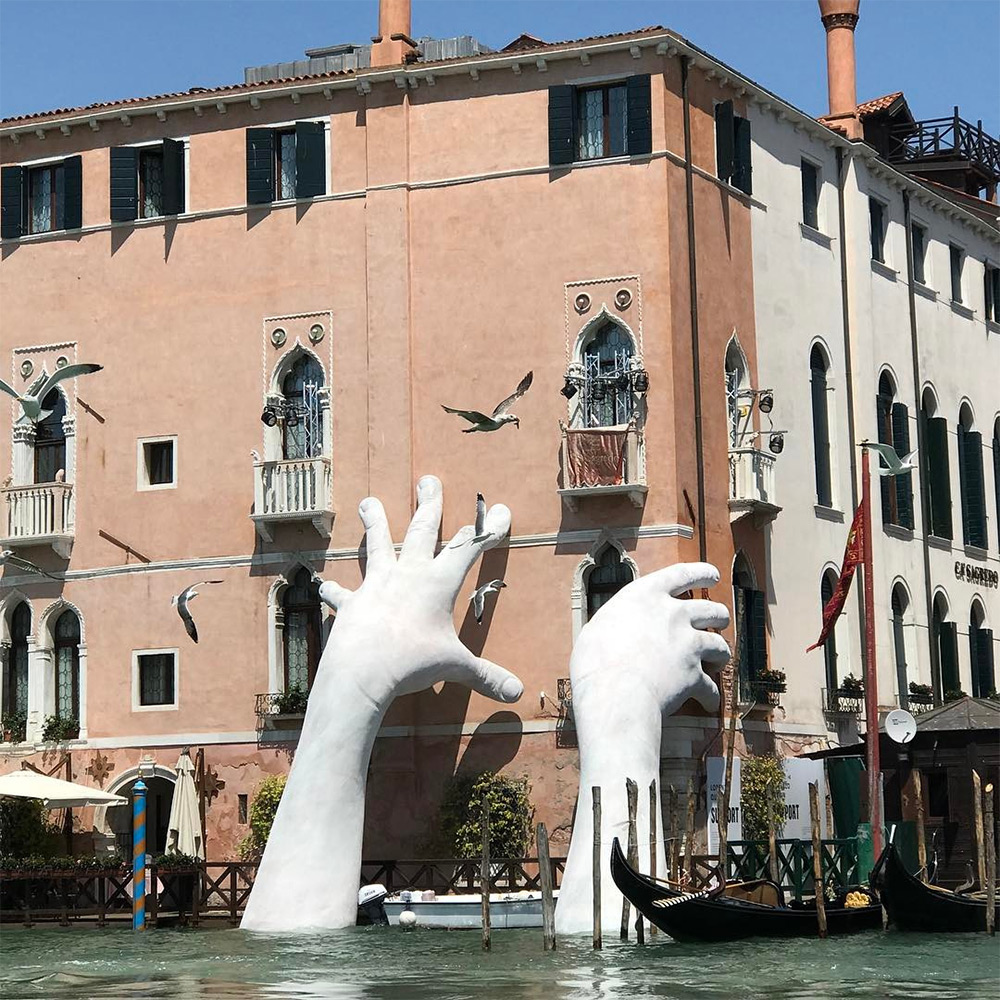
The Venice Biennale started this month and artist Lorenzo Quinn unveiled a monumental installation piece. Called Support, the piece consists of two arms rising up from the canal to support the Ca' Sagredo Hotel to highlight the impending dangers of climate change felt quite keenly in this floating city.
Support will be on view through the end of the Biennale on November 26, 2017.
https://www.lorenzoquinn.com/
http://www.labiennale.org/en/Home.html
Support will be on view through the end of the Biennale on November 26, 2017.
https://www.lorenzoquinn.com/
http://www.labiennale.org/en/Home.html
Saturday, July 13, 2013
BEAUTY: Installation--Joana Vasconcelos
From the website for Joana Vasconcelos' installation at the current Venice Biennale (through November 24th, 2013):
"The Portuguese artist Joana Vasconcelos is a commentator on the real. She investigates the present through a critical reading of Western mythologies and iconographies. She explores mainstream values, habits, and customs in order to examine personal and collective identity with respect to gender, class, and nationality. Her practice involves appropriating familiar objects and images and meticulously re-elaborating them, often calling upon artisanal techniques affiliated with female labor and employing craft-related materials such as textiles and tin-glazed ceramic tiles.
Trafaria Praia is Vasconcelos's proposal for the Participation of Portugal at the 55th International Art Exhibition – la Biennale di Venezia. Her project addresses the historical relationship between Portugal and Italy, which evolved through trade, diplomacy, and art. Lisbon and Venice have many commonalities; both cities played key roles in broadening the European worldview during the Middle Ages and the Renaissance, redefining the imago mundi by establishing networks between East and West. Trafaria Praia looks at the contemporary contact zone between the two cities by examining three fundamental aspects they share: water, navigation, and the vessel.
Vasconcelos constructs an allegorical correspondence between an iconic Lisbon ferryboat, the cacilheiro, and the picturesque Venetian vaporetto.
Vasconcelos has brought to Venice an actual cacilheiro, the Trafaria Praia, and is presenting it as the Portuguese pavilion. Vasconcelos is also presenting the Trafaria Praia as her art. Informed by Marcel Duchamp's 'assisted readymade,' she has changed the object without removing its functionality. On the outside of the ship, from prow to stern, she applies a large-scale panel of azulejos (tin-glazed, blue and white, hand-painted ceramic tiles) that reproduces a contemporary view of Lisbon's skyline, from the Bugio Tower to the Vasco da Gama Tower. The work takes its inspiration from another large-scale panel of azulejos, the Great Panorama of Lisbon, which depicts the city before the legendary earthquake of 1755 and is a quintessential expression of the baroque-style golden age of azulejo production in Portugal. Vasconcelos has made other works that involve covering objects in azulejos; in doing this she evokes the material's frequent deployment in architecture.
On the ship's deck is an environment made of textiles and light. This also echoes past works by Vasconcelos, such as Contamination (2008–10) and the series Valkyries (2004–ongoing), in which organic, often colorful forms hanging from the ceiling interact with the surrounding architectural elements. This new work consists of a complex medley of blue-and-white fabrics all over the ceiling and walls, from which crocheted pieces, intertwined with LEDs, emerge to create a compelling effect. The installation suggests a surreal, womblike atmosphere or the deep ocean—something out of Jules Verne's TWENTY THOUSAND LEAGUES UNDER THE SEA, perhaps, or the Bible story of Jonah and the Whale. It envelops visitors, eliciting both an intellectual and a sensorial response."
http://www.vasconcelostrafariapraia.com/en/home/
http://www.labiennale.org/en/Home.html
Friday, March 22, 2013
BEAUTY: Sculpture--Aron Demetz
Italian artist Aron Demetz has always worked with the human figure. His classical yet somehow minimal people have been rendered in bronze, in wood covered with pine resin, and now, in his latest series, distressed wood. But the distressing occurs only in certain areas, wearing away the torso, or back, or face of a figure. The results are compellingly tactile as well as disturbing, appearing as if a fungus is taking over a body. The shredded, organic grain of the wood is brought out but we are not used to seeing a person torn open, suggesting fragility and the layers of psychological states we all have under our "surface."
I was originally going to post only these photos of his distressed wood figures but after I went to Demetz' website, I became enamored of an installation he did several months ago (September 2012) as part of the 13th International Architecture Exhibition of the Venice Biennale. Called "La credenza della memoria" or "the belief of memory," this fascinating installation was in the famed Caffe Florian, off the San Marco Piazza in Venice. Demetz built a replica of their original Chinese Room from 1858, and carbonized the entire space with a blow torch. Installed over the real Chinese Room, the blackened space references the meditation process, whereby an individual, in order to find one's own spirit, starts in chaos or darkness but moves toward light. The fire burns and purifies, and from this primordial place comes light and color. I love his addition of new-growth blossoms coming out of the charred ceiling and walls.
It all reminds me of Maarten Baas' "Where There's Smoke" chair which receives the same charring technique but then receives a tough, heavy layer of acrylic, sealing in the damage. Marvelous!
http://www.arondemetz.it/
http://www.maartenbaas.com/
I was originally going to post only these photos of his distressed wood figures but after I went to Demetz' website, I became enamored of an installation he did several months ago (September 2012) as part of the 13th International Architecture Exhibition of the Venice Biennale. Called "La credenza della memoria" or "the belief of memory," this fascinating installation was in the famed Caffe Florian, off the San Marco Piazza in Venice. Demetz built a replica of their original Chinese Room from 1858, and carbonized the entire space with a blow torch. Installed over the real Chinese Room, the blackened space references the meditation process, whereby an individual, in order to find one's own spirit, starts in chaos or darkness but moves toward light. The fire burns and purifies, and from this primordial place comes light and color. I love his addition of new-growth blossoms coming out of the charred ceiling and walls.
It all reminds me of Maarten Baas' "Where There's Smoke" chair which receives the same charring technique but then receives a tough, heavy layer of acrylic, sealing in the damage. Marvelous!
http://www.arondemetz.it/
http://www.maartenbaas.com/
Labels:
Aron Demetz,
art,
beauty: sculpture,
Caffe Florian,
chair,
figures,
fire,
interior,
Maarten Baas,
sculpture,
Venice,
Venice Biennale,
Where There's Smoke,
wood,
woodwork
Subscribe to:
Posts (Atom)