Showing posts with label fall-winter 17-18. Show all posts

Monday, January 23, 2017

BEAUTY: Clothing--Thom Browne

Thom Browne created an absolutely fascinating concept for his Fall-Winter '17-'18 show at Paris Fashion Week. Fashion journalist Luke Leitch was at the show and has an excellent description of a very conceptual presentation that was really more performance art than clothing.

"Thom Browne’s show was a three-piece suite on the suit (and its trappings), which aimed, via extreme distortion, to unpick, lay flat, then reveal as a thing of beauty the garment around which Browne has built his brand. The show’s set was 30 piles of thick gray felt—pattern offcuts—arranged in little shrine-like cairns under 30 workroom lamps.

To easily understand this show you have look at Look 1 against Look 16 and then Look 31. Or Look 2 against Look 17 and Look 32. And so on. Browne was building the same 15 suits (and variations of) in three ways.
The first 15 were arguably the freakiest. On mules (which resembled hooves), the models were cinched into bodysuits on which buttons delineated the outline of the garment Browne envisioned them as. This took a lot of buttons, and Browne’s press notes usefully transmitted exactly how many. So Look 15, my favorite simply for being the biggest and most extreme in its second part iteration, was comprised of 1,059 of these buttons, which were the stitches that linked and defined the outline of a double-breasted suit and a double-breasted greatcoat. Really, though, you had to stare pretty hard at the buttons—or read the notes—to get any of that detail for the first 15 looks. The chief impression was of a tentatively treading band of boardroom brothers locked forever in a John Cage–soundtracked endless commute, mitigated only by whatever would fit in that rolling suitcase—“Champagne!” Browne said—and the softening lenses of those blinkering helmet-masks.

Section two laid out the idea. Every look delineated in section one was represented in the flat sum of its parts from the pattern. These were worn half at the front, half at the back. By showing the suits and coats and even the shoes—which were uncobbled asunder—in two dimensions, Browne was leading us to consider their intricacies in three.

Section three put everything together, via button: Those looks were finally tailored into a more conventional whole. Of course, they were barely conventional at all. Hems zipped up and down more dramatically than the New York Times’ pre-election winner projector. Hot pants over leggings are simply not done, old boy. Yet, crazy as Browne’s interjections into the architectural niceties of suiting sometimes were, they still honored the spirit of them.

Afterward, Browne explained what this show was about: 'Playing with proportion. And an appreciation of making clothing really well. Taking all of the pattern pieces and then making an installation of the pattern pieces . . . sewing it all together, buttoning up on the body. That’s what it is! It was a simple idea of playing with proportion.'"

This collection so reminds me of Browne's FW '15-'16 collection, previously here, in which he showed Depression-era business men in threadbare suits dreaming of going back in time to more prosperous days. Each look came out in a set of three: completely worn out in the present, slightly worn in the immediate past, and pristine in the golden days of memory. There is something satisfying about seeing a concept unfold in threes this way. Past, present, future--yesterday, today, tomorrow--below, middle, above. In a strange way, it has the air of mysticism about it.

Deconstructed brogues
Elongated proportions (center) fronting the deconstructed version (right) of the actual suit (left)


https://www.thombrowne.com/

BEAUTY: Clothing--Rick Owens

Rick Owens says he has been in a doom and gloom head space for the last several collections. For this Fall-Winter '17-'18 collection he titled GLITTER, his intent was to lighten up. But these are not light times--at all. "I wanted to kind of get away from the doom. My last few seasons have been about doom: How do you negotiate things, and things changing, and handling that gracefully. But . . . this cycle ends up being a continuation of the other cycle..." Owens said. "You know, I wanted it to be voluptuous and flamboyant but then I look at it: It definitely is about strapping yourself in for a bumpy ride."

Owens has been playing with bulk and volume for the last several seasons as well and we have a continuation of that theme as well. These moving sculptures are examples of how a designer manifests ideas in three dimensions, in space, with fabric and leather. Now, before anyone says to me, "But Jeff, these outfits are ridiculous. Where are you going to wear something like that, to the supermarket," let me point out that the styling for a fashion show is almost always radically different from how the individual pieces look hanging on a hanger in a retail store--and how individuals are going to wear them. Owens drapes jackets and coats around his models. He lets the tops of one-piece leather jumpsuits hang and fall in a puddle at the waist. These are not necessarily the way anyone will wear these pieces. Owens is showing us his inspiration. But if you were to walk into Selfridge's and see, for example, a single black and gold and white striped leather coat, or a suit jacket with long knit sleeves, or even a single green leather jumpsuit, well, then, that would be just fine. And as an aside, why are you so interested in what I am wearing to the supermarket?


https://www.rickowens.eu/en/US

Sunday, January 22, 2017

BEAUTY: Clothing--Yohji Yamamoto

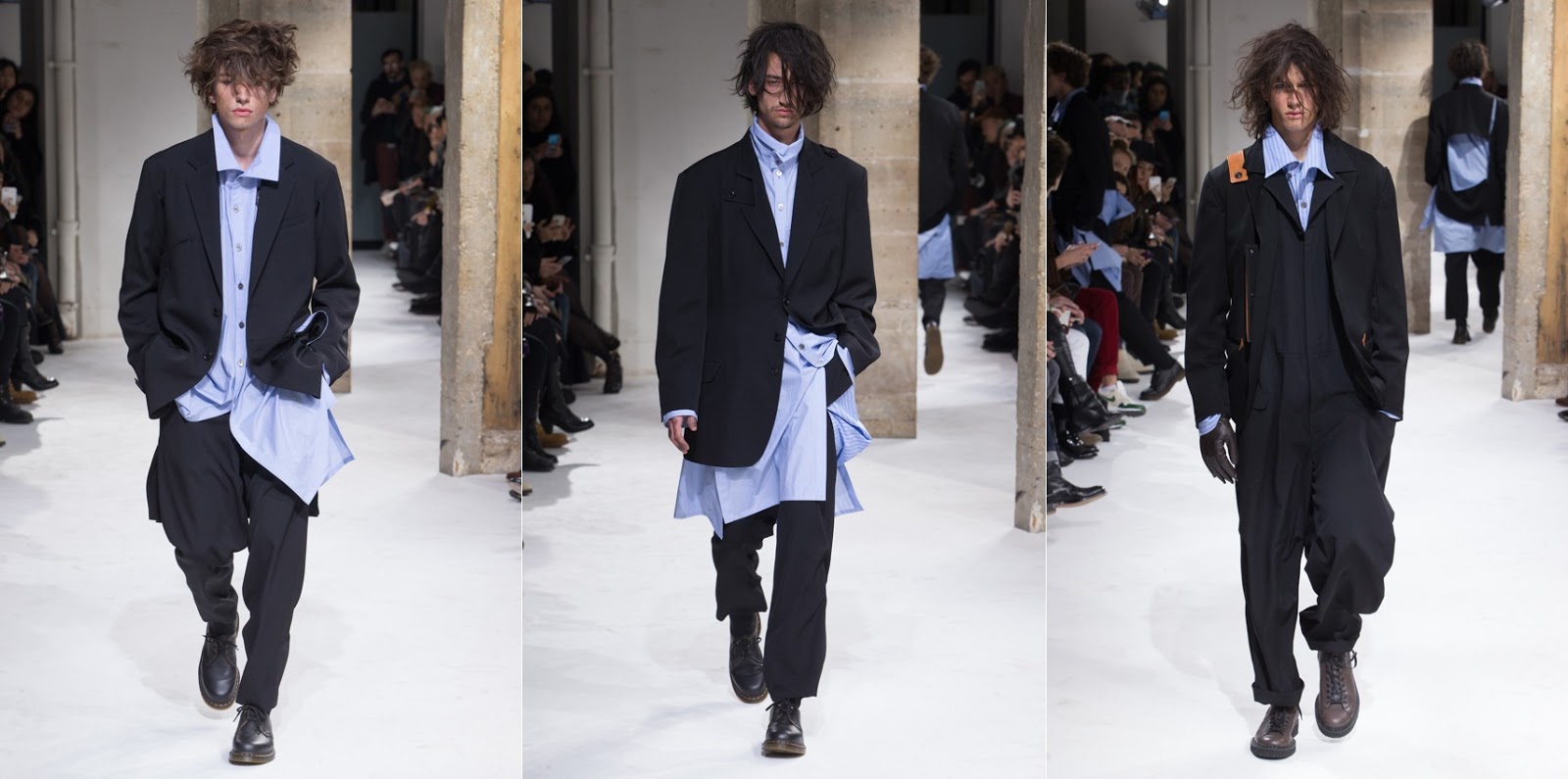
The highly regarded and highly decorated designer Yohji Yamamoto has had a long and storied career, and at age 73, shows no signs of stopping. His Fall-Winter '17-'18 collection at Paris Fashion Week was lyrical and beautiful, awash with an insouciant, rippling sense of Romanticism worthy of any French Symbolist poet. But the original inspiration for the collection is surprising. The invitation to the show was an employee timecard in an envelope marked "WORKING 24 HOURS EVERYDAY," and the spring board for the show was the type of person who works hard at manual labor jobs. Yamamoto said "I admire those people who work seriously using their own body. We’re now at a time in the world where the most important business is money-makes-money. And I hate it." Yamamoto took worker staples like the coverall, the jumpsuit, and the overcoat (a few in white, perhaps referencing meat packers?) but rendered them in gorgeous jacquards and patterns, all in Yamamoto's signature, impeccable, asymmetrical, master tailoring. It is really a lovely, flowing collection (with inventive touches like elongated pointed collars, and some fantastic New Romantic boots) which ultimately has nothing to do with its inspirational source. I can't fault the end result. But there is something interesting about the intersection of his imagined laborers and the material and price point of the clothing.


http://www.yohjiyamamoto.co.jp/en/

BEAUTY: Clothing--Boris Bidjan Saberi

Clearly, this season's Hundredth Monkey moment is turning out to be the concept of mountain climbing. For his Fall-Winter '17-'18 collection at Paris Fashion Week, Boris Bidjan Saberi applied his customary apocalyptic-Gothic sensibility to the idea of ice climbing. Witness the deadly spiked boots to kick into the sides of glaciers, the ropes, the harnesses, the waxed transparent leather coat that looks like it is made by an Inuit out of seal intestine, and the long-haired Yeti coats. Wild. I wonder what it is, psychologically speaking, about mountain climbing that is firing in the imaginations of these artists? An ascent towards something higher/better? An escape from what is below? Are those two yearnings the same thing?


http://www.borisbidjansaberi.com/

BEAUTY: Clothing--Wooyoungmi

Another very interesting Hundredth Monkey moment: McQueen was not the only house motivated by Oscar Wilde!

The mother and daughter team of Madame Woo and Katie Chung who make up the brand Wooyoungmi cited a powerful set of images of Oscar Wilde as inspiration for their Fall-Winter '17-'18 collection shown at Paris Fashion Week. A recent exhibit at the Petit Palais focusing on Wilde and his life featured photographs of the celebrated and infamous writer by Napoléon Sarony, taken in 1882. These images were the springboard for poet blouses and cuts from the 19th which infused the rumpled streetwear look of today, bringing to mind the idea of the flaneur, the French word for one who idly strolls along, watching life at a calm, luxurious pace.


And here are some of the original Napoléon Sarony images of Wilde.


http://www.wooyoungmi.com/
BEAUTY: Clothing--Alexander McQueen

Sarah Burton at Alexander McQueen unveiled a remarkable lookbook for the house's '17-'18 Fall-Winter collection. Inspired by Oscar Wilde and his love of peacock feathers which he used to decorate his living spaces, Burton used the dandy silhouette and love of filigree of Wilde's era and coupled it with the feather motif to stunning effect. Victorian paisley and an Oriental carpet coat complete the concept.


http://www.alexandermcqueen.com/us

Thursday, January 19, 2017

BEAUTY: Clothing--Etro

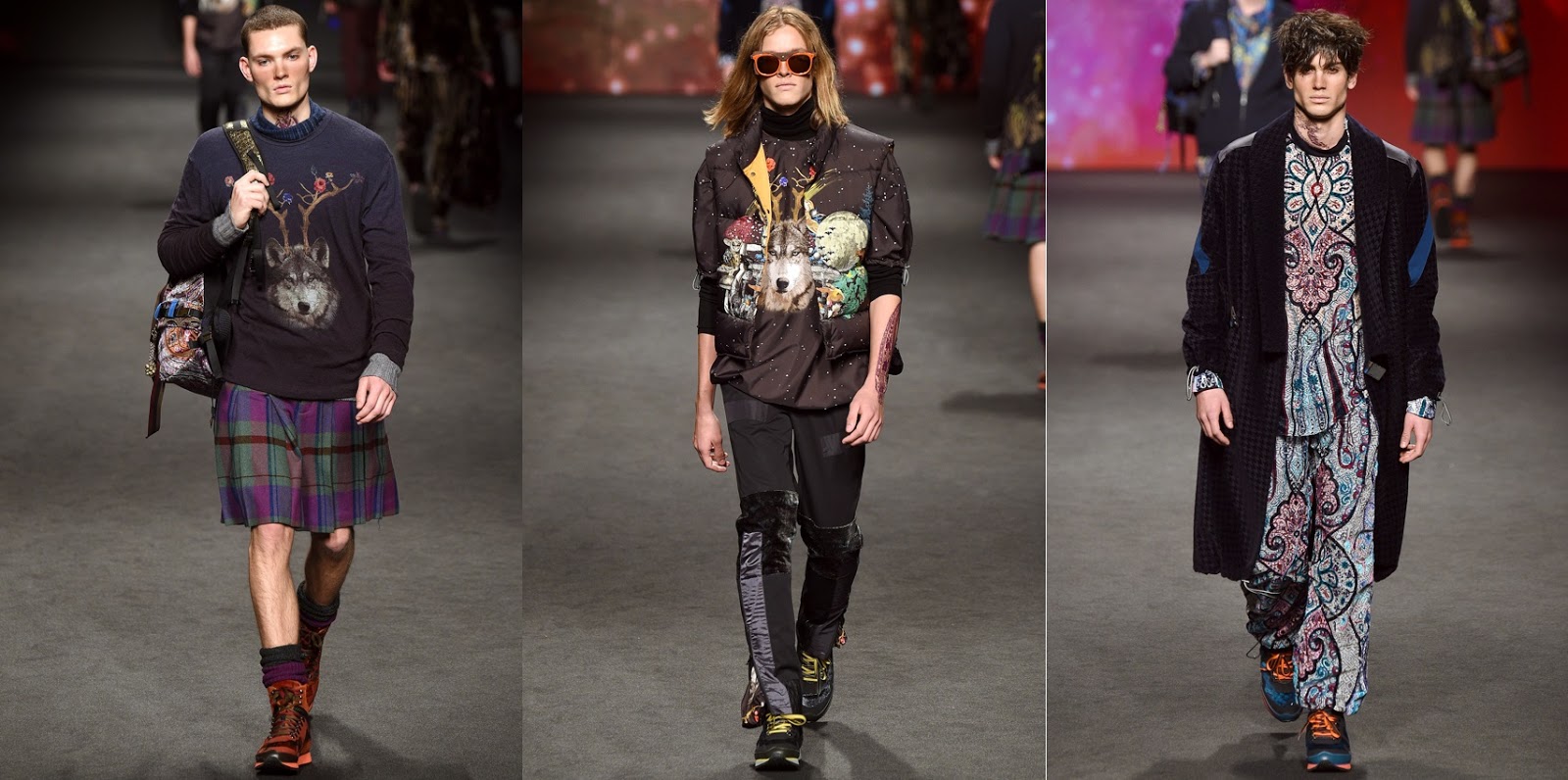
Kean Etro has been designing for his father's company for many years now and doing an absolutely glorious job of keeping the rich, sumptuous spirit of the house alive. The interest in classic paisley and other embellished patterns is always an important part of an Etro collection but this one seems particularly apropos. Fashion journalist Luke Leitch reports that Kean Etro has been obsessed by an unfinished French novel called MOUNT ANALOGUE by René Daumal which "charts an allegorical mountaineering expedition to enlightenment. Today, Kean equipped his models for that path, taking further inspiration from Reinhold Messner—the first man to climb all 14 8,000-meter-plus mountains—and his own in-built mysticism."

Kean himself said, "It’s about the sacredness of the mountains, mixing the idea of climbing and ascendere: ascent." Interesting that this is the second show of the season to riff on the idea of mountaineering (see the Moncler show Thom Browne mounted here).

The idea of Nepal and the Himalayas loomed large in this stunning Fall-Winter collection at Milano Moda Uomo. One of the reasons I appreciate the Etro aesthetic is that it is generally so Romantic, so sweeping, so lyrical. The show opened with etched velvet and velour suits featuring some gorgeous ethnic prints and patterns--all worn with some beautifully luxe hiking boots. Jackets were a combination of a Nepalese coat and the kind of toggled, quilted outerwear worn at Everest base camp. Indeed, some prints showed mountain ranges and snow-capped peaks. Kilts and delicious knits added texture.

The other part of this equation--the psychedelia--showed up in images of spirit animals, like bears or wolves with antlers. And it wouldn't have been a psychedelic reference without the appearance of Magic Mushrooms. The first look featured a pair of sunglasses that also covered the wearer's third eye. In fact, MOUNT ANALOGUE was one of the source materials for Alejandro Jodorowsky's cult film "The Holy Mountain" (previously here). It's exciting to think that Etro is using such heady, arcane material for inspiration.

In his novel, Daumal says:
"Alpinism is the art of climbing mountains by confronting the greatest dangers with the greatest prudence. Art is used here to mean the accomplishment of knowledge in action.

You cannot always stay on the summits. You have to come down again...

So what's the point? Only this: what is above knows what is below, what is below does not know what is above. While climbing, take note of all the difficulties along your path. During the descent, you will no longer see them, but you will know that they are there if you have observed carefully.

There is an art to finding your way in the lower regions by the memory of what you have seen when you were higher up. When you can no longer see, you can at least still know."


https://www.etro.com/en_us/

Sunday, January 15, 2017

BEAUTY: Clothing--Antonio Marras

Antonio Marras is quite a talented man, driven to express his ideas in many forms. As well as fashion, Marras is an accomplished artist with a current show at La Triennale di Milano called “Antonio Marras: Nulla Dies Sine Linea” (translated as “Not One Day Without a Line”) featuring paintings, drawings, ready-mades, and assemblages. The title clearly speaks to his near-visceral need to create. So this was a perfect space to show not only his Fall-Winter '17-'18 menswear collection but also his women's line as well. Inside the gallery were a variety of actors, dancers, mimes, and of course models all milling about the space. There was a towering bearded woman in a multi-layered skirt knitting and reciting a poem.


But there was a runway presentation as well, and the clothes, once out of their artistic surroundings, were equally as fascinating and engaging. Marras said of the collection, "I was thinking of a haunted castle in the rainy, foggy Scottish Highlands, full of ghosts and arcane presences swirling around as in a nightmare, or in a dream, as you prefer!" And what a dream: a parade of ghosts, mostly soldiers who died in or around said castle from the days or Rob Roy to WW I doughboys haunted the catwalk. The historical references were embellished with beautiful embroideries, appliqués, patchwork and intarsia. I can't help but be completely charmed and smitten with this collection, not only for its performance art presentation, but because the collection itself is so sweeping, so dashing, so dreamy and plays into my enduring love for New Romance.


https://www.antoniomarras.com/