Showing posts sorted by relevance for query glenn martens. Sort by date Show all posts
Thursday, July 10, 2025
BEAUTY: Clothing--Maison Margiela
Holy s--t, what an incredible, amazing, and frightening SS '26 collection Glenn Martens (previously here) just showed for his debut as creative director at Maison Margiela--what an explosive way to start his tenure (he was previously creative director at Y/Project and Diesel as well as his own eponymous brand)! Some pieces like the opening plastic encasements looked as if they were consuming the models (Martens said they referenced blown glass). Other pieces gave a ghostly appearance, like sepulchral shrouds. The sense of the entire collection was a deft and deep combination of the original DNA of the Margiela brand (the penchant for collage, the laboratory-like experimentation of hybridizing silhouettes, and love of Frankenstein-ing disparate pieces together), the historical corsetry and scavenged trinkets, baubles, and jewels from John Galliano's (previously here) too-short-time at the house, and of course the twisting volumes of Martens' own vernacular.
The collaged, rummaged effect of the materials (plastic, leather, metal, clumps of tulle) is apocalyptic ("When the world is running down/You make the best of what's still around" said Sting) in addition to being arrestingly layered. Fashion journalist Luke Leitch reports: "A great deal of this Glenn Martens for Maison Margiela debut Artisanal collection is… thrifted! Martens and his teams built a lot of the pieces from second-hand knits and other pieces sourced from GuĂ©rissol, a chain of six stores around Paris at which pieces generally cost just 5 euros. So Martens wasn’t kidding when he said: 'the preciousness of showing you are extremely rich just doesn’t fit into the Margiela language. So we’re not going to do a $75,000 dress, all hand-embroidered or whatever, because that wouldn’t fit in here. But we are going to find a different form of opulence and richness, and hopefully somebody a little bit more cheeky will engage with it.'"
And the plastic and metal masks and veils obscuring every model's face was a nod to another Margiela motif that has appeared many times over the years. The result is disturbing, a little eerie.
The showspace itself was styled to reflect the decaying aesthetic created by the garments. Martens said the look was "all disheveled and falling into pieces...I’m from Bruges, which has this whole gloomy, Gothic kind of gloominess." Large photocopied pieces of Georgian rooms with enormous panels of boiserie, marbled alcoves of cathedrals, or dark caves of ancient plaster papered the walls, crumpled, ripped, torn, but patched and cobbled together to approximate its origin.
Every garment and the show feels somehow miraculously fresh and new even though, as the saying goes, there is nothing new under the sun. But what is new is how things under our sun are put together and Martens has shown a commanding, supreme imagination. What he created is truly stunning. Please do watch the video below to see the pieces in motion...or not in motion as it were.
https://www.maisonmargiela.com/
The collaged, rummaged effect of the materials (plastic, leather, metal, clumps of tulle) is apocalyptic ("When the world is running down/You make the best of what's still around" said Sting) in addition to being arrestingly layered. Fashion journalist Luke Leitch reports: "A great deal of this Glenn Martens for Maison Margiela debut Artisanal collection is… thrifted! Martens and his teams built a lot of the pieces from second-hand knits and other pieces sourced from GuĂ©rissol, a chain of six stores around Paris at which pieces generally cost just 5 euros. So Martens wasn’t kidding when he said: 'the preciousness of showing you are extremely rich just doesn’t fit into the Margiela language. So we’re not going to do a $75,000 dress, all hand-embroidered or whatever, because that wouldn’t fit in here. But we are going to find a different form of opulence and richness, and hopefully somebody a little bit more cheeky will engage with it.'"
And the plastic and metal masks and veils obscuring every model's face was a nod to another Margiela motif that has appeared many times over the years. The result is disturbing, a little eerie.
The showspace itself was styled to reflect the decaying aesthetic created by the garments. Martens said the look was "all disheveled and falling into pieces...I’m from Bruges, which has this whole gloomy, Gothic kind of gloominess." Large photocopied pieces of Georgian rooms with enormous panels of boiserie, marbled alcoves of cathedrals, or dark caves of ancient plaster papered the walls, crumpled, ripped, torn, but patched and cobbled together to approximate its origin.
Every garment and the show feels somehow miraculously fresh and new even though, as the saying goes, there is nothing new under the sun. But what is new is how things under our sun are put together and Martens has shown a commanding, supreme imagination. What he created is truly stunning. Please do watch the video below to see the pieces in motion...or not in motion as it were.
https://www.maisonmargiela.com/
Friday, April 3, 2026
BEAUTY: Clothing--Maison Martin Margiela
I know it is poetry month, and I usually dedicate the month to the written word, but I can't wait until May to post a video of this incredible collection Glenn Martens just showed for Maison Martin Margiela (Martens, previously here, was at Y/Project and Diesel but just took over Margiela from John Galliano). Fashion journalist Luke Leitch of Vogue was at this runway show presented in a shipping container yard in Shanghai and describes what he saw perfectly:
"As deeply conceived as it was exquisitely surfaced, this Maison Margiela show under the hand of Glenn Martens was close to being a masterpiece. And I only say ‘close to’ because; a) to insist that a collection built on upending the notion of perfection is near-perfect must be wrong, and b) Martens and the Margiela studio seem to be just getting into their stride: much more is to come.
Tonight, we were in a Shanghai container yard. Like every ‘destination’ show, this first-ever Maison Margiela runway outside of Paris was driven by expansion, in this case to preface a four-city tour of four exhibitions dedicated to decoding some core lore—including the much-misunderstood masks—in China. Unusually, though, tonight the destination’s dislocation served the collection. We were surrounded by towers of containers, red, blue, and green, stamped with the names of their operating companies and clients: I saw a lot of Temu. This critical artery of trade for the planet’s greatest exporter beat sweetly against the thrifted provenance of much of the collection: free market to flea market.
Martens and the studio started this collection, which included ready-to-wear and the Artisnal offering, by returning to the process often observed by Martin Margiela: creative upcycling. The first Margiela exhibition, which opens here tomorrow, includes 58 archival looks variously fashioned from wigs, combs, playing cards, and much more thrifted ephemera. Fall 2026’s thrifting started with a group of 19th century porcelain dolls. As well as sparking the straightforward China association, these translated into an incredible 90 kilo dress fashioned from a shattered mosaic of porcelain; its hem splintered and shrieked as it was worn across the rough cement floor. They further inspired the first three odd-numbered looks in which eight layers or so of glassy organza were printed and painted and layered and draped and molded over skirts to create eye-defyingly immersive visual surfaces. These were worn under masks shrouded just enough to reveal the printed, vacant moue of dollface makeup beneath.
Once the porcelain had cracked out of view we saw a series of evening looks presented as skin-like surfaces, with jersey stretched and bonded over the guts of tailored garments so tightly that you saw the outline of the suiting architecture beneath. This was later returned to in a series of leather looks, jackets, pants, and dresses, in which the constructed edges of the garment were left unfinished like rawhide. Martens and the studio then applied the Margelian Bianchetto treatment to garments including an inwardly draped silk gown, tailcoats and pants, and an argyle overprinted mohair skirt suit. The bodice and arms of a quite amazing Edwardian-referencing school ma’am gown were molded in latex-blended white paint, so that the Bianchetto surface of the garment was also its substance: this demanded that its model keep her arms crossed in prim admonishment at all times. Another puckered-surface paint-dress was surfaced with gold leaf to create a garment that was both rich and ravaged.
A few dresses from the 1870s that the studio found in its tour of Paris’s flea markets were drenched in beeswax as if trapped in amber, before being hung and left to drip as they hardened. Not unlike the porcelain dress, these were stressed by the wearing they received on the runway, and left trails of cracked wax behind them. Some more 19th century dresses, long preserved but rendered desperately delicate by time, were mounted on fabric and then removed to leave their imprints on ‘new’ dresses: tattered into matter. Upcycled metal wires, vintage velvets, fringed blankets, furniture jacquards, and brittle tapestries were all refashioned into furniture for the human form.
The draping, very Martens-ian, was wonderful. Complexly whipped and whorled, it surged around the body in turmoils like visible emotional weather events: these were charted in reams of taffeta in matte cream or shiny lavender, as well as the metal wires. Less intricate but still impactful were the tailored looks overlayered with silk and lace that created a sleek collision of gender categorizations, and the gowns in faded florals into which were sliced creamy scars of pleating.
The masks might look unsettling; the original point of them was to divert attention away from the person towards the garments being worn, but today many observers seem to find that this Margelian withholding of identity is somehow offensive by proxy. On the ground, however, the most challenging aspect of this collection was when heelless shoe and floor length hem sometimes disagreed with that rough cement floor. No wobble, however, ever quite led to collapse. In an era of globalization and standardization in which identity is commodified as data, this Maison Margiela was fiercely resistant, spiritually elusive, and beautifully imperfect."
https://www.maisonmargiela.com/
"As deeply conceived as it was exquisitely surfaced, this Maison Margiela show under the hand of Glenn Martens was close to being a masterpiece. And I only say ‘close to’ because; a) to insist that a collection built on upending the notion of perfection is near-perfect must be wrong, and b) Martens and the Margiela studio seem to be just getting into their stride: much more is to come.
Tonight, we were in a Shanghai container yard. Like every ‘destination’ show, this first-ever Maison Margiela runway outside of Paris was driven by expansion, in this case to preface a four-city tour of four exhibitions dedicated to decoding some core lore—including the much-misunderstood masks—in China. Unusually, though, tonight the destination’s dislocation served the collection. We were surrounded by towers of containers, red, blue, and green, stamped with the names of their operating companies and clients: I saw a lot of Temu. This critical artery of trade for the planet’s greatest exporter beat sweetly against the thrifted provenance of much of the collection: free market to flea market.
Martens and the studio started this collection, which included ready-to-wear and the Artisnal offering, by returning to the process often observed by Martin Margiela: creative upcycling. The first Margiela exhibition, which opens here tomorrow, includes 58 archival looks variously fashioned from wigs, combs, playing cards, and much more thrifted ephemera. Fall 2026’s thrifting started with a group of 19th century porcelain dolls. As well as sparking the straightforward China association, these translated into an incredible 90 kilo dress fashioned from a shattered mosaic of porcelain; its hem splintered and shrieked as it was worn across the rough cement floor. They further inspired the first three odd-numbered looks in which eight layers or so of glassy organza were printed and painted and layered and draped and molded over skirts to create eye-defyingly immersive visual surfaces. These were worn under masks shrouded just enough to reveal the printed, vacant moue of dollface makeup beneath.
Once the porcelain had cracked out of view we saw a series of evening looks presented as skin-like surfaces, with jersey stretched and bonded over the guts of tailored garments so tightly that you saw the outline of the suiting architecture beneath. This was later returned to in a series of leather looks, jackets, pants, and dresses, in which the constructed edges of the garment were left unfinished like rawhide. Martens and the studio then applied the Margelian Bianchetto treatment to garments including an inwardly draped silk gown, tailcoats and pants, and an argyle overprinted mohair skirt suit. The bodice and arms of a quite amazing Edwardian-referencing school ma’am gown were molded in latex-blended white paint, so that the Bianchetto surface of the garment was also its substance: this demanded that its model keep her arms crossed in prim admonishment at all times. Another puckered-surface paint-dress was surfaced with gold leaf to create a garment that was both rich and ravaged.
A few dresses from the 1870s that the studio found in its tour of Paris’s flea markets were drenched in beeswax as if trapped in amber, before being hung and left to drip as they hardened. Not unlike the porcelain dress, these were stressed by the wearing they received on the runway, and left trails of cracked wax behind them. Some more 19th century dresses, long preserved but rendered desperately delicate by time, were mounted on fabric and then removed to leave their imprints on ‘new’ dresses: tattered into matter. Upcycled metal wires, vintage velvets, fringed blankets, furniture jacquards, and brittle tapestries were all refashioned into furniture for the human form.
The draping, very Martens-ian, was wonderful. Complexly whipped and whorled, it surged around the body in turmoils like visible emotional weather events: these were charted in reams of taffeta in matte cream or shiny lavender, as well as the metal wires. Less intricate but still impactful were the tailored looks overlayered with silk and lace that created a sleek collision of gender categorizations, and the gowns in faded florals into which were sliced creamy scars of pleating.
The masks might look unsettling; the original point of them was to divert attention away from the person towards the garments being worn, but today many observers seem to find that this Margelian withholding of identity is somehow offensive by proxy. On the ground, however, the most challenging aspect of this collection was when heelless shoe and floor length hem sometimes disagreed with that rough cement floor. No wobble, however, ever quite led to collapse. In an era of globalization and standardization in which identity is commodified as data, this Maison Margiela was fiercely resistant, spiritually elusive, and beautifully imperfect."
https://www.maisonmargiela.com/
Thursday, June 20, 2019
BEAUTY: Clothing--Y/Project
I've loved the voluminous, slouchy, puffy silhouette and cut of collections from Y/Project (Glenn Martens) for a while now and while it can be argued that he has always been a Mannerist, he has ramped up the twisting and folding and excess fabric for this SS '20 collection at Paris Fashion Week. Journalist Luke Leitch wittily remarked, "There is an echo in the work of Glenn Martens’s Y/Project of Vivienne Westwood’s 'Drunken Tailoring.' However the distortions achieved by Martens are much more extreme, much more mind-twisting, much more perception-altered: Call it 'Acid Tailoring,' maybe."
His interest in obscuring and deconstructing the body is an exercise in adventure. New shapes and scales surprise the eyes and mind. Lapels are bigger on one side than the other, jackets button asymmetrically, sweaters are ruched up the body, sleeves are longer than needed and sewn on the garment far forward, fanny packs are nearly unrecognizable as they circle the entire torso like an inner tube, plackets wind and twist up the body, shirts bag and bunch in unexpected places, and one side of a trouser waist has so much excess fabric that it flops over the belt exposing its lining. It's all dizzying and sideways and humorous and puzzling...and fascinating.
https://www.yproject.fr/
His interest in obscuring and deconstructing the body is an exercise in adventure. New shapes and scales surprise the eyes and mind. Lapels are bigger on one side than the other, jackets button asymmetrically, sweaters are ruched up the body, sleeves are longer than needed and sewn on the garment far forward, fanny packs are nearly unrecognizable as they circle the entire torso like an inner tube, plackets wind and twist up the body, shirts bag and bunch in unexpected places, and one side of a trouser waist has so much excess fabric that it flops over the belt exposing its lining. It's all dizzying and sideways and humorous and puzzling...and fascinating.
https://www.yproject.fr/
Thursday, February 24, 2022
BEAUTY: Clothing--Diesel
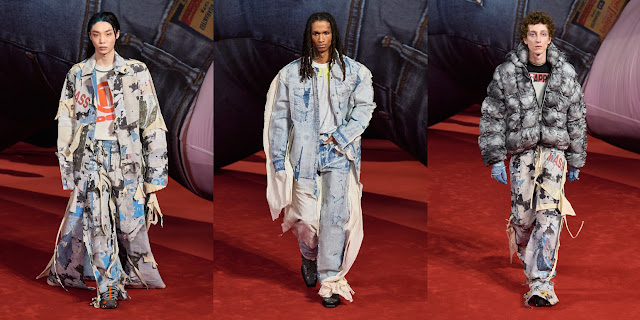
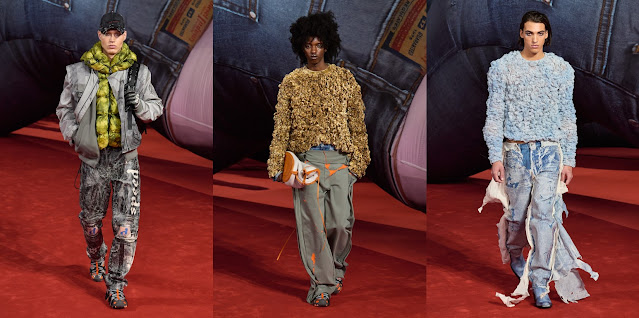
While clothing brand Diesel might be known as a "denim" brand, newly-crowned Creative Director Glenn Martens (who is still heading up Y/Project previously here, where he twists and folds excess fabric into voluminous slouchy puffy silhouettes) decided to take the humble and ubiquitous material beyond its traditional bounds. What results are some pretty amazing creations. This Fall-Winter '22-'23 collection at Milan Fashion Week starts off innocently enough with some ripped jeans on a model in a beautiful sheer top, but quickly morphs into denim bonded with neoprene for a cool, glossy look. From there, the rest of the collection is an exploration of experimental pieces crossed with the sense of classic denim: avant garde and street-wise at the same time. The most amazing pieces in this collection are the "fur" coats: no actual fur, just the cut, frayed, and fluffed edges of denim. Awesome. Also of note are the pretty cool cross-body bags imprinted with the Diesel logo "D" that look like gas tanks from a motorcycle (in black in Look #5 and in silver in Look #9).
Martens is very dedicated to the sustainable and ethical fabrication movement in the fashion industry and he is not just paying lip service. Here he has used off cuts of denim as well as upcycled, layered, bonded, distressed dead stock jersey from Diesel tee shirts to create some of the tops and wide-legged pants that seem to be made of hide. Proof that sustainability and using leftovers can be beautiful. "We want to make more handcrafted pieces and make them locally, out of whatever we have at the factory," Martens said. And that is admirable.
https://global.diesel.com/
Martens is very dedicated to the sustainable and ethical fabrication movement in the fashion industry and he is not just paying lip service. Here he has used off cuts of denim as well as upcycled, layered, bonded, distressed dead stock jersey from Diesel tee shirts to create some of the tops and wide-legged pants that seem to be made of hide. Proof that sustainability and using leftovers can be beautiful. "We want to make more handcrafted pieces and make them locally, out of whatever we have at the factory," Martens said. And that is admirable.
Saturday, January 12, 2019
BEAUTY: Clothing--Y/Project
Glenn Martens--and his Y/Project brand--was the guest designer this year at Pitti Uomo and the folks who run the event gave Martens carte blanche to do whatever he wished in whatever venue he chose. And he chose to show his FW '19-'20 collection in the cloisters of the Santa Maria Novella basilica, at night, in the dark, with only the lights of flashlights provided to the audience to light the models. It's an interesting device...presumably it makes the audience more invested and particpatory. It also feels somehow...holy...to see a show in the cloisters of such an iconic church, under the stars, by the equivalent of candlelight.
I like Martens' sense of volume and his penchant for a sort of crumpled, crunched silhouette. Jackets, sweaters, coats, and suits are cut boxy and roomy. Details like carpet scarves and layers of argyle and sheer material in the fourth image are intriguing. But I honestly LOVE the extremely high boots (waders?) that are cut at the femoral artery...you can see them in leather and suede in the third and fifth images. Marvelous.
https://www.yproject.fr/
I like Martens' sense of volume and his penchant for a sort of crumpled, crunched silhouette. Jackets, sweaters, coats, and suits are cut boxy and roomy. Details like carpet scarves and layers of argyle and sheer material in the fourth image are intriguing. But I honestly LOVE the extremely high boots (waders?) that are cut at the femoral artery...you can see them in leather and suede in the third and fifth images. Marvelous.
https://www.yproject.fr/
Tuesday, January 23, 2018
BEAUTY: Clothing--Misc. Paris Fashion Week
The Fall-Winter '18-'19 fashion season is over, and it was mildly engaging...but frankly, it felt like something was missing: a flair, an elan, a spark. Whatever is was (or wasn't), here are some highlights from the final leg of the season, Paris Fashion Week.
It has been brewing for many seasons now, but there was a new silhouette being promoted by several houses. McQueen showed a fascinating jacket that features generous shoulders and flared hips but true to McQueen's interest in classic men's tailoring, the waist nips in, creating an appealing hourglass shape. And in the hands of Sarah Burton, this does not feel feminine at all. Wonderful!
Wooyoungmi also showed garments that exemplify this new larger, looser, more casual cut of clothing. The idea behind this new silhouette is basically the destruction of the suit as a sign of masculinity or power. With the world changing so fast--a more casual business environment full of millenials, people conducting more of their business as well as personal lives on-line, and changing gender roles--the suit seems to be evolving (additionally, the suit as a business-power signifier is now being equated with unstable power hungry monsters and straight male sexual abusers). I think, as Alexander McQueen's Sarah Burton shows above, classic tailoring will always be around in some form, but Katie Chung (who just this season took over the house from her mother Woo Youngmi) shows that there is something in the air that is morphing not only how we live but how we look and express ourselves.
Now, on to the political. Vogue fashion journalist Sarah Mower was at the Sacai show in Paris and reported on the inspiration and subtext for this saturated collection:
"Why would a Japanese designer in Tokyo wish to collaborate with a Hawaiian shirt brand in Honolulu? Think about it a moment, and you realize that the citizens of both places are enduring the nuclear tension between North Korea and the United States. Chitose Abe is not a political or statement-making designer by any stretch of the imagination. Her quite terrific collection—men’s for Fall ’18 and women’s Pre-Fall shown together—was colorful and gutsy, seemingly less caught up in demonstrating the tricks of her trade than in making whole looks. Ultimately, though, she used her moment with the press to speak up for cross-cultural harmony, and you sensed why she was making a point of it now. Abe also put a T-shirt and fleece hoodie on the runway printed with the New York Times’s 'Truth . . .' slogan."
TRUTH. IT'S MORE IMPORTANT NOW THAN EVER.
Amen to that.
We can always count on Walter Van Beirendonck to provoke. I like his collections not because they are lyrically pleasing to the eye or even wearable (for the most part) but because they are pleasing to the intellect and emotions. I love his technicolor, abstract art sensibility. So I share this collection not only on that level, but for the inspiration and execution of the collection. It was an unashamed exploration of gay fetish culture, featuring rubber outfits with lined holes for nipples, penises, and at the mouth to accept whatever might be put in there. The words TOP, BOTTOM, and PIG were scattered on knit tops. Gas masks and references to puppy play (if you don't know what that is kids, Google it 'cuz I'm not going to explain it to you) showed up as well. But despite all this fetish and sex talk, the collection is surprisingly UN-erotic, even with tee shirts and lycra bodysuits collaged with images of muscle men from gay porn. What I love about this particular statement is not that it is shocking to display such matters culturally, but that we are at a point now where to be shocked by such matters would be shocking. Curiously, there was also a motif that looked like cartoon doodles rendered in the style of 18th century engravings along with the phrase--which is the name of the collection--STATES EMPIRES AND WORLDS OF SUN AND MOON. A nice spiritual allusion to an otherwise visceral collection.
Over in the shoe department, Glenn Martens of Y/Project teamed with Australian footwear manufacturer Ugg to create an exaggerated version of their classic suede and sheepskin boot. Martens employed a technique to make the Ugg boot seem to be three boots worn at once, and created a thigh-high version that pools and gathers. He paired these with pants that seemed to be just as layered and pooling as the boots for a mirrored effect. Martens described this layered effect as "melting," saying "You’re not really sure where one finishes and the other begins." Frankly, I love them. I own a pair of Uggs and I always want them to be higher so I can wear them slouched or rolled down, like this. Thanks Y/Project!
Some more shoes worth mentioning: Maison (Martin) Margiela, now helmed by once-disgraced super-designer John Galliano (who seems to be doing quite well these days), showed a fantastic cloven-toed leather boot (love!)...and an odd pillow-y slipper sneaker with a drawstring.
Dior Homme, a label that has shown clothing on emaciated, seemingly barely pubescent boys sent some looks down the runway on models that have a bit of mileage on them. Thank you Kris Van Assche for celebrating the sexy, mature man!
http://www.alexandermcqueen.com
http://www.wooyoungmi.com/en/index.html
http://www.sacai.jp/
http://www.waltervanbeirendonck.com/
https://yproject.fr/
https://www.maisonmargiela.com
https://www.dior.com/couture/en_us/mens-fashion
It has been brewing for many seasons now, but there was a new silhouette being promoted by several houses. McQueen showed a fascinating jacket that features generous shoulders and flared hips but true to McQueen's interest in classic men's tailoring, the waist nips in, creating an appealing hourglass shape. And in the hands of Sarah Burton, this does not feel feminine at all. Wonderful!
Wooyoungmi also showed garments that exemplify this new larger, looser, more casual cut of clothing. The idea behind this new silhouette is basically the destruction of the suit as a sign of masculinity or power. With the world changing so fast--a more casual business environment full of millenials, people conducting more of their business as well as personal lives on-line, and changing gender roles--the suit seems to be evolving (additionally, the suit as a business-power signifier is now being equated with unstable power hungry monsters and straight male sexual abusers). I think, as Alexander McQueen's Sarah Burton shows above, classic tailoring will always be around in some form, but Katie Chung (who just this season took over the house from her mother Woo Youngmi) shows that there is something in the air that is morphing not only how we live but how we look and express ourselves.
Now, on to the political. Vogue fashion journalist Sarah Mower was at the Sacai show in Paris and reported on the inspiration and subtext for this saturated collection:
"Why would a Japanese designer in Tokyo wish to collaborate with a Hawaiian shirt brand in Honolulu? Think about it a moment, and you realize that the citizens of both places are enduring the nuclear tension between North Korea and the United States. Chitose Abe is not a political or statement-making designer by any stretch of the imagination. Her quite terrific collection—men’s for Fall ’18 and women’s Pre-Fall shown together—was colorful and gutsy, seemingly less caught up in demonstrating the tricks of her trade than in making whole looks. Ultimately, though, she used her moment with the press to speak up for cross-cultural harmony, and you sensed why she was making a point of it now. Abe also put a T-shirt and fleece hoodie on the runway printed with the New York Times’s 'Truth . . .' slogan."
TRUTH. IT'S MORE IMPORTANT NOW THAN EVER.
Amen to that.
We can always count on Walter Van Beirendonck to provoke. I like his collections not because they are lyrically pleasing to the eye or even wearable (for the most part) but because they are pleasing to the intellect and emotions. I love his technicolor, abstract art sensibility. So I share this collection not only on that level, but for the inspiration and execution of the collection. It was an unashamed exploration of gay fetish culture, featuring rubber outfits with lined holes for nipples, penises, and at the mouth to accept whatever might be put in there. The words TOP, BOTTOM, and PIG were scattered on knit tops. Gas masks and references to puppy play (if you don't know what that is kids, Google it 'cuz I'm not going to explain it to you) showed up as well. But despite all this fetish and sex talk, the collection is surprisingly UN-erotic, even with tee shirts and lycra bodysuits collaged with images of muscle men from gay porn. What I love about this particular statement is not that it is shocking to display such matters culturally, but that we are at a point now where to be shocked by such matters would be shocking. Curiously, there was also a motif that looked like cartoon doodles rendered in the style of 18th century engravings along with the phrase--which is the name of the collection--STATES EMPIRES AND WORLDS OF SUN AND MOON. A nice spiritual allusion to an otherwise visceral collection.
Over in the shoe department, Glenn Martens of Y/Project teamed with Australian footwear manufacturer Ugg to create an exaggerated version of their classic suede and sheepskin boot. Martens employed a technique to make the Ugg boot seem to be three boots worn at once, and created a thigh-high version that pools and gathers. He paired these with pants that seemed to be just as layered and pooling as the boots for a mirrored effect. Martens described this layered effect as "melting," saying "You’re not really sure where one finishes and the other begins." Frankly, I love them. I own a pair of Uggs and I always want them to be higher so I can wear them slouched or rolled down, like this. Thanks Y/Project!
Some more shoes worth mentioning: Maison (Martin) Margiela, now helmed by once-disgraced super-designer John Galliano (who seems to be doing quite well these days), showed a fantastic cloven-toed leather boot (love!)...and an odd pillow-y slipper sneaker with a drawstring.
Dior Homme, a label that has shown clothing on emaciated, seemingly barely pubescent boys sent some looks down the runway on models that have a bit of mileage on them. Thank you Kris Van Assche for celebrating the sexy, mature man!
http://www.alexandermcqueen.com
http://www.wooyoungmi.com/en/index.html
http://www.sacai.jp/
http://www.waltervanbeirendonck.com/
https://yproject.fr/
https://www.maisonmargiela.com
https://www.dior.com/couture/en_us/mens-fashion
Sunday, July 10, 2022
BEAUTY: Clothing--Olivier Rousteing for Jean Paul Gaultier
Jean Paul Gaultier stopped showing on the Paris fashion calendar many years ago now but his house and brand are still in operation, despite the fact that he himself mounted a farewell show in 2020. In fact, Gaultier has embarked on a fun project to hand over a season's collection to another designer to interpret what the house has done in the past, to take elements from classic Gaultier designs and create a new mix, a mash-up as it were.
This high-profile collaboration (which obliquely recalls Warhol and Basquiat working together) is still fairly new: Sacai’s Chitose Abe (previously here) created a womenswear collection for Fall 2021 and Glenn Martens (previously here) created a Spring 2022 collection, also for women. And for this third outing, Gaultier chose Olivier Rousteing who currently heads Balmain (previously here) to whip up something from the archives. And he did not disappoint. The runway presentation was divided into halves which began with a small menswear collection and moved on to a more extensive women's collection. His take on both men's and women's was supremely imaginative. But he used Gaultier's 1994 tattoo collection, appropriately entitled "Les Tatouages" as a springboard for his men (see photos from the mind-boggling original JPG runway show at Vogue's designer archives here).
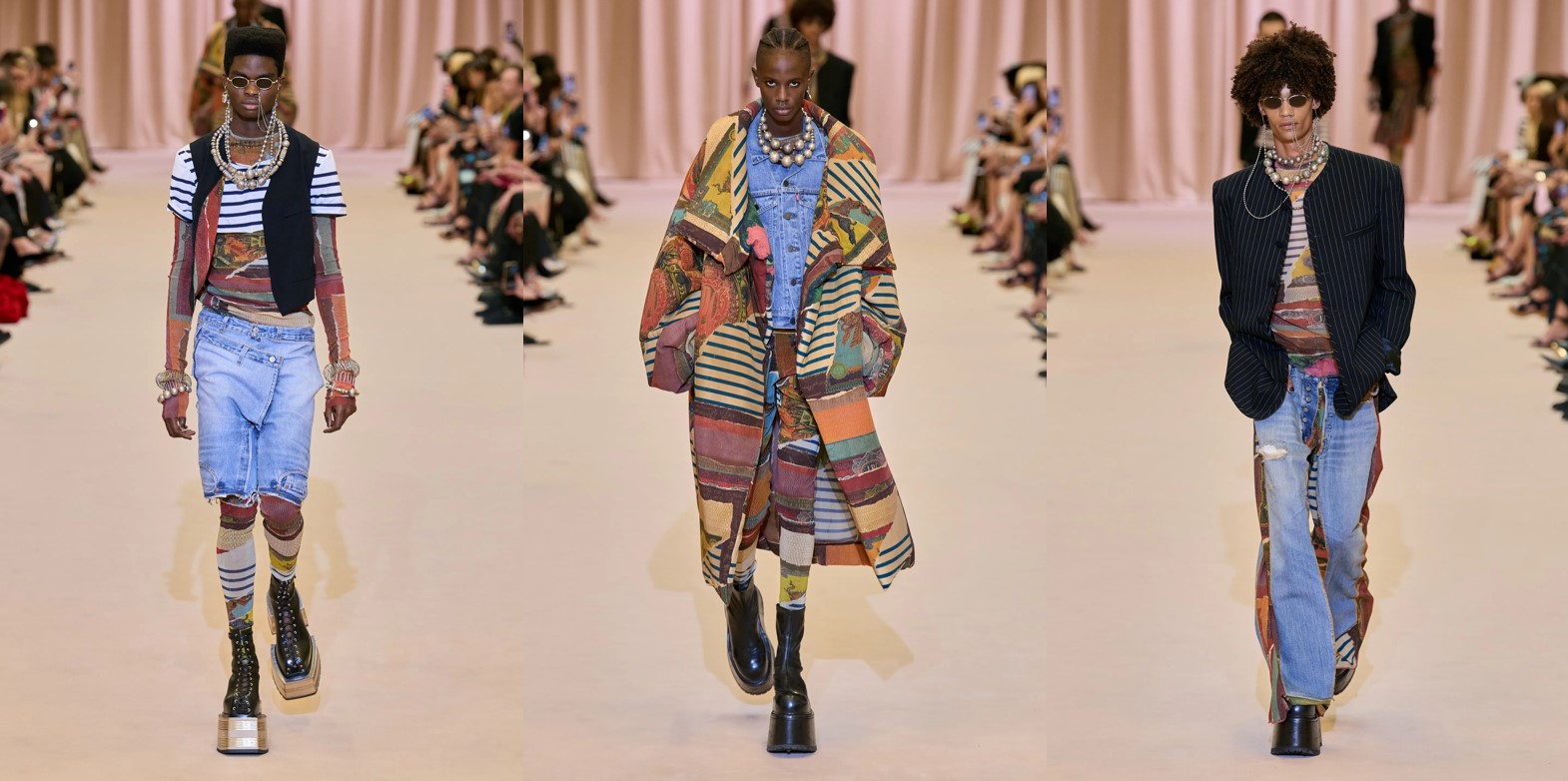
Check out Rousteing's mash up of the tattoo motifs which also feature curlicues and baroque graphics from world currency layered on top of the classic white and navy blue striped Breton sweater celebrated by JPG. Sections of denim jackets, shorts, and trousers get cut up and appliquéd to other garments for a trompe l'oeil effect. Accessories feature huge, chunky silver necklaces and bracelets that recall the tribal, Berber-inspired jewelry from the original collection. And the incredible platform boots feature a sole of metal that references a familiar element in the JPG universe: the revolutionary packing and bottle of his Le Male fragrance!
In fact, his women's section opened with a truly stunning art piece: an outfit that is a direct representation of the Le Male perfume bottle. The bodice is a mold of actual glass made by the expert responsible for the stained glass windows of Notre Dame while the skirt is metal. Just incredible!
Watch the show below and you can see how Rousteing combined the Gaultier motifs with the intricately braided rope detail he is known for at Balmain.
https://fashion.jeanpaulgaultier.com/
This high-profile collaboration (which obliquely recalls Warhol and Basquiat working together) is still fairly new: Sacai’s Chitose Abe (previously here) created a womenswear collection for Fall 2021 and Glenn Martens (previously here) created a Spring 2022 collection, also for women. And for this third outing, Gaultier chose Olivier Rousteing who currently heads Balmain (previously here) to whip up something from the archives. And he did not disappoint. The runway presentation was divided into halves which began with a small menswear collection and moved on to a more extensive women's collection. His take on both men's and women's was supremely imaginative. But he used Gaultier's 1994 tattoo collection, appropriately entitled "Les Tatouages" as a springboard for his men (see photos from the mind-boggling original JPG runway show at Vogue's designer archives here).
Check out Rousteing's mash up of the tattoo motifs which also feature curlicues and baroque graphics from world currency layered on top of the classic white and navy blue striped Breton sweater celebrated by JPG. Sections of denim jackets, shorts, and trousers get cut up and appliquéd to other garments for a trompe l'oeil effect. Accessories feature huge, chunky silver necklaces and bracelets that recall the tribal, Berber-inspired jewelry from the original collection. And the incredible platform boots feature a sole of metal that references a familiar element in the JPG universe: the revolutionary packing and bottle of his Le Male fragrance!
Watch the show below and you can see how Rousteing combined the Gaultier motifs with the intricately braided rope detail he is known for at Balmain.
https://fashion.jeanpaulgaultier.com/
Subscribe to:
Posts (Atom)