Showing posts with label BBC Culture. Show all posts

Saturday, November 6, 2021

Wes Anderson: "Cinema's most misunderstood filmmaker"

I have been a fan of Wes Anderson and his films since his debut film "Bottle Rocket." And for those who think that Wes Anderson films are just all style and weird people for the sake of being stylish and weird, here is a wonderful article Mark Allison wrote for BBC Culture that explains how I feel about the work of this incredible director.

Cinema's most misunderstood filmmaker

By Mark Allison 20th October 2021 | BBC Culture


Is there anything more to Wes Anderson's films than twee whimsicality and aloof performances? Much more, argues Mark Allison: they tell us the truth about being human.

"The paths of glory lead but to the grave." So reads the headstone above the burial place of Eloise Fischer, mother of Jason Schwartzman's Max Fischer, in Wes Anderson's 1998 film Rushmore. An extract from Thomas Gray's 1751 poem Elegy Written in a Country Churchyard, it might seem a more fitting epitaph for the tomb of a great military hero than this unremarkable grave. But Anderson's films don't exist within our dull reality – his worlds are fairy tales, and like all good fairy tales, they begin with death.

Everything Anderson dreams up is ultimately about life's first inevitability, and the craterous absence it leaves in the lives of the bereaved – even if they might not be prepared to admit it. Max's traumatic loss of his mother, for example, is mentioned just twice in Rushmore's script, and both times briefly. But her presence, or lack thereof, defines all that Max does – particularly his strange, Oedipal obsession with the widowed Mrs Cross (Olivia Williams). Rushmore is a film about lonely, damaged people seeking human connection, and this spectre of unresolved grief haunts the Texan director's output.


In The Royal Tenenbaums, Ben Stiller plays the cartoonish but traumatised Chas
(Credit: Alamy)

Despite this thematic absorption, death is unlikely to be the first thing that comes to mind when considering Anderson's oeuvre. His distinctively affected visual style has been subject to both criticism and parody. A 2013 Saturday Night Live sketch imagined an Andersonian horror film called The Midnight Coterie of Sinister Intruders; brimming with twee pretensions, dad-rock needle-drops and oddly detached performances. But this preoccupation with the offbeat surface of Anderson's work underestimates his deep understanding of the human condition and the gentle empathy which pervades his filmmaking.

From his debut feature Bottle Rocket (1996), the director's reliance on understatement has lent his work a unique profundity. When Luke Wilson's awkwardly inept crook Anthony Adams candidly remarks, "I'm usually so exhausted now at the end of the days that I don't have time to think about blown opportunities or wasted time," he betrays an immense and existential sadness that cuts disarmingly to the heart of his lot in life.

This peculiar aloofness is a distinctive trait in Anderson's characters, but it is only a varnish on deeply rooted experiences of tragedy and emotional trauma. Ben Stiller's Chas Tenenbaum in The Royal Tenenbaums (2001) appears to be a cartoonish figure with his hypochondriac mania and bright red tracksuit, but at his core he is a man disturbed by the death of his wife and the weight of his continuing responsibility towards their children.


Steve Zissou (Bill Murray) in The Life Aquatic is a protagonist whose journey is defined by grief
(Credit: Alamy)

Likewise, Bill Murray's title character in The Life Aquatic with Steve Zissou (2004) is a transparently absurd personality from the moment he first dons his crimson beanie and holstered Glock, but the brutal death of his best friend, for which he vows revenge, is no less ghastly as a result. Anderson's protagonists bury their trauma beneath a facade of caricature, and their journeys are defined by how they deal with their grief.

Loss continues to hang over Anderson's latest film, The French Dispatch (2021), which is perhaps his most nakedly sentimental work. Opening with the death of a long-serving magazine editor, the film is structured as an episodic obituary for a man, a publication, and an entire industry facing gradual extinction. The name of the fictional French city in which the film is set, Ennui-sur-Blasé, unsubtly signposts this atmosphere of melancholic nostalgia. The colourful characters we've come to expect from Anderson are still present, but their eccentricities contribute to a tableau of mid-century journalism as an exciting and noble arena, since lost to time.

Death had an even more explicit presence in an earlier version of the film. The writer and filmmaker Matt Zoller Seitz tells BBC Culture, "The prologue to The French Dispatch originally ended with Owen Wilson in a graveyard having a picnic near the grave of a young woman, presumably his wife". It seems there is so much mourning in Anderson's worlds that he can afford to cut some of it for pacing.

HUMAN CONNECTION

While Anderson is deft in walking the line between farce and tragedy, he occasionally suspends his broadly comedic sensibility for moments of unadulterated horror. When Richie Tenenbaum attempts suicide, the frankness with which it is depicted is sudden and distressing. Equally, the death of Steve Zissou's son Ned, or the fatal accident during the river crossing in The Darjeeling Limited (2007), deliver an unexpectedly brutal gut punch. These moments of catastrophe enforce a sense of real and terrifying consequence into Anderson's fantastical worlds.


Anderson's films – including The Grand Budapest Hotel – frequently address the theme of death
(Credit: Alamy)

"Death is the biggest thing that we can't control. We can't even know what lies beyond it," Seitz tells BBC Culture. "Accepting this constitutes a harsh lesson for Wes Anderson protagonists, who are often obsessed with controlling everything."

Anderson is not shy in crediting his influences, from filmmakers Michael Powell and Emeric Pressburger to the writer Stefan Zweig, but the director's own experiences also provide a major source of inspiration. His films are littered with autobiographical details; Rushmore, for example, was filmed in the director's own alma mater, St John's School in Houston, Texas, while the family conflict at the heart of The Royal Tenenbaums was inspired by his own parents' divorce.

The most sobering moment in The Grand Budapest Hotel (2014) comes as Zero Moustafa reveals to M Gustave that his entire family was killed in an earlier war. Speaking to Seitz for his 2015 book on The Grand Budapest Hotel, Anderson elaborates that Zero's harrowing story was inspired by his partner, Juman Malouf, and the experiences of her family in Lebanon.

Perhaps it's because there's so much of Anderson in his own work that it never feels crass when he mixes sensitive themes with absurdist humour. As producer James L Brooks writes in his introduction to Anderson and Owen Wilson's Rushmore screenplay, "They have pulled off the hardest trick in all of contemporary American film: they have won the freedom to use movies as a form of self-expression."

During the director's commentary on the Criterion edition of The Royal Tenenbaums, Anderson explains the dual impulses of visual invention and emotional authenticity that motivate him. "This is a movie where there's a lot of artifice… and it's fun for me to work on those things," he says, "but ultimately the movie didn't mean anything to me until the characters started to become connected to things that I had been through."


In The Darjeeling Limited, three brothers travel to India in search of enlightenment but find instead a new respect for each other
(Credit: Alamy)

So powerful is Anderson's empathy for his characters and their emotional distress that there is rarely room for outright villains in his stories – the farmers in Fantastic Mr Fox (2009) and the fascist ZigZag movement in Grand Budapest being exceptions. As director Martin Scorsese reflected for Esquire in March 2000, "[Bottle Rocket] was a movie without a trace of cynicism, that obviously grew out of its director's affection for his characters in particular and for people in general. A rarity."

A common thread across Anderson's work is the healing power of simple human connection. When Chas Tenenbaum confides to his father, Gene Hackman's Royal, "I've had a rough year, Dad", the response is simply, "I know you have, Chassie''. Both understand all that he's going through, and simply vocalising it is the first step in a deeper reconciliation.

Similarly, when Steve Zissou finally faces the Jaguar Shark that killed his best friend, having lost his own son in pursuit of revenge, all he can say is, "I wonder if it remembers me?" It's a phrase loaded with the meaning of a thousand monologues. How many of us have wasted time in search of things we didn't really want, and neglected what we do in the process?

For the Whitman brothers in The Darjeeling Limited, their journey to India may not have brought the intended spiritual enlightenment or reconciliation with their estranged mother, but they nevertheless find their love and respect for one another renewed. In the film's closing moments, as they toss aside the hideously printed leather luggage they inherited from their father, they cleanse themselves of the emotional baggage that had pushed them apart.

The French Dispatch is a portrayal of mid-century journalism – and loss is a theme throughout the film
(Credit: Alamy)

Not all of Anderson's characters are able to come to terms with their grief so cleanly. The scale of Zero's loss in The Grand Budapest Hotel is such that he is unable to recover. Concluding his life story to Jude Law's author, he glosses over the execution of M Gustave and tragically premature death of his wife and child. As the playwright Anne Washburn writes in her introduction to Seitz's book, "In the character of Zero Mustafa, we see a man who has adapted to his losses but has never rebuilt his life, choosing instead to enshrine his past; he is a testament, rather than a true survivor".

Being a survivor comes with its own responsibilities to continue the memory of those who have passed, a burden that Anderson is keen to bear. The end credits of The French Dispatch duly feature a dedication to a number of 20th-Century writers and journalists, all of whom have long since filed their final dispatch. The lasting impression is the same sentiment of fading glory and inevitable decay that decorated Elouise Fischer's grave in Rushmore, and has since reached across Wes Anderson's career.


Link to original article:
https://www.bbc.com/culture/article/20211015-cinemas-most-misunderstood-filmmaker

Wednesday, January 27, 2021

"The Philadelphia Story" Turns 80!

The Philadelphia Story: How an 80-year-old comedy resonates

By Gregory Wakeman | BBC Culture
20th January 2021


The Philadelphia Story was released 80 years ago this month. Gregory Wakeman explores how the comedy deals with sensitive modern issues through the prism of quips, barbs – and sexual tension.

It didn't take long for the film world to fall in love with The Philadelphia Story. Soon after its New York City premiere on 26 December, 1940, the romantic comedy was met with superlative reviews that only multiplied once it was released across the rest of the US in January 1941.

Audiences quickly grew to adore it, too. It soon broke a box office record at the Radio City Music Hall in New York City and went on to become the fifth highest-grossing film of 1941. Its place in cinematic history was firmly secured just a month after its wide release, when Jimmy Stewart picked up his first and only best actor Academy Award statuette for his performance as reporter Macaulay "Mike" Connor.

He is just one of Katharine Hepburn's suitors in The Philadelphia Story. Her socialite character Tracy Lord is due to marry the wealthy George Kittredge (John Howard), nuptials that Stewart's Connor and Tracy's ex-husband CK Dexter Haven, played by Cary Grant, look to disrupt.


Stewart believed that he only won the prize for The Philadelphia Story because his performance in Mr Smith Goes to Washington lost out to Goodbye, Mr Chips' Robert Donat a year earlier. That argument loses weight, though, when you consider that Donald Ogden Stewart's deliciously charming script for The Philadelphia Story won best writing at the same ceremony, it was nominated for best picture, best director, best actress, and best supporting actress gongs, and Katharine Hepburn was given the 1940 New York Film Critics Circle award for her portrayal.

Over the subsequent decades, its reputation has only grown, too. By 1956, The Philadelphia Story had already been remade into the smash hit musical High Society, starring Bing Crosby, Frank Sinatra and Grace Kelly, in her final film role. In 2008 the American Film Institute named it the fifth best romantic comedy in Hollywood history, while it has proven to be so critic-proof that it still holds a 100% score on Rotten Tomatoes.

Eighty years after its release, The Philadelphia Story's grace, wit, and sheer romanticism doesn't just mean it stands out as one of the best films to emerge from the classic Hollywood era, but that it also might be the definitive romantic comedy, too. That's if it's even a romantic comedy in the first place.

As Dr Tamar Jeffers McDonald, the author of Romantic Comedy: Boy Meets Girl Meets Genre, explains, some people believe that The Philadelphia Story is a screwball comedy, rather than romantic comedy, as it uses various tropes of the sub-genre, including "warring lovers" and has some elements of overlapping dialogue. Even that's up for debate, though. By the start of 1941 the screwball genre was already in decline, as the tastes of audiences were changing thanks to World War Two. At the same time, The Philadelphia Story's dialogue is much less quickfire, and it has a sentimentality, sincerity – and, some might even say, sophistication – that sets it apart from other screwball films.


There’s another sub-genre that The Philadelphia Story has often been aligned with. The comedy of remarriage was an extension of the screwball comedy that became prominent throughout the 1930s and early 1940s as the Production Code banned any reference to sex out of marriage or adultery in movies. In order to get around this, filmmakers simply had their leading romantic characters divorce at the start of the film, then they could flirt and even kiss other characters, all without it being censored.

Theodora Gets Wild, His Girl Friday, and My Favorite Wife followed this structure, but no film did so with the subtlety of The Philadelphia Story, which genuinely leaves you wondering whether Lord is going to end up with Connor or Haven. Jeffers McDonald believes the "palatable" manner with which The Philadelphia Story explores themes like "identity, love as play or fight, divorce, adultery, and frustration" are why it has endured over the decades.

Patrick McGilligan, who wrote the biopic George Cukor: A Double Life about The Philadelphia Story's director, says it has had "a lasting impact as an adult exemplar of the genre", especially when compared to its peers from the same period.


"There is more realism in the acknowledgement of divorce and differences between a married couple. The audience is allowed to see that Hepburn and Grant both have faults. It's a 'happy ending,' but not really, because so much pain has gone before. In this day and age, it seems more adult, modern, sophisticated than most others of the era."

Of course, the entirety of The Philadelphia Story is "elevated by its classy cast", which just so happens to include arguably the most beguiling trio of actors in cinematic history. But while Stewart and Grant excel, it is Hepburn that pre-eminently shines throughout The Philadelphia Story.

Return to stardom

At this point it should be pointed out just how vital The Philadelphia Story was to Hepburn's career. By the end of 1938, Hepburn had been labelled "box office poison". Some of the Hepburn films to perform poorly during this period included Mary Of Scotland, A Woman Rebels, Quality Street, Stage Door, and, despite its legacy as a stone-cold classic now, even Bringing Up Baby. With her career in freefall, Hepburn, who by this point had already won her first best actress Academy Award for 1934's Morning Glory and been nominated in 1936 for Alice Adams, decided to buy herself out of her contract with RKO.

Hepburn retreated to the theatre. Her close friend, the playwright Philip Barry, already had the idea for a play and a character that he knew she’d be perfect for. Tracy Lord was inspired by the Philadelphia socialite Helen Hope Montgomery Scott, once labelled by Vanity Fair magazine "the unofficial queen of Philadelphia's WASP oligarchy". Barry had become close friends with her through Edgar Scott, the heir to the Pennsylvania Railroad fortune, his former classmate at Harvard and her husband.


Barry recognised similarities between Hepburn and Scott, whose exuberance was the stuff of legend even by the end of the 1930s. Not only were there rumours that she had been proposed to four times on the night she made her entrance as a debutante at the 1922 Philadelphia Assemblies Ball, but she also reportedly danced the foxtrot with the Duke Of Windsor at New York City’s legendary El Morocco nightclub, and the Charleston with Josephine Baker in Paris.

At the same time, Barry had become fascinated by speculation that wealthy families were being blackmailed by increasingly prominent and Machiavellian tabloid newspapers, so that salacious gossip about them would be kept secret. Premiering in March 1939, The Philadelphia Story play quickly became a smash hit on Broadway, where it grossed more than $1 million in sales before making another $750,000 when it toured nationally. Hepburn starred in and backed the play financially, giving up a salary and taking a cut of its profits instead.

So it was little surprise, then, that she saw it as the perfect piece of material to launch her back to Hollywood stardom. Hepburn even got a helping hand from Howard Hughes, her ex-lover, who helped her pay for the film rights so that she could have more creative control. Her deal with MGM for the film meant she could veto any potential producer, director, or co-star.

This decision proved to be a masterstroke. Hepburn's complex portrayal of Lord, who is as aggressive as she is vulnerable, nervous, charming, and hilarious, immediately made audiences more sympathetic to her. "When the film was released, most critics and audience members believed Tracy was a portrayal of the 'real' Hepburn," says Jeffers McDonald. "She had spent most of the 1930s being seen by the press, especially the movie fan magazines, as pretentious and awful."


"Playing a character like Tracy, who was similarly rich, privileged and annoying, Hepburn can be seen enacting a public apology for past bad behaviour. Having Tracy knocked off her pedestal by her dealings with men, becoming more humble and pliant, Hepburn could remake her own image and it is very noticeable that she started becoming popular with audiences after this."

In A Scott Berg's biography on the actress, Hepburn recalls not wanting to "make a grand entrance" in The Philadelphia Story for this very reason, explaining, "Moviegoers haven't seen me in over a year, and they already made it clear that they think I'm too la-di-da or something. A lot of people want to see me fall flat on my face." Thus, the opening scene of The Philadelphia Story, which sees Grant push Hepburn on to the floor, was born.

When it came to her co-stars, Hepburn dilly-dallied over whether Clark Gable and Spencer Tracy should play Dexter and Mike, before rightfully deciding on Grant and Stewart. George Cukor was always going to be one of her first choices as director, though. He was the one who "discovered her for Hollywood from the stage", says McGilligan, leading to Hepburn's first role in 1932's A Bill of Divorcement.

They remained close friends until his death in 1983, with Cukor directing Hepburn in eight films and two TV movies. "He had a feminine sympathy or consciousness, he deeply understood Hepburn on and off the screen, and was her most frequent director over time – because he was her favourite," says McGilligan. "He had the same deep communion with Barry and Stewart. What they all believed in was performance above cinematic tricks, humanity in characterisation, and the integrity of the play transferred to the screen."

With The Philadelphia Story, according to McGilligan, Cukor obtained a "humanity that would have not come from a lesser director". It also helped that he had previously paired Hepburn up with Grant in both 1938's Holiday, another adaptation of a Philip Barry play, and 1935's Sylvia Scarlett. Two more rom-coms that were deemed box-office flops, despite some impressive reviews.

The Philadelphia Story gave Cukor, Grant and Hepburn, with the help of Stewart, another chance to correct this trend. "There is a looseness, a naturalness to the comedic repartee," says McGilligan. "And the film becomes – as I think it must have been also on the stage – a kind of auto-critique of Hepburn's hauteur that she joins in while also taking stock of Grant's character in a way that is more critical than other screwball comedies. So Cukor also brings out the mistakes in their relationship, the bitterness in their characters, in a way that is more adult than other screwball comedies."

Cukor also allowed Hepburn's character to have sexual tension with both those played by Grant and Stewart. "It's a double love story," says McGilligan. "There is the one between Hepburn and Grant, which is over with but simmering beneath the surface, and the one between Hepburn and Stewart, which makes headway in the story." This meant that audiences didn't know who Hepburn's character would end up with. "The viewer is probably torn between who should get Hepburn, just as she is torn. As Cary Grant is probably Hollywood's all-time romantic icon – Stewart less so – he is the odds-on favourite. But his devious means of winning her back keeps the audience guessing until the surprise end."

This element of intrigue and surprise would be replicated over many other romantic comedies for decades to come. From Casablanca to Sabrina, as well as Broadcast News, Clueless, 500 Days Of Summer, To All the Boys I've Loved Before, and especially Nancy Meyers' It's Complicated and Something's Gotta Give.

But Cukor and The Philadelphia Story's influence doesn't stop there. He set the standards of "taste and intelligence," says McGilligan, who believes Cukor subverted the genre and its tropes, especially when it came to how male and female characters were depicted. "Cukor himself was gay. So what makes his films unique is that he is depicting his own ideas about romance and love through the prism of this genre, using strong women (like Hepburn) as his alter ego, and making the men (like Cary Grant) less absurdly masculine, in various ways." So while The Philadelphia Story's genre might be up for debate, what's for certain is that it was decades ahead of its time.


Link to original article:
https://www.bbc.com/culture/article/20210120-the-philadelphia-story-how-an-80-year-old-comedy-resonates

Sunday, September 13, 2020

How George Michael Transformed Pop by Nick Levine

How George Michael Transformed Pop
By Nick Levine for BBC Culture
8th September 2020


When George Michael released his second solo album Listen without Prejudice Vol 1 in September 1990, he wasn’t asking fans to embrace a captivating new persona as equivalent pop giants like Madonna and David Bowie did during their imperial phases. But in a way, he was attempting something just as audacious: he wanted to shed the misleading image he had created for himself as one of the most recognisable stars of the 1980s. Now he wanted to show the world more, though not yet all, of who he really was. “Today the way I play the game has got to change,” he sang on the album’s astonishing second single Freedom! ‘90, a song the producer Mark Ronson has described as a “funk groove masterpiece” and “the Mona Lisa”.

In the same song, Michael delivered the rather pleading refrain “I just hope you understand – sometimes the clothes do not make the man”, then drove home his message in the accompanying music video by torching his signature leather jacket from the Faith album campaign three years earlier. However, in a typically contradictory artistic statement, the video in which he asked us to embrace the new, more authentic him featured five huge supermodels of the era – Naomi Campbell, Linda Evangelista, Tatjana Patitz, Christy Turlington and Cindy Crawford – but not a single glimpse of the artist himself. As singer-songwriter Leo Kalyan notes wryly, Freedom! ‘90 has “one of the most iconic music videos of all time – despite George Michael’s absence from it”. Indeed, Michael refused to appear not only in Listen without Prejudice Vol 1’s music videos, but even on its album cover. Though still only 27 years old, he already had the music industry clout to do exactly as he pleased.


Michael made his name alongside school friend Andrew Ridgeley as part of the exuberant duo Wham! (Credit: Getty Images)

As it turns 30 this month, Listen without Prejudice Vol 1 is now widely acknowledged as a modern pop classic. An October 2017 reissue released to coincide with George Michael: Freedom, a posthumous documentary film about the singer who had passed away 10 months earlier, returned the album to the top of the UK charts 27 years after it first made number one. With sophisticated pop songs influenced by The Beatles (Heal the Pain) and The Rolling Stones (Waiting for That Day) and a stripped-down cover of Stevie Wonder’s They Won’t Go When I Go that shows off Michael’s chops as a soul singer, it is seen in retrospect as the album that successfully cemented his position as a pop maestro, not a mere pop puppet.

A huge gamble

But when it first came out in September 1990, this deeply introspective and mostly downbeat LP was a massive risk for a singer who had become a global superstar by crafting glittering, radio-friendly hits like 1984’s debut solo single Careless Whisper and 1998’s pop-soul gem Father Figure. It was also the first time that Michael, the north London-born son of a Greek Cypriot restaurateur and an English dancer, allowed his personal happiness to impinge on his vaulting professional ambition.

After forming the exuberant duo Wham! in 1981, he and school friend Andrew Ridgeley scored a string of global hits that made them pin-ups and even pioneers: in 1985, Wham! made history by becoming the first Western group to visit China. A year later, Michael cannily called time on the two-piece before their fizzy pop confections like Club Tropicana and Wake Me Up Before You Go-Go could become passé – Wham! bowed out in the most triumphant style imaginable, with a sell-out concert at London’s Wembley Stadium. In 1987, he released his debut solo album Faith – a collection of state-of-the-art pop-R&B which sold more than 25 million copies worldwide, placing him up there with Madonna, Michael Jackson, Prince and Whitney Houston as an icon of the era. Alongside the music, he refined his pin-up status with an image that Paul Flynn, author of Good As You: 30 Years of Gay Britain, calls “straight drag”. Flynn says that in 1987’s Faith video, Michael “dressed himself up very much like Tom Cruise in Top Gun”, a style calculated to be as marketable as possible. Or, as Michael put it himself, knowingly, on Freedom! ‘90, after his band Wham! ended in 1986 and he began focusing on his solo career, he “went back home [and] got a brand new face for the boys at MTV” .

The album is a grand apologia for being in the closet – and the one where he turns his back on fame – Paul Flynn
Today, it's impossible not to view Michael's Faith image – and his determination to shed it with Listen without Prejudice Vol 1 – through the prism of his own repressed sexuality. By the late-1980s he knew he was far more attracted to men than women, but chose to keep it hidden for the sake of his family and career. “If your goal is to become the biggest-selling artist in America – which was still my bizarre goal – you’re not going to make life difficult for yourself, are you?” he told Gay Times in 2007. Michael didn’t come out until 1998 when he was arrested by an undercover officer for engaging in a “lewd act” in an LA public lavatory – an incident he then sent up in that year’s disco banger Outside, taking the sting out of any embarrassment he might have felt. “I’d service the community,” he sang with his tongue firmly in his cheek, “but I already have, you see.”


For his first solo album Faith, Michael adopted a performatively macho image complete with aviators and leather jacket (Credit: Getty Images)

But if Outside seemed to show fans a new, more liberated Michael, then it was a process that started eight years earlier with Listen without Prejudice Vol 1. Flynn calls the album Michael’s “grand apologia for being in the closet” as well as “the album where he turns his back on fame”. “It’s the album where he realises where his hollow ambitions have led him to, and the compromises they have involved, which have so much to do with his sexuality,” Flynn says. He points out that the poignant album track Mother’s Pride, on which Michael sings about a son going off to war, can be read as a metaphor for a son coming out of the closet. Certainly, Michael delivers lyrics such as “and in her heart the time has come to lose a son” with palpable pathos.

Reckoning with his sexuality

While writing Faith, Michael disguised any personal turmoil within flashy pop music that was designed to grab the zeitgeist – though the music video for I Want Your Sex, the album’s self-consciously provocative lead single, featured his then-girlfriend Cathy Jeung, Michael later said it was written about a man who was playing hard to get. On Listen without Prejudice Vol 1, however, Michael’s complex private life fuelled music that was more subdued and nuanced, and which alluded to his sexuality without making anything explicit. Cowboys and Angels, a beautiful jazz-flavoured ballad from the album, was inspired by the same unrequited love that Michael mined for I Want Your Sex. “He was the guy I was in love with when I was with Cathy (Jeung), who was definitely in love with me at that time,” he told Attitude magazine in 2004. “So it was very autobiographical.”

There were also hints of Michael's inner conflict in Heal the Pain, a Beatles-influenced folk-pop song which he later recorded as a duet with Paul McCartney. Now, when Michael sings, “How can the outside world be a place that your heart can embrace? Be good to yourself because nobody else has the power to make you happy,” it’s easy to hear him directing this sound advice at himself. Elsewhere, the house-flecked Soul Free – besides Freedom! ‘90, the album’s only uptempo song – shimmered with the possibility of a semi-illicit thrill as Michael sang in an ecstatic falsetto: “When you touch me baby, I don't have no choice, oh that sweet temptation in your voice!”

Freedom! ‘90 is about breaking free of your past – and for Michael this seems to be as much about making a point to his record label as about embracing his sexuality – Leo Kalyan
However, it would be reductive to suggest that Listen without Prejudice Vol 1 was solely about Michael processing his sexuality. It's also an album where he shook off any remnants of his teen-pop years. “Freedom! 90 is about breaking free of your past,” Kalyan says, “and for George Michael this seems to be as much about making a point to his record label as about embracing his sexuality for the first time”. The sublime, slow-burning Waiting for That Day placed Michael next to the big boys of British rock by borrowing from The Rolling Stones – Mick Jagger and Keith Richards get a co-writing credit for his nod to You Can’t Always Get What You Want – and Praying for Time, a socially conscious ballad, has earned comparisons to John Lennon over the years. Released as the album’s lead single, it found Michael grappling with Western wealth inequality and the hypocrisy surrounding it. Even 30 years on, his dry observation that “charity is a coat you wear twice a year” still feels stingingly on the nose.

Underappreciated in its time

Though Listen without Prejudice Vol 1 sold eight million copies worldwide and won Michael a Brit Award for best British album, it was widely regarded as a commercial disappointment after Faith’s blockbuster success. Michael felt his record label, Sony Music, had failed to promote it properly in the US and subsequently took them to court, alleging that the company treated him as “no more than a piece of software”. Because of this lawsuit, which Michael eventually lost, a planned follow-up album called Listen without Prejudice Vol 2 never materialised.


As his career progressed, Michael became admired for his unapologetic candour when it came to sex and sexuality, among other things (Credit: Alamy)

It’s fitting, though, that Michael gave three songs intended for the project – including the brilliant, hip-shaking hit single Too Funky – to Red Hot + Dance, an HIV/Aids charity album released in June 1992. Written by a closeted gay man at the height of the epidemic, Listen without Prejudice Vol 1 is an album steeped in the grief and confusion of the HIV/Aids era. Michael acknowledged in a 2007 Desert Island Discs interview that “Aids was the predominant feature of being gay in the 1980s and early 90s as far as any parent was concerned” and a major factor in his decision not to come out to his own family sooner. It’s little wonder that, as he became more emotionally honest in his music, he no longer sounded ready to party.

Now, nearly four years after Michael’s untimely death on 25 December 2016, Listen without Prejudice Vol 1 forms a cornerstone of his legacy – along with his early Wham! hits, 1987’s more ostentatious Faith and 1996’s fascinating and reflective Older album. “His music connects with so many people because he wrote classic songs about universal human experiences, but he always told the story through his individual lens,” says Kalyan.

Though he remained closeted and conflicted for another eight years following its release, Listen without Prejudice Vol 1’s steadfast rejection of pop star artifice is an important stepping stone in Michael’s journey to becoming the scrupulously honest man we now remember him as. He retained a certain mystique right up to his death, but Michael’s willingness to confront his public and private mistakes helped to pave the way for today’s more transparent pop landscape, where a superstar like Katy Perry feels comfortable discussing her depression in a radio interview, and other household names like Justin Bieber and Dua Lipa post apologies for tone deaf moments and past faux pas.

After he came out in 1998, Michael became known for speaking with absolute candour about his recreational drug use, the depression he suffered in the 1990s after losing his lover Anselmo Feleppa to Aids then his mother Lesley to cancer, and his unapologetic attitude towards gay sex. Asked by The Guardian in 2006 why he enjoyed cruising on London’s Hampstead Heath when “he could get any man he wants”, Michael replied matter-of-factly: “I do get anyone I want. But I like a bit of everything. I have friends up there, I have a laugh.” Drag king and mega-fan Georgeous Michael says that “as a queer person coming of age in the early 2000s, it felt really empowering to hear someone embrace those things publicly”.

So, when he sings “gotta have some faith in my sound – it’s the one good thing that I’ve got,” on Freedom! ‘90, Michael was only half right. His sound helped to make him the pre-eminent British pop star of his generation, but George Michael's profound humanity and successful battle to present himself authentically is what makes him a truly great artist. That battle wasn’t won by Listen without Prejudice Vol 1, but this incredible album is definitely the point at which he put his flag in the sand.


Link to original article:
https://www.bbc.com/culture/article/20200908-how-george-michael-transformed-pop


http://www.georgemichael.com/

Friday, May 12, 2017

"The Art Movements Lost To History" from BBC Culture

I found this article from BBC Culture fascinating and despite the fact that I have an art background, there were a few facts here that were never covered in my Art History classes! For instance, who knew that there was a reactionary movement to Cubism called Purism?


THE ART MOVEMENTS LOST TO HISTORY

Have you ever heard of Rayonism, Tonalism or Precisionism? Not as visible as Impressionism, they still mattered in their own unique ways, writes Kelly Grovier.

By Kelly Grovier
10 April 2017

Impressionism changed everything. Born of defiance and a rejection of tired traditions, the collective visions of Monet and Manet, Morisot and Renoir, Pissarro and Sisley became (and remain to this day) more popular than any in the history of image-making. If that weren’t remarkable enough, the movement’s nerve and verve succeeded in opening the floodgates to a dizzying proliferation of artistic ideas, ideals and painterly techniques that altered forever the story of art.

Before Impressionism’s emergence in the 1860s, prevailing artistic tastes shifted relatively slowly. One could be forgiven for thinking, over-simplistically, that one dominant school followed another with a kind of fluid inevitability, like the passing of an aesthetic baton from one era to next: the Renaissance handing off to Mannerism, Baroque to Rococo, Romanticism to Realism. But when Impressionism entered the race, suddenly that single lane of traffic divided into many, as separate strands spidered away from the linear path into a spaghetti of creative confusion. The ensuing century and a half witnessed more than four times as many distinct and nameable movements than the entire millennium that came before.

This year alone marks the centenary of the formal establishment of at least three separate artistic schools that emerged independently in three different locations: De Stijl in the Netherlands, Productivism in Russia and Pittura Metafisica in Italy. The first of these, De Stijl, remains familiar to more than merely devoted students of art history. The geometric colour blocks of Piet Mondrian, one of De Stijl’s co-founders, continue to mesmerise. But how many of us can, without the aid of Google, picture in our mind’s eye a work by De Stijl’s Russian and Italian creative siblings – hugely significant interludes in Modern art, but hardly household terms?
For every Expressionist, Cubist, Surrealist and Pop Art legend that our eyes know by heart, there’s a Tonalist, Vorticist, Biomorphist and Maximalist whose imagination rings a bell but whose manifesto slips the mind. What follows is a crib sheet to seven art movements that came and went since Impressionism upset the artistic apple cart – movements you know you know, but can’t quite name.

Synthetism (circa 1877 - 1893)

As their name suggests, Synthetists were interested in unity. Unsatisfied with Impressionism’s sleight of hand, they strove to balance both an object’s appearance and the emotion it provokes, rather than privileging one or the other. The Flageolet Player on the Cliff(1889), a painting by the French artist Paul Gauguin, is emblematic of the style. Glimpsed from a precarious vantage, a girl swings her scythe in time to the romantic notes wafting from the flute of a boy beside her on the ledge-like path. Gauguin manages to capture the vertigo of young love while at the same time remaining faithful to every humid gradation of the day’s dying light.


Tonalism (1880s and ‘90s)

At the same moment that the Synthetists were striking an equilibrium between feeling and form, a group of artists in the US were earning the nickname Tonalists for their tendency to draw a gauzy veil of light-suspending atmosphere across their works. James McNeill Whistler was one of the school’s attendees and so was the spiritually-sensitive George Inness – a devotee of the mystical writings of the Swedish theologian Emanuel Swedenborg. Only a whisper of lunar light illuminates the marshes of Alexandria Bay, New York, in Inness’s 1887 canvas, Moonrise. Swaddled in quarter-light, the sodden landscape through which a barely-visible boatman appears to pass from one state of existence to another dissolves into a murky mist before our very eyes.


Purism (1918 - 1925)

Almost as quickly as the Cubist pioneers Pablo Picasso and Georges Braque had established the movement’s epoch-defining principles of fragmentation and multi-perspectivism in the 1910s, there was kickback. Among those putting the boot in were the French painter and writer Amédée Ozenfant and the celebrated French-Swiss architect Charles-Édouard Jeanneret (known as Le Corbusier). Wishing to restore geometric soundness to objects (and objecting to how fashionable, decoratively, Cubism had become), Ozenfant and Le Corbusier argued for a robust simplicity of forms. Ozenfant’s Still Life with Glass of Red Wine (1921) is a case in point. Where Cubists would merrily smash to smithereens the simplest bottle of red, the Purists saw the world as archetypally intact and brought to the table something reliably solid instead.


Precisionism (1920s and 30s)

Some art schools take things in fresh new directions. Others innovate by unifying. They strive to consolidate the salient ideas of forerunning schools. Precisionism is one of those. Hailed as the first native art movement to plant roots in the United States, Precisionism absorbed principles of rivalrous European manifestos in its evocation of uniquely American themes. Charles Demuth’s iconic I Saw the Figure 5 in Gold (1928) is indicative of the eclectic style. Inspired by William Carlos Williams’s 1921 imagistic poem The Great Figure, Demuth captures the deafening reverberations of a fire engine’s blaring approach in a fierce fracture of colour and sound that is neither Cubist nor Futurist, yet both.


Rayonism (1910s)

With obsessive attention to the behaviour of light on objects, the Impressionists startled and delighted. Decades later, in the 1910s, a pair of Russian artists, Mikhail Larionov and Natalia Goncharova, took things to another level by removing material substance altogether while retaining the sharp shards of light that it reflects. The result was Rayonism: shattered meshes of refracted colour such as Larionov’s Red Rayonism (1913). Though convinced their school represented the culmination of all previous artistic movements, Rayonism proved in fact to be merely another nudge toward that impending seismic surge that will strike in the 1940s, Abstract Expressionism, whose epicentre would not be Russia, but the United States.


Synchromism (1910s and 20s)

While the Russian Rayonists were busy stripping form from light, a duo of American artists, Stanton MacDonald-Wright and Morgan Russell, were endeavouring to distill a rhythmic eye-music from the silent syncopations of pure colour. They called their project Synchromism and the individual works that comprised it, ‘synchromies’. Russell’s Cosmic Synchromy, painted between 1913 and 1914, is characteristic of the movement’s ambition to record in colour luminous symphonies of seeing: the mute music of the mesmerising spheres.


Lettrism (1942 - )

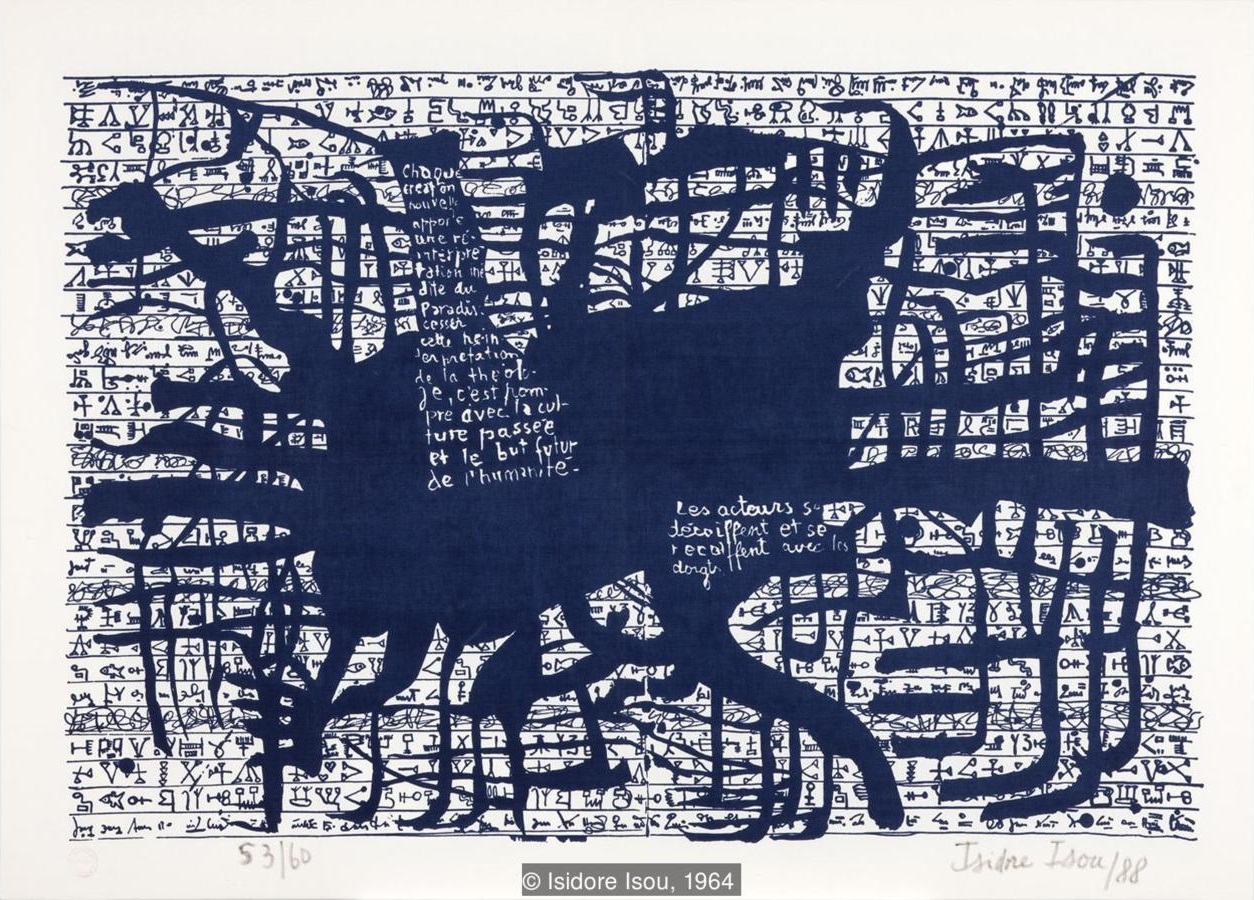
Where Synchromism coaxed from quiet colour an orchestra of harmonious hues, a later movement, known as Lettrism, sought to sync the competing urgencies of language and image into a merged melody. Conceived in the 1940s by Isidore Isou, a Romanian expat to creatively-feverish Paris, Lettrism (or “Letterism” as Isou preferred) waged its campaign to change the way we experience art on a variety of cultural fronts: from literature to cinema, graphics to politics. Painters enlisted in the Lettrist cause forged a fresh genre of image-making they called ‘hypergraphics’ – a hybrid verbal-visual vision that relied for its effect on an erosion of the boundaries between reading and looking. In Isou’s own painting Hypergraphie, Polylogue, from 1964, an abacus of strange, hieroglyphic-like symbols is slowly blotted out by a huge indecipherable cipher as literal language and the splotches of abstraction slip into a seamless primordial soup of something seen. Through the Lettrist’s integrating eyes, art is the last word.


Link to original article here:
http://www.bbc.com/culture/story/20170410-the-art-movements-lost-to-history

Thursday, August 25, 2016

The 100 Greatest Films of the 21st Century

BBC Culture asked 177 film critics and historians for their input on a list of The 100 Greatest Films of the 21st Century. And the results are actually quite fulfilling. When one looks at what has been created on film since the year 2000 (which, yes, BBC Culture admits is not technically the start of the 21st century), it's rather astounding to see that we are living in perhaps a new Golden Age of cinema. We have seen the rebirth of the auteur, and just take a gander at the list to refresh yourself with the many, many exquisite films that have been made in the last fifteeen years. Or make your acquaintance with several if you have not seen them.

100. Toni Erdmann (Maren Ade, 2016)
100. Requiem for a Dream (Darren Aronofsky, 2000)
100. Carlos (Olivier Assayas, 2010)
99. The Gleaners and I (Agnès Varda, 2000)
98. Ten (Abbas Kiarostami, 2002)
97. White Material (Claire Denis, 2009)
96. Finding Nemo (Andrew Stanton, 2003)
95. Moonrise Kingdom (Wes Anderson, 2012)
94. Let the Right One In (Tomas Alfredson, 2008)
93. Ratatouille (Brad Bird, 2007)
92. The Assassination of Jesse James by the Coward Robert Ford (Andrew Dominik, 2007)
91. The Secret in Their Eyes (Juan José Campanella, 2009)
90. The Pianist (Roman Polanski, 2002)
89. The Headless Woman (Lucrecia Martel, 2008)
88. Spotlight (Tom McCarthy, 2015)
87. Amélie (Jean-Pierre Jeunet, 2001)
86. Far From Heaven (Todd Haynes, 2002)
85. A Prophet (Jacques Audiard, 2009)
84. Her (Spike Jonze, 2013)
83. A.I. Artificial Intelligence (Steven Spielberg, 2001)
82. A Serious Man (Joel and Ethan Coen, 2009)
81. Shame (Steve McQueen, 2011)
80. The Return (Andrey Zvyagintsev, 2003)
79. Almost Famous (Cameron Crowe, 2000)
78. The Wolf of Wall Street (Martin Scorsese, 2013)
77. The Diving Bell and the Butterfly (Julian Schnabel, 2007)
76. Dogville (Lars von Trier, 2003)
75. Inherent Vice (Paul Thomas Anderson, 2014)
74. Spring Breakers (Harmony Korine, 2012)
73. Before Sunset (Richard Linklater, 2004)
72. Only Lovers Left Alive (Jim Jarmusch, 2013)
71. Tabu (Miguel Gomes, 2012)
70. Stories We Tell (Sarah Polley, 2012)
69. Carol (Todd Haynes, 2015)
68. The Royal Tenenbaums (Wes Anderson, 2001)
67. The Hurt Locker (Kathryn Bigelow, 2008)
66. Spring, Summer, Fall, Winter…and Spring (Kim Ki-duk, 2003)
65. Fish Tank (Andrea Arnold, 2009)
64. The Great Beauty (Paolo Sorrentino, 2013)
63. The Turin Horse (Béla Tarr and Ágnes Hranitzky, 2011)
62. Inglourious Basterds (Quentin Tarantino, 2009)
61. Under the Skin (Jonathan Glazer, 2013)
60. Syndromes and a Century (Apichatpong Weerasethakul, 2006)
59. A History of Violence (David Cronenberg, 2005)
58. Moolaadé (Ousmane Sembène, 2004)
57. Zero Dark Thirty (Kathryn Bigelow, 2012)
56. Werckmeister Harmonies (Béla Tarr, director; Ágnes Hranitzky, co-director, 2000)
55. Ida (Paweł Pawlikowski, 2013)
54. Once Upon a Time in Anatolia (Nuri Bilge Ceylan, 2011)
53. Moulin Rouge! (Baz Luhrmann, 2001)
52. Tropical Malady (Apichatpong Weerasethakul, 2004)
51. Inception (Christopher Nolan, 2010)
50. The Assassin (Hou Hsiao-hsien, 2015)
49. Goodbye to Language (Jean-Luc Godard, 2014)
48. Brooklyn (John Crowley, 2015)
47. Leviathan (Andrey Zvyagintsev, 2014)
46. Certified Copy (Abbas Kiarostami, 2010)
45. Blue Is the Warmest Color (Abdellatif Kechiche, 2013)
44. 12 Years a Slave (Steve McQueen, 2013)
43. Melancholia (Lars von Trier, 2011)
42. Amour (Michael Haneke, 2012)
41. Inside Out (Pete Docter, 2015)
40. Brokeback Mountain (Ang Lee, 2005)
39. The New World (Terrence Malick, 2005)
38. City of God (Fernando Meirelles and Kátia Lund, 2002)
37. Uncle Boonmee Who Can Recall His Past Lives (Apichatpong Weerasethakul, 2010)
36. Timbuktu (Abderrahmane Sissako, 2014)
35. Crouching Tiger, Hidden Dragon (Ang Lee, 2000)
34. Son of Saul (László Nemes, 2015)
33. The Dark Knight (Christopher Nolan, 2008)
32. The Lives of Others (Florian Henckel von Donnersmarck, 2006)
31. Margaret (Kenneth Lonergan, 2011)
30. Oldboy (Park Chan-wook, 2003)
29. WALL-E (Andrew Stanton, 2008)
28. Talk to Her (Pedro Almodóvar, 2002)
27. The Social Network (David Fincher, 2010)
26. 25th Hour (Spike Lee, 2002)
25. ​Memento (Christopher Nolan, 2000)
24. The Master (Paul Thomas Anderson, 2012)
23. Caché (Michael Haneke, 2005)
22. Lost in Translation (Sofia Coppola, 2003)
21. The Grand Budapest Hotel (Wes Anderson, 2014)
20. Synecdoche, New York (Charlie Kaufman, 2008)
19. Mad Max: Fury Road (George Miller, 2015)
18. The White Ribbon (Michael Haneke, 2009)
17. Pan's Labyrinth (Guillermo Del Toro, 2006)
16. Holy Motors (Leos Carax, 2012)
15. 4 Months, 3 Weeks and 2 Days (Cristian Mungiu, 2007)
14. The Act of Killing (Joshua Oppenheimer, 2012)
13. Children of Men (Alfonso Cuarón, 2006)
12. Zodiac (David Fincher, 2007)
11. Inside Llewyn Davis (Joel and Ethan Coen, 2013)
10. No Country for Old Men (Joel and Ethan Coen, 2007)
9. A Separation (Asghar Farhadi, 2011)
8. Yi Yi: A One and a Two (Edward Yang, 2000)
7. The Tree of Life (Terrence Malick, 2011)
6. Eternal Sunshine of the Spotless Mind (Michel Gondry, 2004)
5. Boyhood (Richard Linklater, 2014)
4. Spirited Away (Hayao Miyazaki, 2001)
3. There Will Be Blood (Paul Thomas Anderson, 2007)
2. In the Mood for Love (Wong Kar-wai, 2000)
1. Mulholland Drive (David Lynch, 2001)

I am absolutely THRILLED to see Terrence Malick's transcendent film "The Tree of Life" at #7 (previously here). I'm also extremely pleased to see on the list Charlie Kaufman's existential masterpiece "Synecdoche, New York (previously here), Wes Anderson's delightful and touching "The Royal Tenenbaums" (previously here), and the amazing, dreamy "Uncle Boonmee Who Can Recall His Past Lives" by Apichatpong Weerasethakul (previously here).

But of course I did not foresee David Lynch's pristine yet enigmatic "Mulholland Drive" (previously here) at the #1 spot!!!

Link to original article on BBC:
http://www.bbc.com/culture/story/20160819-the-21st-centurys-100-greatest-films