
I am mesmerized by this incredible track and video from Actress, the nom de musique of English electronic / Afro-Futurism-adjacent artist Darren J. Cunningham. The images to this song "Overchord" are arresting. The narrative takes place in a minimalist dream space layered with enigmatic systems and objects ... in short, dream logic reigns supreme. In many ways, it reminds me of the work of contemporary artist Matthew Barney. Kudos to Cunningham, director Anna van der Velde, DP Peter Bishop, and of course Production Designer Hugo Harris. Stunning work.
https://whoisactress.com/
Showing posts with label actress. Show all posts
Showing posts with label actress. Show all posts
Friday, August 28, 2026

Thursday, August 27, 2026
R.I.P.
It often comes in threes...
https://www.dollyparton.com/
https://www.timcurry.co.uk/
https://yayoi-kusama.jp/
https://www.dollyparton.com/
https://www.timcurry.co.uk/
https://yayoi-kusama.jp/
Saturday, May 16, 2026
Notes for Radical Living by Tilda Swinton
Notes for Radical Living by Tilda Swinton
Make friends with chaos
Hold a calm mind
Let things shake
Forgive human frailty
Champion second chances
Defy kindness
Reverence fellowship
Listen to the quiet
Respect the young
Seek growth
Trust in change
Treasure learning
Inspire faith in evolution
Reach beyond the binary
Be wary of the doubtless
Honor the bright headed
Grow plants
Attend to the weather
Be electric
Cherish language
Celebrate silence
Dance daily
Bless the handmade
Sing into pain
Challenge assumptions
Follow the wind
Look upwards
Swoon under clouds
Feel your courage
Face forward
Read history
Open your ears
Drop your shoulders
Bend your knees
Raise the roof
Keep breathing
Be trustworthy
Take care of yourself
Believe in goodness
Head for the light
--from Tilda Swinton’s 2025 book “Ongoing”

https://www.rizzoliusa.com/book/9780847860517/
Make friends with chaos
Hold a calm mind
Let things shake
Forgive human frailty
Champion second chances
Defy kindness
Reverence fellowship
Listen to the quiet
Respect the young
Seek growth
Trust in change
Treasure learning
Inspire faith in evolution
Reach beyond the binary
Be wary of the doubtless
Honor the bright headed
Grow plants
Attend to the weather
Be electric
Cherish language
Celebrate silence
Dance daily
Bless the handmade
Sing into pain
Challenge assumptions
Follow the wind
Look upwards
Swoon under clouds
Feel your courage
Face forward
Read history
Open your ears
Drop your shoulders
Bend your knees
Raise the roof
Keep breathing
Be trustworthy
Take care of yourself
Believe in goodness
Head for the light
--from Tilda Swinton’s 2025 book “Ongoing”
https://www.rizzoliusa.com/book/9780847860517/
Sunday, February 2, 2025
R.I.P. Marianne Faithfull
R.I.P. Marianne Faithfull. It seemed that for most of her life, as sung by former boyfriend Mick Jagger, wild horses could not drag her away. She survived heroin addiction, anorexia, homelessness, and near-death from COVID. But now she's gone and she leaves behind a fascinating life and artistic catalog.
I first became aware of her in 1980 when she released "Broken English," a sort of "comeback" album...or at least a "transformation" album that saw her go from 60s-70s personality to contemporary, cutting edge artist. Here she is singing the amazing, pulsing title track.
Her version of the lovely "The Ballad of Lucy Jordan" was also on this album.
She delighted fans in 2002 with her "Kissin' Time" release that saw her collaborate with Beck, Billy Corgan (Smashing Pumpkins), Blur, Pulp, and Dave Stewart (Eurythmics). Here is the funky Beck/Faithfull tune "Sex With Strangers" starring supermodel Kate Moss.
Thanks for the music, Marianne. Have fun frolicking with those wild horses...
http://www.mariannefaithfull.org.uk/
Friday, February 16, 2024
BEAUTY: Clothing--Thom Browne
Thom Browne closed New York Fashion Week with a spectacular, theatrical performance showcasing his Fall-Winter '24-'25 men's and women's collection. He took inspiration from Edgar Allan Poe's iconic poem "The Raven" and sent models out with black talon nails, black feathered hairpieces, and garments featuring ravens and of course the word "Nevermore." During the show, the Poe poem was read in its entirety by actress Carrie Coon who plays Bertha Russell on HBO Max's "The Gilded Age." Her reading should go down in history as the definitive version...watch the video below (the streaming and pre-show lasts until 23:00 when the show gets underway) and listen to Coon's effective, escalating emotion that leads to a chilling state of utter madness, while taking in the staging and set of a snow-covered field populated with bare, gnarled trees. And the clothing? Perfection.


https://www.thombrowne.com


https://www.thombrowne.com
Wednesday, November 9, 2022
"Our Flag" by Ibrahim Maalouf featuring Sharon Stone
Powerful.
"Our Flag" by Ibrahim Maalouf with a spoken word section by Sharon Stone.
This nation needs a vacation
From the presentation of your hesitation
You cannot stop your disassociation
From the unethical beautification of your campaign negotiation YOU CANNOT STOP
With world wide domination
Well it’s not that easy to obtain without cessation
Of the complete dehumanization
Of what we stand for
Tell him people:
Don’t walk away boy
We’ve got something to say boy Our Country’s not a toy
Don’t walk away
You don’t get to turn your back and pretend that all you start won’t be the end
You were told to love honor protect and defend you’ve torn our hearts, our flag it cannot mend Other country’s trust was ours on lend
When will they ever believe us again?
And whose money do you think you spend? Stop pushing, stop pushing, stop pushing, stop pushing, stop pushing us to the end
Yeah, tell him people:
Don’t walk away boy
We’ve got something to say boy Our Country’s not a toy
Don’t walk away
One wonders what will be your complete undoing
Is it that you don’t remember what it is or for whom you are working?
We were considered the free world, where are we going?
Freedoms a gift, a treasure, a decency, not a coin
You can spend on graft, deceit and not repeat annoying
Phrases to brainwash unassuming children going
From channel to channel watching people dying
Buoying
Their spirits with convenient captures of coy
Reticent terrorists, fallen villains in front of millions of sad patriots who need more
Oh please tell him patriots:
Don’t walk away boy
We’ve got something to say boy Our Country’s not a toy
Don’t walk away
We want leadership with dignity and reverence for life
Memories provide possibility for more than death and strife
Roosevelt, Kennedy and King loved us too when unrest was rife
They were brave and true and wrote it with their life
Give us something real, a dream not just for you
A future without shame grief and despair
Wonder, love, brotherhood, education and care
America I love you, I treasure you and I am sorry for our mistakes
I want a leader who stands for our values, thoughts, mountains, skies, oceans, ozone and lakes
I’m unafraid to tell him:
Yes walk away boy
Cause we have something to say Our Country is not a toy
It’s time to walk away boy
Put your head down and walk walk on M*********** walk
United States of America, and democracy, I love you too...and I wish we were not at this point.
https://www.ibrahimmaalouf.com/en/
Wednesday, June 30, 2021
Cara Delevingne’s LA House, 2021
Cara Delevingne has moved into a new house, and she outfitted it with some amazing features...wild, extravagant, humorous, impractical features with some wonderful art installations (an indoor ball pit, a secret vagina passage to a guest room that exits through a washing machine, a stripper room)! Do take a look at the video since she walks the Architectural Digest crew through some areas that are not in the photos below!


https://www.instagram.com/caradelevingne/


Monday, March 15, 2021
The Colorful Home of Emmy Raver-Lampman and Daveed Diggs
I love the Los Angeles home of Emmy Raver-Lampman (from Netflix's "The Umbrella Academy") and Daveed Diggs (from the stellar stage hit "Hamilton" for which he won a both a Grammy and a Tony!), that Raver-Lampman designed with interior designer Mandy Cheng. I appreciate it as an interior designer, but also just as a person who is visually stimulated. There is so much beauty and color and texture and life and fun in this home.
https://www.architecturaldigest.com/story/step-inside-emmy-raver-lampman-and-daveed-diggss-colorful-southern-california-home
http://daveeddiggs.com/
In their living room, I love the photo booth kissing series over the fireplace, Raver Lampman's lovely basket collection on the walls, and of course the hanging swing seats.
Raver-Lampman used her quarantine down-time to paint hash marks on the wall of their office which replicates the look of high end wallcoverings like Porter Teleo.
Diggs chose the humorous wallcovering in the powder room: the Bay Area Toile by Flavor Paper, featuring iconic people from the San Francisco Bay Area like legendary quarterback Joe Montana, local Channel 2 news anchor Dennis Richmond (if you are a long-time resident of the Bay Area who is of a certain age, like myself, you will certainly recognize Dennis Richmond!), rapper E-40, political activist Angela Davis, and even Chez Panisse founder Alice Waters.
They converted a never-used wine storage space under the stairs into a really cool record lounge spot!
The stair runner is super--a patchwork of smaller rugs and runners sewn together to create a kaleidoscopic effect.
Upstairs, guest rooms feature a jungle-and-monkey-themed wallcovering from venerable Enlgish wallcovering house Cole and Son, a blue watercolor wallcovering from Feather, and a master bedroom that features a light hearted art work of the Obamas sitting on sandwiches! Watch the video at the bottom of this post for a delightful walk-through of the home hosted by Emmy and Daveed themselves!


http://daveeddiggs.com/
Wednesday, January 27, 2021
"The Philadelphia Story" Turns 80!
The Philadelphia Story: How an 80-year-old comedy resonates
By Gregory Wakeman | BBC Culture
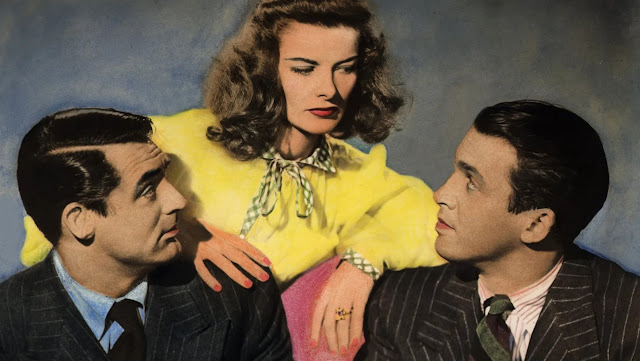
The Philadelphia Story was released 80 years ago this month. Gregory Wakeman explores how the comedy deals with sensitive modern issues through the prism of quips, barbs – and sexual tension.
20th January 2021

It didn't take long for the film world to fall in love with The Philadelphia Story. Soon after its New York City premiere on 26 December, 1940, the romantic comedy was met with superlative reviews that only multiplied once it was released across the rest of the US in January 1941.
Audiences quickly grew to adore it, too. It soon broke a box office record at the Radio City Music Hall in New York City and went on to become the fifth highest-grossing film of 1941. Its place in cinematic history was firmly secured just a month after its wide release, when Jimmy Stewart picked up his first and only best actor Academy Award statuette for his performance as reporter Macaulay "Mike" Connor.
He is just one of Katharine Hepburn's suitors in The Philadelphia Story. Her socialite character Tracy Lord is due to marry the wealthy George Kittredge (John Howard), nuptials that Stewart's Connor and Tracy's ex-husband CK Dexter Haven, played by Cary Grant, look to disrupt.

Stewart believed that he only won the prize for The Philadelphia Story because his performance in Mr Smith Goes to Washington lost out to Goodbye, Mr Chips' Robert Donat a year earlier. That argument loses weight, though, when you consider that Donald Ogden Stewart's deliciously charming script for The Philadelphia Story won best writing at the same ceremony, it was nominated for best picture, best director, best actress, and best supporting actress gongs, and Katharine Hepburn was given the 1940 New York Film Critics Circle award for her portrayal.
Over the subsequent decades, its reputation has only grown, too. By 1956, The Philadelphia Story had already been remade into the smash hit musical High Society, starring Bing Crosby, Frank Sinatra and Grace Kelly, in her final film role. In 2008 the American Film Institute named it the fifth best romantic comedy in Hollywood history, while it has proven to be so critic-proof that it still holds a 100% score on Rotten Tomatoes.
Eighty years after its release, The Philadelphia Story's grace, wit, and sheer romanticism doesn't just mean it stands out as one of the best films to emerge from the classic Hollywood era, but that it also might be the definitive romantic comedy, too. That's if it's even a romantic comedy in the first place.
As Dr Tamar Jeffers McDonald, the author of Romantic Comedy: Boy Meets Girl Meets Genre, explains, some people believe that The Philadelphia Story is a screwball comedy, rather than romantic comedy, as it uses various tropes of the sub-genre, including "warring lovers" and has some elements of overlapping dialogue. Even that's up for debate, though. By the start of 1941 the screwball genre was already in decline, as the tastes of audiences were changing thanks to World War Two. At the same time, The Philadelphia Story's dialogue is much less quickfire, and it has a sentimentality, sincerity – and, some might even say, sophistication – that sets it apart from other screwball films.

There’s another sub-genre that The Philadelphia Story has often been aligned with. The comedy of remarriage was an extension of the screwball comedy that became prominent throughout the 1930s and early 1940s as the Production Code banned any reference to sex out of marriage or adultery in movies. In order to get around this, filmmakers simply had their leading romantic characters divorce at the start of the film, then they could flirt and even kiss other characters, all without it being censored.
Theodora Gets Wild, His Girl Friday, and My Favorite Wife followed this structure, but no film did so with the subtlety of The Philadelphia Story, which genuinely leaves you wondering whether Lord is going to end up with Connor or Haven. Jeffers McDonald believes the "palatable" manner with which The Philadelphia Story explores themes like "identity, love as play or fight, divorce, adultery, and frustration" are why it has endured over the decades.
Patrick McGilligan, who wrote the biopic George Cukor: A Double Life about The Philadelphia Story's director, says it has had "a lasting impact as an adult exemplar of the genre", especially when compared to its peers from the same period.

"There is more realism in the acknowledgement of divorce and differences between a married couple. The audience is allowed to see that Hepburn and Grant both have faults. It's a 'happy ending,' but not really, because so much pain has gone before. In this day and age, it seems more adult, modern, sophisticated than most others of the era."
Of course, the entirety of The Philadelphia Story is "elevated by its classy cast", which just so happens to include arguably the most beguiling trio of actors in cinematic history. But while Stewart and Grant excel, it is Hepburn that pre-eminently shines throughout The Philadelphia Story.
Return to stardom
At this point it should be pointed out just how vital The Philadelphia Story was to Hepburn's career. By the end of 1938, Hepburn had been labelled "box office poison". Some of the Hepburn films to perform poorly during this period included Mary Of Scotland, A Woman Rebels, Quality Street, Stage Door, and, despite its legacy as a stone-cold classic now, even Bringing Up Baby. With her career in freefall, Hepburn, who by this point had already won her first best actress Academy Award for 1934's Morning Glory and been nominated in 1936 for Alice Adams, decided to buy herself out of her contract with RKO.
Hepburn retreated to the theatre. Her close friend, the playwright Philip Barry, already had the idea for a play and a character that he knew she’d be perfect for. Tracy Lord was inspired by the Philadelphia socialite Helen Hope Montgomery Scott, once labelled by Vanity Fair magazine "the unofficial queen of Philadelphia's WASP oligarchy". Barry had become close friends with her through Edgar Scott, the heir to the Pennsylvania Railroad fortune, his former classmate at Harvard and her husband.

Barry recognised similarities between Hepburn and Scott, whose exuberance was the stuff of legend even by the end of the 1930s. Not only were there rumours that she had been proposed to four times on the night she made her entrance as a debutante at the 1922 Philadelphia Assemblies Ball, but she also reportedly danced the foxtrot with the Duke Of Windsor at New York City’s legendary El Morocco nightclub, and the Charleston with Josephine Baker in Paris.
At the same time, Barry had become fascinated by speculation that wealthy families were being blackmailed by increasingly prominent and Machiavellian tabloid newspapers, so that salacious gossip about them would be kept secret. Premiering in March 1939, The Philadelphia Story play quickly became a smash hit on Broadway, where it grossed more than $1 million in sales before making another $750,000 when it toured nationally. Hepburn starred in and backed the play financially, giving up a salary and taking a cut of its profits instead.
So it was little surprise, then, that she saw it as the perfect piece of material to launch her back to Hollywood stardom. Hepburn even got a helping hand from Howard Hughes, her ex-lover, who helped her pay for the film rights so that she could have more creative control. Her deal with MGM for the film meant she could veto any potential producer, director, or co-star.
This decision proved to be a masterstroke. Hepburn's complex portrayal of Lord, who is as aggressive as she is vulnerable, nervous, charming, and hilarious, immediately made audiences more sympathetic to her. "When the film was released, most critics and audience members believed Tracy was a portrayal of the 'real' Hepburn," says Jeffers McDonald. "She had spent most of the 1930s being seen by the press, especially the movie fan magazines, as pretentious and awful."

"Playing a character like Tracy, who was similarly rich, privileged and annoying, Hepburn can be seen enacting a public apology for past bad behaviour. Having Tracy knocked off her pedestal by her dealings with men, becoming more humble and pliant, Hepburn could remake her own image and it is very noticeable that she started becoming popular with audiences after this."
In A Scott Berg's biography on the actress, Hepburn recalls not wanting to "make a grand entrance" in The Philadelphia Story for this very reason, explaining, "Moviegoers haven't seen me in over a year, and they already made it clear that they think I'm too la-di-da or something. A lot of people want to see me fall flat on my face." Thus, the opening scene of The Philadelphia Story, which sees Grant push Hepburn on to the floor, was born.
When it came to her co-stars, Hepburn dilly-dallied over whether Clark Gable and Spencer Tracy should play Dexter and Mike, before rightfully deciding on Grant and Stewart. George Cukor was always going to be one of her first choices as director, though. He was the one who "discovered her for Hollywood from the stage", says McGilligan, leading to Hepburn's first role in 1932's A Bill of Divorcement.
They remained close friends until his death in 1983, with Cukor directing Hepburn in eight films and two TV movies. "He had a feminine sympathy or consciousness, he deeply understood Hepburn on and off the screen, and was her most frequent director over time – because he was her favourite," says McGilligan. "He had the same deep communion with Barry and Stewart. What they all believed in was performance above cinematic tricks, humanity in characterisation, and the integrity of the play transferred to the screen."
With The Philadelphia Story, according to McGilligan, Cukor obtained a "humanity that would have not come from a lesser director". It also helped that he had previously paired Hepburn up with Grant in both 1938's Holiday, another adaptation of a Philip Barry play, and 1935's Sylvia Scarlett. Two more rom-coms that were deemed box-office flops, despite some impressive reviews.
The Philadelphia Story gave Cukor, Grant and Hepburn, with the help of Stewart, another chance to correct this trend. "There is a looseness, a naturalness to the comedic repartee," says McGilligan. "And the film becomes – as I think it must have been also on the stage – a kind of auto-critique of Hepburn's hauteur that she joins in while also taking stock of Grant's character in a way that is more critical than other screwball comedies. So Cukor also brings out the mistakes in their relationship, the bitterness in their characters, in a way that is more adult than other screwball comedies."
Cukor also allowed Hepburn's character to have sexual tension with both those played by Grant and Stewart. "It's a double love story," says McGilligan. "There is the one between Hepburn and Grant, which is over with but simmering beneath the surface, and the one between Hepburn and Stewart, which makes headway in the story." This meant that audiences didn't know who Hepburn's character would end up with. "The viewer is probably torn between who should get Hepburn, just as she is torn. As Cary Grant is probably Hollywood's all-time romantic icon – Stewart less so – he is the odds-on favourite. But his devious means of winning her back keeps the audience guessing until the surprise end."
This element of intrigue and surprise would be replicated over many other romantic comedies for decades to come. From Casablanca to Sabrina, as well as Broadcast News, Clueless, 500 Days Of Summer, To All the Boys I've Loved Before, and especially Nancy Meyers' It's Complicated and Something's Gotta Give.
But Cukor and The Philadelphia Story's influence doesn't stop there. He set the standards of "taste and intelligence," says McGilligan, who believes Cukor subverted the genre and its tropes, especially when it came to how male and female characters were depicted. "Cukor himself was gay. So what makes his films unique is that he is depicting his own ideas about romance and love through the prism of this genre, using strong women (like Hepburn) as his alter ego, and making the men (like Cary Grant) less absurdly masculine, in various ways." So while The Philadelphia Story's genre might be up for debate, what's for certain is that it was decades ahead of its time.
Link to original article:
https://www.bbc.com/culture/article/20210120-the-philadelphia-story-how-an-80-year-old-comedy-resonates
Audiences quickly grew to adore it, too. It soon broke a box office record at the Radio City Music Hall in New York City and went on to become the fifth highest-grossing film of 1941. Its place in cinematic history was firmly secured just a month after its wide release, when Jimmy Stewart picked up his first and only best actor Academy Award statuette for his performance as reporter Macaulay "Mike" Connor.
He is just one of Katharine Hepburn's suitors in The Philadelphia Story. Her socialite character Tracy Lord is due to marry the wealthy George Kittredge (John Howard), nuptials that Stewart's Connor and Tracy's ex-husband CK Dexter Haven, played by Cary Grant, look to disrupt.

Over the subsequent decades, its reputation has only grown, too. By 1956, The Philadelphia Story had already been remade into the smash hit musical High Society, starring Bing Crosby, Frank Sinatra and Grace Kelly, in her final film role. In 2008 the American Film Institute named it the fifth best romantic comedy in Hollywood history, while it has proven to be so critic-proof that it still holds a 100% score on Rotten Tomatoes.
Eighty years after its release, The Philadelphia Story's grace, wit, and sheer romanticism doesn't just mean it stands out as one of the best films to emerge from the classic Hollywood era, but that it also might be the definitive romantic comedy, too. That's if it's even a romantic comedy in the first place.
As Dr Tamar Jeffers McDonald, the author of Romantic Comedy: Boy Meets Girl Meets Genre, explains, some people believe that The Philadelphia Story is a screwball comedy, rather than romantic comedy, as it uses various tropes of the sub-genre, including "warring lovers" and has some elements of overlapping dialogue. Even that's up for debate, though. By the start of 1941 the screwball genre was already in decline, as the tastes of audiences were changing thanks to World War Two. At the same time, The Philadelphia Story's dialogue is much less quickfire, and it has a sentimentality, sincerity – and, some might even say, sophistication – that sets it apart from other screwball films.

Theodora Gets Wild, His Girl Friday, and My Favorite Wife followed this structure, but no film did so with the subtlety of The Philadelphia Story, which genuinely leaves you wondering whether Lord is going to end up with Connor or Haven. Jeffers McDonald believes the "palatable" manner with which The Philadelphia Story explores themes like "identity, love as play or fight, divorce, adultery, and frustration" are why it has endured over the decades.
Patrick McGilligan, who wrote the biopic George Cukor: A Double Life about The Philadelphia Story's director, says it has had "a lasting impact as an adult exemplar of the genre", especially when compared to its peers from the same period.

Of course, the entirety of The Philadelphia Story is "elevated by its classy cast", which just so happens to include arguably the most beguiling trio of actors in cinematic history. But while Stewart and Grant excel, it is Hepburn that pre-eminently shines throughout The Philadelphia Story.
Return to stardom
At this point it should be pointed out just how vital The Philadelphia Story was to Hepburn's career. By the end of 1938, Hepburn had been labelled "box office poison". Some of the Hepburn films to perform poorly during this period included Mary Of Scotland, A Woman Rebels, Quality Street, Stage Door, and, despite its legacy as a stone-cold classic now, even Bringing Up Baby. With her career in freefall, Hepburn, who by this point had already won her first best actress Academy Award for 1934's Morning Glory and been nominated in 1936 for Alice Adams, decided to buy herself out of her contract with RKO.
Hepburn retreated to the theatre. Her close friend, the playwright Philip Barry, already had the idea for a play and a character that he knew she’d be perfect for. Tracy Lord was inspired by the Philadelphia socialite Helen Hope Montgomery Scott, once labelled by Vanity Fair magazine "the unofficial queen of Philadelphia's WASP oligarchy". Barry had become close friends with her through Edgar Scott, the heir to the Pennsylvania Railroad fortune, his former classmate at Harvard and her husband.

At the same time, Barry had become fascinated by speculation that wealthy families were being blackmailed by increasingly prominent and Machiavellian tabloid newspapers, so that salacious gossip about them would be kept secret. Premiering in March 1939, The Philadelphia Story play quickly became a smash hit on Broadway, where it grossed more than $1 million in sales before making another $750,000 when it toured nationally. Hepburn starred in and backed the play financially, giving up a salary and taking a cut of its profits instead.
So it was little surprise, then, that she saw it as the perfect piece of material to launch her back to Hollywood stardom. Hepburn even got a helping hand from Howard Hughes, her ex-lover, who helped her pay for the film rights so that she could have more creative control. Her deal with MGM for the film meant she could veto any potential producer, director, or co-star.
This decision proved to be a masterstroke. Hepburn's complex portrayal of Lord, who is as aggressive as she is vulnerable, nervous, charming, and hilarious, immediately made audiences more sympathetic to her. "When the film was released, most critics and audience members believed Tracy was a portrayal of the 'real' Hepburn," says Jeffers McDonald. "She had spent most of the 1930s being seen by the press, especially the movie fan magazines, as pretentious and awful."

"Playing a character like Tracy, who was similarly rich, privileged and annoying, Hepburn can be seen enacting a public apology for past bad behaviour. Having Tracy knocked off her pedestal by her dealings with men, becoming more humble and pliant, Hepburn could remake her own image and it is very noticeable that she started becoming popular with audiences after this."
In A Scott Berg's biography on the actress, Hepburn recalls not wanting to "make a grand entrance" in The Philadelphia Story for this very reason, explaining, "Moviegoers haven't seen me in over a year, and they already made it clear that they think I'm too la-di-da or something. A lot of people want to see me fall flat on my face." Thus, the opening scene of The Philadelphia Story, which sees Grant push Hepburn on to the floor, was born.
When it came to her co-stars, Hepburn dilly-dallied over whether Clark Gable and Spencer Tracy should play Dexter and Mike, before rightfully deciding on Grant and Stewart. George Cukor was always going to be one of her first choices as director, though. He was the one who "discovered her for Hollywood from the stage", says McGilligan, leading to Hepburn's first role in 1932's A Bill of Divorcement.
They remained close friends until his death in 1983, with Cukor directing Hepburn in eight films and two TV movies. "He had a feminine sympathy or consciousness, he deeply understood Hepburn on and off the screen, and was her most frequent director over time – because he was her favourite," says McGilligan. "He had the same deep communion with Barry and Stewart. What they all believed in was performance above cinematic tricks, humanity in characterisation, and the integrity of the play transferred to the screen."
With The Philadelphia Story, according to McGilligan, Cukor obtained a "humanity that would have not come from a lesser director". It also helped that he had previously paired Hepburn up with Grant in both 1938's Holiday, another adaptation of a Philip Barry play, and 1935's Sylvia Scarlett. Two more rom-coms that were deemed box-office flops, despite some impressive reviews.
The Philadelphia Story gave Cukor, Grant and Hepburn, with the help of Stewart, another chance to correct this trend. "There is a looseness, a naturalness to the comedic repartee," says McGilligan. "And the film becomes – as I think it must have been also on the stage – a kind of auto-critique of Hepburn's hauteur that she joins in while also taking stock of Grant's character in a way that is more critical than other screwball comedies. So Cukor also brings out the mistakes in their relationship, the bitterness in their characters, in a way that is more adult than other screwball comedies."
Cukor also allowed Hepburn's character to have sexual tension with both those played by Grant and Stewart. "It's a double love story," says McGilligan. "There is the one between Hepburn and Grant, which is over with but simmering beneath the surface, and the one between Hepburn and Stewart, which makes headway in the story." This meant that audiences didn't know who Hepburn's character would end up with. "The viewer is probably torn between who should get Hepburn, just as she is torn. As Cary Grant is probably Hollywood's all-time romantic icon – Stewart less so – he is the odds-on favourite. But his devious means of winning her back keeps the audience guessing until the surprise end."
This element of intrigue and surprise would be replicated over many other romantic comedies for decades to come. From Casablanca to Sabrina, as well as Broadcast News, Clueless, 500 Days Of Summer, To All the Boys I've Loved Before, and especially Nancy Meyers' It's Complicated and Something's Gotta Give.
But Cukor and The Philadelphia Story's influence doesn't stop there. He set the standards of "taste and intelligence," says McGilligan, who believes Cukor subverted the genre and its tropes, especially when it came to how male and female characters were depicted. "Cukor himself was gay. So what makes his films unique is that he is depicting his own ideas about romance and love through the prism of this genre, using strong women (like Hepburn) as his alter ego, and making the men (like Cary Grant) less absurdly masculine, in various ways." So while The Philadelphia Story's genre might be up for debate, what's for certain is that it was decades ahead of its time.
Link to original article:
https://www.bbc.com/culture/article/20210120-the-philadelphia-story-how-an-80-year-old-comedy-resonates
Friday, September 21, 2018
"The Carnival is Over" by Shirin Neshat featuring Cate Blanchett and Anohni
Apropos of yesterday's lovely video of female unity and power by Cher here, visual artist, filmmaker, and photographer Shirin Neshat has created an amazing video starring the always-powerful Cate Blanchett and the voice of transgender singer-songwriter Anohni.
“For a long time my work has focused on women and the ways in which they defy society’s repressive codes. I was interested in how female singers are universally treated as objects of desire. At first, Cate looks gorgeous, but when she sings it’s a transgender’s voice. The audience heckles her, and she becomes confrontational. When the music comes back on, she does a seductive dance but her face is evil. For her final act of subversion, she takes off her hair and makeup and walks away. That part was Cate’s idea. F**k the beauty.”

Neshat and Blanchett do not have sites.
http://anohni.com
Tuesday, September 18, 2018
BEAUTY: Photography and Film--Alex Prager
Photographer Alex Prager (previously here) created a truly ambitious photo and film project. Face In The Crowd features actress Elizabeth Banks, elaborate indoor sets (that look like they are outdoors), truck loads of costumes and props, and a crowd of 350 unique looking extras! She shot the photos while filming. Once edited, the footage became a 3-screen immersive art installation with a 10 minute run-time.


Look at this preview of the art installation that shows the pristine cinematography (reminding me of Gregory Crewdson and Cindy Sherman)...
...and then please do take the few minutes to watch this behind-the-scenes look at Face In the Crowd which shows the staggering scale of this work.
http://www.alexprager.com/
Subscribe to:
Posts (Atom)
