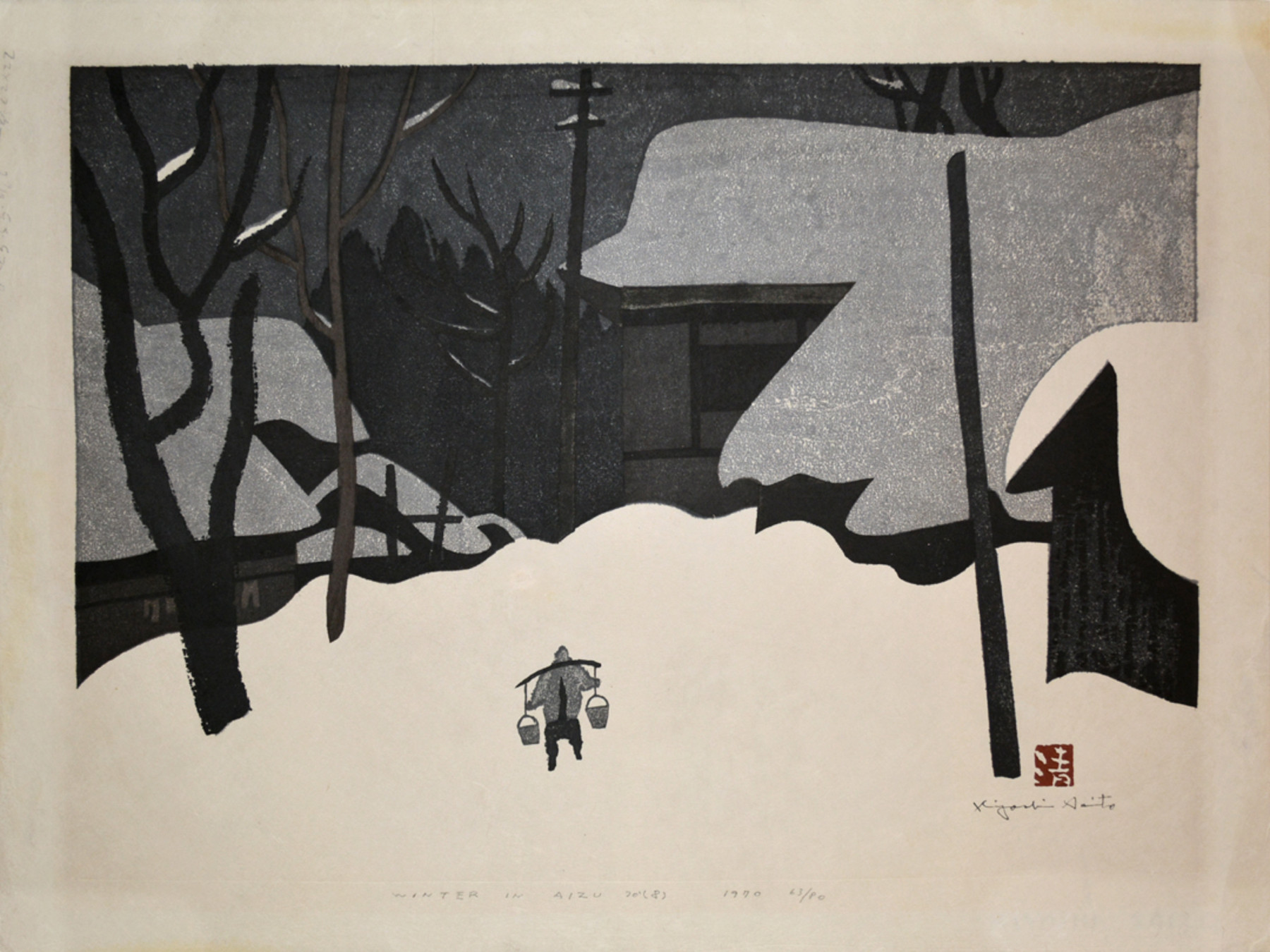
Kiyoshi Saito (1907 - 1997) was a very influential Japanese printmaker and his stunning winter snow prints from his Winter in Aizu '70 series are presented in a monochromatic color palette, recalling black and white photography, or simply the bleak grey light of winter.
Artist Hans Op de Beeck (previously here with his Staging Silence film series) paints figures at night against a fantastical, glowing sky. These works are all the more intriguing since they are executed solely in watercolor. His site explains:
As the title suggests, "The Night Walkers" is a series of black and white watercolours in which characters walk at night. We see the fictional figures in silhouette, en route under the starry sky to an unknown destination. Their attributes and their specific attire or special hairstyle refer to the carnival, the circus, the subcultural or the playing of music in the open air. The presence of animals in a number of works reinforces the fairy-tale character.
The series of films artist Hans Op de Beeck calls Staging Silence are miracles of illusion. Charming miniature scenes are built in real time as the viewer watches...I respond strongly to this idea and the imagery since I did this as a child. I studiously built houses and interiors and sets out of cardboard boxes and household objects standing in for furniture and furnishings. Each one of these films is hypnotizing in its pace and seamlessness. It is nearly a meditative experience. Enjoy.
Staging Silence
'Staging Silence' is based on abstract, archetypal settings that lingered in the memory of the artist as the common denominator of the many similar public places he has experienced. The presented video images are both ridiculous and serious, much like the eclectic mix of pictures in our minds. The decision to film in black and white emphasises this ambiguity: the amateurish quality of the video evokes the legacy of slapstick as well as the insidious suspense and latent derailment of the film noir. The title refers to the staging of such dormant decors onto which the spectator, in the absence of other figures, can project himself as the lone protagonist.
Remembered images are disproportionate mixtures of concrete information and fantasy, and in this film they materialise before the spectator's eyes by means of anonymous tinkering actions and improvising hands. Arms appear and disappear at random, manipulating banal objects, scale representations and artificial lighting to create alienating yet recognizable locations. These places are nothing more than animated decors for possible stories, evocative visual propositions, to be experienced by the spectator. The film is accompanied by a score inspired by the images, composed and performed by composer-musician Serge Lacroix.
Staging Silence (2)
The presence of the theatre is directly invoked in the work 'Staging Silence (2)'. Shown as a 'black box' video installation, the monochrome footage depicts a small stage on which scenarios involving everyday household objects, foodstuffs and constructions are played out to a soundtrack by the Ambient composer Scanner. Hands appear in the margins of the screen, in the manner of a shadow play or puppet-show, to roll out the landscape like a carpet; water is poured and becomes a shimmering sea, whose gentle waves are raised with long black sticks. An island is fashioned in its midst, made from half-peeled potatoes and a bonsai tree, whilst a boat is fastened to a pontoon. We can observe every gesture, and each subterfuge is revealed as the scenes unfold. The more the artist reveals his sleight-of-hand, his artifice, the further it chimes with our imagination, and the more we are willing to suspend our disbelief, the most fundamental aspect that defines narrative. It challenges our predilection for present-day spectacles boasting seamless special effects, in which artifice and reality are indistinguishable.
In the final sequence, a vast city emerges, built painstakingly from stacked cubes of sugar. Then, black rain falls, administered by watering cans, which coats the buildings in their entirety and causes them to saturate and slowly melt and crumble into ruins.
The artist is cast in the role of omnipotent world-maker, though we are always aware of the Lilliputian dimensions of his creations, bestowing an air of charm and modesty to his magic box theatre.
Staging Silence (3)
‘Staging Silence (3)’ is the third and final installment in a series of autonomous art films, all realised according to the same principles. In the three films, two pairs of anonymous hands construct and deconstruct fictional interiors and landscapes on a mini film set of just three square meters in size.
This film takes the viewer on a visual journey through depopulated, enigmatic and often melancholic, but nonetheless playful, small-scaled places, which are built up and taken down before the eye of the camera.
The two pairs of anonymous hands, like a double Deus ex Machina of sorts, decide on the life and death, growth and blossoming or decay of the places that are conjured up. The landscapes and interiors are teaming with cultural and subcultural references, including historical as well as current themes that refer to the way in which man - both in his dealings with architecture and with nature — 'humanises' the open space in an attempt to create meaning, identity and a logical interaction with time. For the first time in the series, this film also includes clear references to the life-size sculptures and immersive installations of Op de Beeck’s oeuvre.
The Philadelphia Story: How an 80-year-old comedy resonates
By Gregory Wakeman | BBC Culture
20th January 2021
The Philadelphia Story was released 80 years ago this month. Gregory Wakeman explores how the comedy deals with sensitive modern issues through the prism of quips, barbs – and sexual tension.
It didn't take long for the film world to fall in love with The Philadelphia Story. Soon after its New York City premiere on 26 December, 1940, the romantic comedy was met with superlative reviews that only multiplied once it was released across the rest of the US in January 1941.
Audiences quickly grew to adore it, too. It soon broke a box office record at the Radio City Music Hall in New York City and went on to become the fifth highest-grossing film of 1941. Its place in cinematic history was firmly secured just a month after its wide release, when Jimmy Stewart picked up his first and only best actor Academy Award statuette for his performance as reporter Macaulay "Mike" Connor.
He is just one of Katharine Hepburn's suitors in The Philadelphia Story. Her socialite character Tracy Lord is due to marry the wealthy George Kittredge (John Howard), nuptials that Stewart's Connor and Tracy's ex-husband CK Dexter Haven, played by Cary Grant, look to disrupt.
Stewart believed that he only won the prize for The Philadelphia Story because his performance in Mr Smith Goes to Washington lost out to Goodbye, Mr Chips' Robert Donat a year earlier. That argument loses weight, though, when you consider that Donald Ogden Stewart's deliciously charming script for The Philadelphia Story won best writing at the same ceremony, it was nominated for best picture, best director, best actress, and best supporting actress gongs, and Katharine Hepburn was given the 1940 New York Film Critics Circle award for her portrayal.
Over the subsequent decades, its reputation has only grown, too. By 1956, The Philadelphia Story had already been remade into the smash hit musical High Society, starring Bing Crosby, Frank Sinatra and Grace Kelly, in her final film role. In 2008 the American Film Institute named it the fifth best romantic comedy in Hollywood history, while it has proven to be so critic-proof that it still holds a 100% score on Rotten Tomatoes.
Eighty years after its release, The Philadelphia Story's grace, wit, and sheer romanticism doesn't just mean it stands out as one of the best films to emerge from the classic Hollywood era, but that it also might be the definitive romantic comedy, too. That's if it's even a romantic comedy in the first place.
As Dr Tamar Jeffers McDonald, the author of Romantic Comedy: Boy Meets Girl Meets Genre, explains, some people believe that The Philadelphia Story is a screwball comedy, rather than romantic comedy, as it uses various tropes of the sub-genre, including "warring lovers" and has some elements of overlapping dialogue. Even that's up for debate, though. By the start of 1941 the screwball genre was already in decline, as the tastes of audiences were changing thanks to World War Two. At the same time, The Philadelphia Story's dialogue is much less quickfire, and it has a sentimentality, sincerity – and, some might even say, sophistication – that sets it apart from other screwball films.
There’s another sub-genre that The Philadelphia Story has often been aligned with. The comedy of remarriage was an extension of the screwball comedy that became prominent throughout the 1930s and early 1940s as the Production Code banned any reference to sex out of marriage or adultery in movies. In order to get around this, filmmakers simply had their leading romantic characters divorce at the start of the film, then they could flirt and even kiss other characters, all without it being censored.
Theodora Gets Wild, His Girl Friday, and My Favorite Wife followed this structure, but no film did so with the subtlety of The Philadelphia Story, which genuinely leaves you wondering whether Lord is going to end up with Connor or Haven. Jeffers McDonald believes the "palatable" manner with which The Philadelphia Story explores themes like "identity, love as play or fight, divorce, adultery, and frustration" are why it has endured over the decades.
Patrick McGilligan, who wrote the biopic George Cukor: A Double Life about The Philadelphia Story's director, says it has had "a lasting impact as an adult exemplar of the genre", especially when compared to its peers from the same period.
"There is more realism in the acknowledgement of divorce and differences between a married couple. The audience is allowed to see that Hepburn and Grant both have faults. It's a 'happy ending,' but not really, because so much pain has gone before. In this day and age, it seems more adult, modern, sophisticated than most others of the era."
Of course, the entirety of The Philadelphia Story is "elevated by its classy cast", which just so happens to include arguably the most beguiling trio of actors in cinematic history. But while Stewart and Grant excel, it is Hepburn that pre-eminently shines throughout The Philadelphia Story.
Return to stardom
At this point it should be pointed out just how vital The Philadelphia Story was to Hepburn's career. By the end of 1938, Hepburn had been labelled "box office poison". Some of the Hepburn films to perform poorly during this period included Mary Of Scotland, A Woman Rebels, Quality Street, Stage Door, and, despite its legacy as a stone-cold classic now, even Bringing Up Baby. With her career in freefall, Hepburn, who by this point had already won her first best actress Academy Award for 1934's Morning Glory and been nominated in 1936 for Alice Adams, decided to buy herself out of her contract with RKO.
Hepburn retreated to the theatre. Her close friend, the playwright Philip Barry, already had the idea for a play and a character that he knew she’d be perfect for. Tracy Lord was inspired by the Philadelphia socialite Helen Hope Montgomery Scott, once labelled by Vanity Fair magazine "the unofficial queen of Philadelphia's WASP oligarchy". Barry had become close friends with her through Edgar Scott, the heir to the Pennsylvania Railroad fortune, his former classmate at Harvard and her husband.
Barry recognised similarities between Hepburn and Scott, whose exuberance was the stuff of legend even by the end of the 1930s. Not only were there rumours that she had been proposed to four times on the night she made her entrance as a debutante at the 1922 Philadelphia Assemblies Ball, but she also reportedly danced the foxtrot with the Duke Of Windsor at New York City’s legendary El Morocco nightclub, and the Charleston with Josephine Baker in Paris.
At the same time, Barry had become fascinated by speculation that wealthy families were being blackmailed by increasingly prominent and Machiavellian tabloid newspapers, so that salacious gossip about them would be kept secret. Premiering in March 1939, The Philadelphia Story play quickly became a smash hit on Broadway, where it grossed more than $1 million in sales before making another $750,000 when it toured nationally. Hepburn starred in and backed the play financially, giving up a salary and taking a cut of its profits instead.
So it was little surprise, then, that she saw it as the perfect piece of material to launch her back to Hollywood stardom. Hepburn even got a helping hand from Howard Hughes, her ex-lover, who helped her pay for the film rights so that she could have more creative control. Her deal with MGM for the film meant she could veto any potential producer, director, or co-star.
This decision proved to be a masterstroke. Hepburn's complex portrayal of Lord, who is as aggressive as she is vulnerable, nervous, charming, and hilarious, immediately made audiences more sympathetic to her. "When the film was released, most critics and audience members believed Tracy was a portrayal of the 'real' Hepburn," says Jeffers McDonald. "She had spent most of the 1930s being seen by the press, especially the movie fan magazines, as pretentious and awful."
"Playing a character like Tracy, who was similarly rich, privileged and annoying, Hepburn can be seen enacting a public apology for past bad behaviour. Having Tracy knocked off her pedestal by her dealings with men, becoming more humble and pliant, Hepburn could remake her own image and it is very noticeable that she started becoming popular with audiences after this."
In A Scott Berg's biography on the actress, Hepburn recalls not wanting to "make a grand entrance" in The Philadelphia Story for this very reason, explaining, "Moviegoers haven't seen me in over a year, and they already made it clear that they think I'm too la-di-da or something. A lot of people want to see me fall flat on my face." Thus, the opening scene of The Philadelphia Story, which sees Grant push Hepburn on to the floor, was born.
When it came to her co-stars, Hepburn dilly-dallied over whether Clark Gable and Spencer Tracy should play Dexter and Mike, before rightfully deciding on Grant and Stewart. George Cukor was always going to be one of her first choices as director, though. He was the one who "discovered her for Hollywood from the stage", says McGilligan, leading to Hepburn's first role in 1932's A Bill of Divorcement.
They remained close friends until his death in 1983, with Cukor directing Hepburn in eight films and two TV movies. "He had a feminine sympathy or consciousness, he deeply understood Hepburn on and off the screen, and was her most frequent director over time – because he was her favourite," says McGilligan. "He had the same deep communion with Barry and Stewart. What they all believed in was performance above cinematic tricks, humanity in characterisation, and the integrity of the play transferred to the screen."
With The Philadelphia Story, according to McGilligan, Cukor obtained a "humanity that would have not come from a lesser director". It also helped that he had previously paired Hepburn up with Grant in both 1938's Holiday, another adaptation of a Philip Barry play, and 1935's Sylvia Scarlett. Two more rom-coms that were deemed box-office flops, despite some impressive reviews.
The Philadelphia Story gave Cukor, Grant and Hepburn, with the help of Stewart, another chance to correct this trend. "There is a looseness, a naturalness to the comedic repartee," says McGilligan. "And the film becomes – as I think it must have been also on the stage – a kind of auto-critique of Hepburn's hauteur that she joins in while also taking stock of Grant's character in a way that is more critical than other screwball comedies. So Cukor also brings out the mistakes in their relationship, the bitterness in their characters, in a way that is more adult than other screwball comedies."
Cukor also allowed Hepburn's character to have sexual tension with both those played by Grant and Stewart. "It's a double love story," says McGilligan. "There is the one between Hepburn and Grant, which is over with but simmering beneath the surface, and the one between Hepburn and Stewart, which makes headway in the story." This meant that audiences didn't know who Hepburn's character would end up with. "The viewer is probably torn between who should get Hepburn, just as she is torn. As Cary Grant is probably Hollywood's all-time romantic icon – Stewart less so – he is the odds-on favourite. But his devious means of winning her back keeps the audience guessing until the surprise end."
This element of intrigue and surprise would be replicated over many other romantic comedies for decades to come. From Casablanca to Sabrina, as well as Broadcast News, Clueless, 500 Days Of Summer, To All the Boys I've Loved Before, and especially Nancy Meyers' It's Complicated and Something's Gotta Give.
But Cukor and The Philadelphia Story's influence doesn't stop there. He set the standards of "taste and intelligence," says McGilligan, who believes Cukor subverted the genre and its tropes, especially when it came to how male and female characters were depicted. "Cukor himself was gay. So what makes his films unique is that he is depicting his own ideas about romance and love through the prism of this genre, using strong women (like Hepburn) as his alter ego, and making the men (like Cary Grant) less absurdly masculine, in various ways." So while The Philadelphia Story's genre might be up for debate, what's for certain is that it was decades ahead of its time.
This beautiful, chilly stop motion short film, "Freeze Frame" is by Soetkin Verstegen. She says:
"Freeze frame: the most absurd technique since the invention of the moving image.
Through an elaborate process of duplicating the same image over and over again, it creates the illusion of stillness.
Identical figures perform the hopeless task of preserving blocks of ice. The repetitive movements reanimate the animals captured inside."
...the tense psychological thriller/supernatural horror film "The Lighthouse."
I must say I was a little apprehensive going in to this film. It was directed by Robert Eggers who directed the amazing horror film "The VVitch" (which I loved and reviewed here) but it was distributed by film company A24 who also released Ari Aster's film "Hereditary"--which was unsettling and puzzling--but also Aster's film "Midsommar," one of the most disturbing films, if not the most disturbing film I have ever seen in my entire life. And I was a film major, I have seen a s**t ton of films in my life, so for me to say that should carry some weight. I felt damaged and psychically attacked after witnessing "Midsommar," a film whose meaning, at a core level, expresses a type of mind boggling evil I think most humans never imagine and might not be able to fathom. So I wondered about "The Lighthouse" because it is billed as a horror film from the same company.
But I was actually engaged, pleasantly fascinated, and appropriately creeped out...and thankfully, Eggers' imagination does not feel the need to show an audience a world that is literally nauseating. Instead, he uses, much like his first film "The VVitch," mythology as a spring board to tell a story.
Essentially a two man play, a grizzled Willem Dafoe and a thoroughly gaunt Robert Pattinson play two men in the late 1890s who are dropped off on an island off the New England coast in order to tend to a lighthouse. They replaced the last two men, and their shift is supposed to last for a few weeks until a storm strands them on the island with the next ship unable to reach them. Dafoe, the senior of the pair, orders Pattinson around, making him do all of the menial chores while denying him the opportunity to tend to the actual light. The relationship between the men grows more complicated over time--more contentious, more intimate, more mistrustful, more friendly, even oddly sexual--while the isolation and storm tests their grips on reality itself. Pattinson begins having nightmares and visions while Dafoe seems to be jealously guarding the light and communing with mysterious sea creatures.
In fact, a creature plays an important part in this hallucinatory tale...Dafoe warns his helper never to kill a seagull because in seafaring lore, it is extremely bad luck. But every time he goes outside, Pattinson is continually harassed and attacked by a one-eyed seagull which he ends up killing. Bring on the bad luck. The presence of a kind of sentient, magical creature with supernatural powers is certainly reminiscent of the "The VVitch"'s Black William, a goat with evil connections.
But I think the most striking part of this story--and the most satisfying--is the idea that this is a modern retelling of the Prometheus myth. In ancient Greek mythology, the only beings who held the power of fire were the Olympian Gods but Prometheus, a Titan, stole fire from the Gods and gave it to Mankind in an act of charity. For his crime, Zeus, king of the Olympian Gods, punished Prometheus by chaining him to a rock; each day an eagle (symbol of Zeus) came to eat out his liver which grew back every night only for said eagle to return and feast again the next day. The light in the lighthouse is the obvious stand-in for fire itself, with Dafoe acting the role of Zeus and Pattinson as a wanna-be Prometheus. There are a few marvelous moments in the film that obliquely (and one moment not so obliquely) support this narrative.
All this is played out against an atmosphere that is claustrophobic and effectively fraught with tension and dread.
Recommend? Yes. Dafoe and Pattinson both give literally perfect performances. The black and white art direction is stunning, and the direction and editing are brilliant. Oh, as is the incredibly twisted and appropriate soundtrack.
Interior designer Erin Martin created a gorgeous home for an ex-Argentinian couple, now relocated to Beverly Hills. I love how she limited the color palette to black and white yet the end result looks rich and sumptuous (I wish my own interior design clients were not so fearful of saturated hues). The Latin American pieces look exquisite in black and the Mediterranean tile speaks to that California-style vernacular that exemplifies what design is all about here in my state.
"Oh, By The Way" is my digital scrap book of things I like, things I would share with a close friend and say: “Oh, by the way, do you know of this artist/ clothing or interior designer/ model/ singer/ actor/ gorgeous man… or, have you seen this video/ photo/ film... or heard (or do you remember) this song/ band... or, read this book/ poem/ inspiring quote... or, visited this place/ museum/ restaurant/ famous building... or, have you heard of this amazing new scientific discovery?”
I am dedicated to posting the positive, the fascinating, the beautiful, the interesting, the moving, and the inspiring and uplifting. Sometimes I post cultural as well as personal observations, milestones, and remembrances. And just like life, all of these things may often have a bit of melancholy or even sadness in them, which is what makes our time here so lovely and bittersweet and precious.
Some of the photos, art, poetry, and prose are my own original work, credited with my initials, JEF. When it isn't, I always try to post links to the original source material, but often I find photos on the web that are not linked or other material that is not sourced. In these instances, I post them without malice since it is assumed that such things, by being globally posted on something as uncontrollable as the internet to begin with, are in the public domain. If you identify the source of an image that is not linked, please politely let me know (without accusing me of theft, please) and I will be happy to provide a link. If you are the owner of an image and would prefer it be removed, I am happy to do that as well (again, without accusing me of theft, please).
I hope to inspire and entertain my readers with things that inspire and entertain me. There is a startling amount of beauty and creativity in the world and it enriches us all to participate in it.
All-time Favorite Films
2001: A Space Odyssey (Kubrick)
After Hours (Hysterical, hair-raising ride through NYC at night)
Amelie
American Beauty (Alan Ball)
Baraka (Stunning, transcending—the "spiritus mundi" on film)
Belle et Bete (Cocteau)
Big Sleep, The (The epitome of film noir)
Bringing Up Baby (Hepburn & Grant—the epitome of screwball comedy)
Cook, The Thief, His Wife, and Her Lover, The (Greenaway)
Crash (Cronenberg—DIFFICULT subject, not for everyone)
Don’t Look Now (Nicolas Roeg—ultimate modern gothic horror)
Drowning By Numbers (Greenaway)
Easy Rider
Edward II (Derek Jarman)
Erendira (From magic realist Marquez’ brilliant short story)
Eyes Wide Shut (Kubrick's last film)
Fearless (Jeff Bridges—life and death)
Funny Bones (Leslie Caron, Jerry Lewis, and the brilliant Lee Evans)
Holiday (Hepburn & Grant)
Howard’s End (The ultimate statement of the unfairness of class systems)
Hunger, The
Ice Storm, The
Inland Empire (David Lynch)
Interiors (Woody Allen's ode to Bergman)
Jetée, La (French short that inspired Gilliam's "12 Monkeys")
Jules et Jim (Truffaut)
Juliet of the Spirits (My favorite Fellini)
Kwaidan (4 Japanese ghost stories)
L’Age d’Or (Bunuel)
Last Temptation of Christ, The (Jesus was a shaman)
Latcho Drom (Beautiful visual documentary of Romany culture around the world)
Lion in Winter, The (Hepburn!—Like “Who’s Afraid of Virginia Woolf” but circa 1183)
Living End, The
Logan's Run
Lost Highway (David Lynch)
Magnolia
Maurice (Boy gets boy, they live happily ever after!!!!!)
Men Don’t Leave (Jessica Lange’s gorgeous delicate performance)
Mirror, The (achingly beautiful stream of consciousness Tarkovsky)
Nights of Cabiria, The (Fellini)
Orlando (Tilda Swinton’s pristine performance and Sally Potter’s ravishing visuals)
Orphée (HEAVEN! Cocteau was a genius)
Pennies From Heaven (Steve Martin/ stunning Edward Hopper sets!)
Philadelphia Story, The (Hepburn)
Pillow Book, The (Greenaway)
Planet of the Apes (1968...NOT 2001!)
Postman Always Rings Twice, The (Nicholson/Lange--WOW)
Prospero’s Books (Greenaway)
Rebel Without a Cause ("I got the bullets!")
Satyricon (Fellini)
Shining, The (Kubrick)
Solaris (atmospheric, haunting Andrei Tarkovsky sci-fi)
Stalker (chilling Andrei Tarkovsky sci-fi)
Thin Red Line, The (Terrence Malick--existential poetry cleverly disguised as a war film)
Titus (Julie Taymor does Shakespeare)
Tommy (Brilliant, audacious Ken Russell film of The Who's rock opera)
Tree Of Life, The (Terrence Malick masterpiece)
Un Chien Andalou (Bunuel and Dali, need more be said?)
Wall,The (Pink Floyd)
Wings of Desire (All the feelings of the entire human race in one film)
Woman of the Year (Dated yet charming Hepburn vehicle)
Zabriskie Point (Empty, open, classic early 70s)
ZOO, A Zed and Two Noughts (Greenaway)
The Sounds My Soul Makes: Music
Annie Lennox
Brian Eno
Cocteau Twins
David Bowie
David Sylvian
Dead Can Dance
Durutti Column
Elbow
Everything But the Girl
Gang of Four
Gem Club
Goldfrapp
Joni Mitchell
José González
Junip
Kate Bush
Laurie Anderson
M83
Morrissey
Nine Inch Nails
Peter Gabriel
Peter Murphy
Rickie Lee Jones
Sigur Ros
Simple Minds
Smiths, The
Sufjan Stevens
Talk Talk
Tears For Fears
This Mortal Coil
Tori Amos
Ultravox
William Orbit
Zero 7
Important Books That Have Influenced Me
100 Years of Solitude—Gabriel Garcia Marquez
A Wrinkle in Time, A Wind in the Doorway (for young people but worth it)—Madeleine L’Engle