
It is always a glorious day when I discover there is a new Wes Anderson (previously here) film on the way! "Asteroid City" looks as charming as his previous films--and it appears that he is using his established repertory of players along with some great new faces like Bryan Cranston, Maya Hawke, Steve Carell, Margot Robbie, and Jarvis Cocker. The trailer below features classic Anderson framing and his lovely, washed-out-old-Kodak-snapshot color palette.
Focus Features says:
"ASTEROID CITY takes place in a fictional American desert town circa 1955. Synopsis: The itinerary of a Junior Stargazer/Space Cadet convention (organized to bring together students and parents from across the country for fellowship and scholarly competition) is spectacularly disrupted by world-changing events.
ASTEROID CITY is only in theaters June 16th."
I can't wait!
https://www.focusfeatures.com/asteroid-city
Showing posts with label feature film. Show all posts
Showing posts with label feature film. Show all posts
Thursday, March 30, 2023

Wednesday, August 19, 2020
"2020: An Isolation Odyssey"
Brooklyn filmmaker, artist, and designer Lydia Cambron has created a wonderfully filmic, shot-for-shot remake of the last section of Kubrick's iconic film "2001: A Space Odyssey." She explains:
"2020: an isolation odyssey is a reenactment of the iconic finale of 2001: A Space Odyssey (Stanley Kubrick, 1968). Restaged in the context of home quarantine, the journey through time adapts to the mundane dramas of self-isolation–poking fun at the navel-gazing saga of life alone and indoors.
This project began in late March and was completed in late May, spanning the height of the pandemic in New York City. Staged in a one bedroom Brooklyn apartment, 2020 presents an obvious similarity to the domestic setting of 2001. The stacked videos and synced movements also reveal parallels in emotion. The narrowness of daily life in a single space, transitioning from confusion to acceptance, a distorted sense of time, and ‘returning’ after a transformational event–all experiences analogous to quarantine.
The adapted version delineates the passing of time through wardrobe rather than age, identifying each phase of the character’s journey with a product of self care or PPE. Tools of private entertainment or self betterment are also used as props, questioning our confidence in products and productivity as anchors during times of uncertainty. Multitasking while #wfh, conjuring guilt or longing with unused exercise equipment, your entire being reduced to a measure of time–these scenes all illustrate the absurd comedy of trying to maintain control during this unprecedented and unpredictable time."
Do stick around for the hilarious credits at the end!
http://lydiacambron.com/
"2020: an isolation odyssey is a reenactment of the iconic finale of 2001: A Space Odyssey (Stanley Kubrick, 1968). Restaged in the context of home quarantine, the journey through time adapts to the mundane dramas of self-isolation–poking fun at the navel-gazing saga of life alone and indoors.
This project began in late March and was completed in late May, spanning the height of the pandemic in New York City. Staged in a one bedroom Brooklyn apartment, 2020 presents an obvious similarity to the domestic setting of 2001. The stacked videos and synced movements also reveal parallels in emotion. The narrowness of daily life in a single space, transitioning from confusion to acceptance, a distorted sense of time, and ‘returning’ after a transformational event–all experiences analogous to quarantine.
The adapted version delineates the passing of time through wardrobe rather than age, identifying each phase of the character’s journey with a product of self care or PPE. Tools of private entertainment or self betterment are also used as props, questioning our confidence in products and productivity as anchors during times of uncertainty. Multitasking while #wfh, conjuring guilt or longing with unused exercise equipment, your entire being reduced to a measure of time–these scenes all illustrate the absurd comedy of trying to maintain control during this unprecedented and unpredictable time."
Do stick around for the hilarious credits at the end!
http://lydiacambron.com/
Tuesday, March 10, 2020
Just watched...
...the tense psychological thriller/supernatural horror film "The Lighthouse."

I must say I was a little apprehensive going in to this film. It was directed by Robert Eggers who directed the amazing horror film "The VVitch" (which I loved and reviewed here) but it was distributed by film company A24 who also released Ari Aster's film "Hereditary"--which was unsettling and puzzling--but also Aster's film "Midsommar," one of the most disturbing films, if not the most disturbing film I have ever seen in my entire life. And I was a film major, I have seen a s**t ton of films in my life, so for me to say that should carry some weight. I felt damaged and psychically attacked after witnessing "Midsommar," a film whose meaning, at a core level, expresses a type of mind boggling evil I think most humans never imagine and might not be able to fathom. So I wondered about "The Lighthouse" because it is billed as a horror film from the same company.
But I was actually engaged, pleasantly fascinated, and appropriately creeped out...and thankfully, Eggers' imagination does not feel the need to show an audience a world that is literally nauseating. Instead, he uses, much like his first film "The VVitch," mythology as a spring board to tell a story.
Essentially a two man play, a grizzled Willem Dafoe and a thoroughly gaunt Robert Pattinson play two men in the late 1890s who are dropped off on an island off the New England coast in order to tend to a lighthouse. They replaced the last two men, and their shift is supposed to last for a few weeks until a storm strands them on the island with the next ship unable to reach them. Dafoe, the senior of the pair, orders Pattinson around, making him do all of the menial chores while denying him the opportunity to tend to the actual light. The relationship between the men grows more complicated over time--more contentious, more intimate, more mistrustful, more friendly, even oddly sexual--while the isolation and storm tests their grips on reality itself. Pattinson begins having nightmares and visions while Dafoe seems to be jealously guarding the light and communing with mysterious sea creatures.
In fact, a creature plays an important part in this hallucinatory tale...Dafoe warns his helper never to kill a seagull because in seafaring lore, it is extremely bad luck. But every time he goes outside, Pattinson is continually harassed and attacked by a one-eyed seagull which he ends up killing. Bring on the bad luck. The presence of a kind of sentient, magical creature with supernatural powers is certainly reminiscent of the "The VVitch"'s Black William, a goat with evil connections.
But I think the most striking part of this story--and the most satisfying--is the idea that this is a modern retelling of the Prometheus myth. In ancient Greek mythology, the only beings who held the power of fire were the Olympian Gods but Prometheus, a Titan, stole fire from the Gods and gave it to Mankind in an act of charity. For his crime, Zeus, king of the Olympian Gods, punished Prometheus by chaining him to a rock; each day an eagle (symbol of Zeus) came to eat out his liver which grew back every night only for said eagle to return and feast again the next day. The light in the lighthouse is the obvious stand-in for fire itself, with Dafoe acting the role of Zeus and Pattinson as a wanna-be Prometheus. There are a few marvelous moments in the film that obliquely (and one moment not so obliquely) support this narrative.
All this is played out against an atmosphere that is claustrophobic and effectively fraught with tension and dread.


Recommend? Yes. Dafoe and Pattinson both give literally perfect performances. The black and white art direction is stunning, and the direction and editing are brilliant. Oh, as is the incredibly twisted and appropriate soundtrack.
https://a24films.com/films/the-lighthouse

I must say I was a little apprehensive going in to this film. It was directed by Robert Eggers who directed the amazing horror film "The VVitch" (which I loved and reviewed here) but it was distributed by film company A24 who also released Ari Aster's film "Hereditary"--which was unsettling and puzzling--but also Aster's film "Midsommar," one of the most disturbing films, if not the most disturbing film I have ever seen in my entire life. And I was a film major, I have seen a s**t ton of films in my life, so for me to say that should carry some weight. I felt damaged and psychically attacked after witnessing "Midsommar," a film whose meaning, at a core level, expresses a type of mind boggling evil I think most humans never imagine and might not be able to fathom. So I wondered about "The Lighthouse" because it is billed as a horror film from the same company.
But I was actually engaged, pleasantly fascinated, and appropriately creeped out...and thankfully, Eggers' imagination does not feel the need to show an audience a world that is literally nauseating. Instead, he uses, much like his first film "The VVitch," mythology as a spring board to tell a story.
Essentially a two man play, a grizzled Willem Dafoe and a thoroughly gaunt Robert Pattinson play two men in the late 1890s who are dropped off on an island off the New England coast in order to tend to a lighthouse. They replaced the last two men, and their shift is supposed to last for a few weeks until a storm strands them on the island with the next ship unable to reach them. Dafoe, the senior of the pair, orders Pattinson around, making him do all of the menial chores while denying him the opportunity to tend to the actual light. The relationship between the men grows more complicated over time--more contentious, more intimate, more mistrustful, more friendly, even oddly sexual--while the isolation and storm tests their grips on reality itself. Pattinson begins having nightmares and visions while Dafoe seems to be jealously guarding the light and communing with mysterious sea creatures.
In fact, a creature plays an important part in this hallucinatory tale...Dafoe warns his helper never to kill a seagull because in seafaring lore, it is extremely bad luck. But every time he goes outside, Pattinson is continually harassed and attacked by a one-eyed seagull which he ends up killing. Bring on the bad luck. The presence of a kind of sentient, magical creature with supernatural powers is certainly reminiscent of the "The VVitch"'s Black William, a goat with evil connections.
But I think the most striking part of this story--and the most satisfying--is the idea that this is a modern retelling of the Prometheus myth. In ancient Greek mythology, the only beings who held the power of fire were the Olympian Gods but Prometheus, a Titan, stole fire from the Gods and gave it to Mankind in an act of charity. For his crime, Zeus, king of the Olympian Gods, punished Prometheus by chaining him to a rock; each day an eagle (symbol of Zeus) came to eat out his liver which grew back every night only for said eagle to return and feast again the next day. The light in the lighthouse is the obvious stand-in for fire itself, with Dafoe acting the role of Zeus and Pattinson as a wanna-be Prometheus. There are a few marvelous moments in the film that obliquely (and one moment not so obliquely) support this narrative.
All this is played out against an atmosphere that is claustrophobic and effectively fraught with tension and dread.


Recommend? Yes. Dafoe and Pattinson both give literally perfect performances. The black and white art direction is stunning, and the direction and editing are brilliant. Oh, as is the incredibly twisted and appropriate soundtrack.
https://a24films.com/films/the-lighthouse
Monday, February 17, 2020
"The French Dispatch of the Liberty, Kansas Evening Sun"--A New Film by Wes Anderson!
It is always a glorious day when I discover there is a new Wes Anderson film on the way! This trailer looks charming as usual--I love Anderson's color palette, and it appears that he is using his established repertory of players along with some great new faces like Elizabeth Moss, Geoffrey Wright, Timothée Chalamet, and Henry Winkler (!). I just can't wait for the release date of July 24, 2020...but I suppose I will have to.

https://www.searchlightpictures.com/thefrenchdispatch/

https://www.searchlightpictures.com/thefrenchdispatch/
Sunday, December 29, 2019
Just watched...
...Terrence Malick's newest masterpiece "A Hidden Life."

Just before the holiday, I had the privilege of seeing "A Hidden Life," Terrence Malick's tenth feature film. Regular readers know I am a huge Malick fan, as evidenced by the presence of several of his films in my All-Time Favorite Films list to the right.
The first thing one notices with this most recent film is his return to a more structured story. I believe his last three projects, "To The Wonder," "Knight of Cups," and "Song To Song" are a trilogy about being lost in a life without meaning in the 21st century. We were witness to a kind of confusion, ennui, and an inability to commit oneself to anything or anyone, including oneself. Malick's approach to this subject matter was even more loose, Impressionistic, and improvisational than he has been in the past and the results were criticized for lacking a clear plot. I have a high tolerance for soft narratives and while it is true that the films show a lot of characters simply wandering around certain locations either staring at each other or off in the distance, I felt the films were a perfect product of what Malick was trying to say and portray.
But with "A Hidden Life," Malick told an audience at a rare Q&A in 2016 that he has "repented and gone back to working with a much tighter script" but went on to qualify that with the idea that "it actually makes it easier to improvise when you have rails underneath you."
Based on the life story of Franz Jägerstätter (played with great presence by August Diehl), much of the action takes place in the little Austrian village of St. Radegund where Jägerstätter and his wife (masterfully played by Valerie Pachner), like most villagers, tend a farm. Theirs is a simple way of life. Of course Malick is a master of the landscape shot (swoon over most every scene in "The New World" and cry with nostalgia at the lovely hometown shots in "Tree of Life") and there are absolutely breathtaking images of Austrian peaks and high-altitude meadows, but what struck me immediately was the backbreaking, merciless, unending work daily life must have been for these people. Seeing them use little hand held scythes to cut down grass as my attention pulled out to reveal an entire mountainside made me ache just watching it.
But this is 1939 and the Nazis have conscripted him to serve in the military. Yet even though they are isolated in a mountain village in Austria, he and his family know exactly what is going on in Germany and the rest of the world, and he knows that what the Reich is, is wrong. He refuses to swear an oath to Hitler and he is taken into custody for a trial. Jailed and beaten, the Nazis eventually kill him. And all the while his jailers, the village mayor, the clergy tell him to simply take the oath and swear loyalty to Hitler because there is no harm in it, he can say the words and not mean them. But Jägerstätter understands the existential dilemma as well as the very real danger of trying to walk such a line. There were thousands who did just that and while they may have saved their lives and the lives of their families, they enabled millions of people to lose theirs. And they have to--or had to--live with that knowledge, that they enabled absolute evil. Principles, morality, and ethics are not concepts that can be chosen or followed only when convenient. But having said that, I am not sure what I myself would have done. Perhaps I would have sworn the oath and then worked with the Resistance. His is a bravery I am not sure I--or many of us--possess.
In fact, the film's title refers to something else Jägerstätter was told, over and over: that one person, one single act, a hidden life out of the view of the world, cannot make a difference. But this film and the story of the real life Jägerstätter proves that it can. (The story of Jägerstätter's life did not come to the attention of the general public until the 1960s...and in 2007, he was declared a martyr and beatified by the Catholic Church. The same church that actually aided and conspired with the Nazis...I'm just saying. Read about his life here.)
Even though there is a tighter script, and a clear narrative with a beginning and end, this is still a beautiful, glorious Malick film with all that entails. The heart and mind are still given equal, albeit dream-like, screen time. The aforementioned concepts of principles, morality, and ethics along with philosophical and spiritual ideas are held aloft in the stunningly beautiful and pristine Austrian mountains. Like I said, Malick really knows how to choose and lens phenomenal landscapes. And even when he is shooting interior scenes, he still composes and shoots them (with wide angle lenses) like landscapes. Look at the scenes in the Bishop's office and the church in "A Hidden Life" and marvel at how a desk and stacks of books can look like the mountain landscape outside. It is a gorgeous and subtle motif.


Recommend? Yes. Beautiful for the eyes but also for the heart and mind. And it is no accident that a film portraying a man refusing to swear loyalty to a sick, egomaniacal Fascist was made and released in this current political climate.
http://www.foxsearchlight.com/ahiddenlife/

Just before the holiday, I had the privilege of seeing "A Hidden Life," Terrence Malick's tenth feature film. Regular readers know I am a huge Malick fan, as evidenced by the presence of several of his films in my All-Time Favorite Films list to the right.
The first thing one notices with this most recent film is his return to a more structured story. I believe his last three projects, "To The Wonder," "Knight of Cups," and "Song To Song" are a trilogy about being lost in a life without meaning in the 21st century. We were witness to a kind of confusion, ennui, and an inability to commit oneself to anything or anyone, including oneself. Malick's approach to this subject matter was even more loose, Impressionistic, and improvisational than he has been in the past and the results were criticized for lacking a clear plot. I have a high tolerance for soft narratives and while it is true that the films show a lot of characters simply wandering around certain locations either staring at each other or off in the distance, I felt the films were a perfect product of what Malick was trying to say and portray.
But with "A Hidden Life," Malick told an audience at a rare Q&A in 2016 that he has "repented and gone back to working with a much tighter script" but went on to qualify that with the idea that "it actually makes it easier to improvise when you have rails underneath you."
Based on the life story of Franz Jägerstätter (played with great presence by August Diehl), much of the action takes place in the little Austrian village of St. Radegund where Jägerstätter and his wife (masterfully played by Valerie Pachner), like most villagers, tend a farm. Theirs is a simple way of life. Of course Malick is a master of the landscape shot (swoon over most every scene in "The New World" and cry with nostalgia at the lovely hometown shots in "Tree of Life") and there are absolutely breathtaking images of Austrian peaks and high-altitude meadows, but what struck me immediately was the backbreaking, merciless, unending work daily life must have been for these people. Seeing them use little hand held scythes to cut down grass as my attention pulled out to reveal an entire mountainside made me ache just watching it.
But this is 1939 and the Nazis have conscripted him to serve in the military. Yet even though they are isolated in a mountain village in Austria, he and his family know exactly what is going on in Germany and the rest of the world, and he knows that what the Reich is, is wrong. He refuses to swear an oath to Hitler and he is taken into custody for a trial. Jailed and beaten, the Nazis eventually kill him. And all the while his jailers, the village mayor, the clergy tell him to simply take the oath and swear loyalty to Hitler because there is no harm in it, he can say the words and not mean them. But Jägerstätter understands the existential dilemma as well as the very real danger of trying to walk such a line. There were thousands who did just that and while they may have saved their lives and the lives of their families, they enabled millions of people to lose theirs. And they have to--or had to--live with that knowledge, that they enabled absolute evil. Principles, morality, and ethics are not concepts that can be chosen or followed only when convenient. But having said that, I am not sure what I myself would have done. Perhaps I would have sworn the oath and then worked with the Resistance. His is a bravery I am not sure I--or many of us--possess.
In fact, the film's title refers to something else Jägerstätter was told, over and over: that one person, one single act, a hidden life out of the view of the world, cannot make a difference. But this film and the story of the real life Jägerstätter proves that it can. (The story of Jägerstätter's life did not come to the attention of the general public until the 1960s...and in 2007, he was declared a martyr and beatified by the Catholic Church. The same church that actually aided and conspired with the Nazis...I'm just saying. Read about his life here.)
Even though there is a tighter script, and a clear narrative with a beginning and end, this is still a beautiful, glorious Malick film with all that entails. The heart and mind are still given equal, albeit dream-like, screen time. The aforementioned concepts of principles, morality, and ethics along with philosophical and spiritual ideas are held aloft in the stunningly beautiful and pristine Austrian mountains. Like I said, Malick really knows how to choose and lens phenomenal landscapes. And even when he is shooting interior scenes, he still composes and shoots them (with wide angle lenses) like landscapes. Look at the scenes in the Bishop's office and the church in "A Hidden Life" and marvel at how a desk and stacks of books can look like the mountain landscape outside. It is a gorgeous and subtle motif.


Recommend? Yes. Beautiful for the eyes but also for the heart and mind. And it is no accident that a film portraying a man refusing to swear loyalty to a sick, egomaniacal Fascist was made and released in this current political climate.
http://www.foxsearchlight.com/ahiddenlife/
Friday, May 11, 2018
"McQueen"
In theatres this June 8th, 2018: a documentary about Alexander McQueen! I can't wait!

Mirroring the savage beauty, maverick originality and vivacity of his design, “McQueen” is an intimate revelation of Alexander [Lee] McQueen’s own personal and professional world, both tortured and inspired. It is a film which celebrates a radical and mesmerising genius of profound influence and shows his rags-to-riches story as a modern-day fairy tale laced with the gothic.
As a self-described “unremarkable” working-class boy from East London, he harnessed his demons and went on to become a global one-man fashion brand and one of the most iconic artists of the century. He was a punk rebel, celebrated for overturning the silver-spoon world of Paris haute couture and ushering in the heady, revolutionary era of ‘Cool Britannia,’ as well as provoking and subverting the fashion industry in ways that often caused controversy and scandal.
Portraying his life from his debut collection through to the tragedy of his premature death, “McQueen” is a film that evokes Lee McQueen’s unique vision, originality and maverick sense of humour. The transformative impact of his personality and his work is captured in never-before-seen home movies, audio tapes and “behind-the-scenes” footage shot throughout his career. This material is stitched together with deeply personal interviews from close family, friends and collaborators and cinematic original material that takes us on a journey into McQueen’s mind. His fears, dreams, obsessions, desires and nightmares are on screen for the audience to re-live along with the most memorable and iconic moments in his shows - like nothing the fashion world has ever seen before, or since. The film allows us to search deeply into what made the man a unique artist of his times, as well as helping us to understand the mystery of why, at the height of his acclaim and power, he shockingly made the decision to end to it all.
A FILM BY
Ian Bonhôte And Peter Ettedgui
WRITTEN AND
CO-DIRECTED BY
Peter Ettedgui
DIRECTED AND
PRODUCED BY
Ian Bonhôte
PRODUCED BY
Andee Ryder, Nick Taussig And Paul Van Carter
MUSIC BY
Michael Nyman

https://www.mcqueenfilm.co.uk/
Mirroring the savage beauty, maverick originality and vivacity of his design, “McQueen” is an intimate revelation of Alexander [Lee] McQueen’s own personal and professional world, both tortured and inspired. It is a film which celebrates a radical and mesmerising genius of profound influence and shows his rags-to-riches story as a modern-day fairy tale laced with the gothic.
As a self-described “unremarkable” working-class boy from East London, he harnessed his demons and went on to become a global one-man fashion brand and one of the most iconic artists of the century. He was a punk rebel, celebrated for overturning the silver-spoon world of Paris haute couture and ushering in the heady, revolutionary era of ‘Cool Britannia,’ as well as provoking and subverting the fashion industry in ways that often caused controversy and scandal.
Portraying his life from his debut collection through to the tragedy of his premature death, “McQueen” is a film that evokes Lee McQueen’s unique vision, originality and maverick sense of humour. The transformative impact of his personality and his work is captured in never-before-seen home movies, audio tapes and “behind-the-scenes” footage shot throughout his career. This material is stitched together with deeply personal interviews from close family, friends and collaborators and cinematic original material that takes us on a journey into McQueen’s mind. His fears, dreams, obsessions, desires and nightmares are on screen for the audience to re-live along with the most memorable and iconic moments in his shows - like nothing the fashion world has ever seen before, or since. The film allows us to search deeply into what made the man a unique artist of his times, as well as helping us to understand the mystery of why, at the height of his acclaim and power, he shockingly made the decision to end to it all.
A FILM BY
Ian Bonhôte And Peter Ettedgui
WRITTEN AND
CO-DIRECTED BY
Peter Ettedgui
DIRECTED AND
PRODUCED BY
Ian Bonhôte
PRODUCED BY
Andee Ryder, Nick Taussig And Paul Van Carter
MUSIC BY
Michael Nyman
https://www.mcqueenfilm.co.uk/
Saturday, January 6, 2018
Just watched...
..."Call Me By Your Name."

Because I am a Screen Actors Guild-AFTRA member, this is the time of year where my union sends out "for-your-consideration" screener copies of films that are nominated for a SAG Award so us members can vote in the award ceremony. And I was thrilled when this 2017 film showed up in my mailbox since I had been meaning to see it in theatres (trying to find time to attend the cinema with my life schedule can be challenging).
Directed by Luca Guadagnino (who directed the sensuous "I Am Love" with Tilda Swinton, previously here) and starring Timothée Chalamet and Armie Hammer, this miracle of a film based on the novel by André Aciman of the same name got under my skin and hit me hard. If I write about a film for "Oh, By The Way," I try not to reveal too much about the film since I believe my readers should experience a film the way the filmmaker intended it to be seen, to unfold as a dream. But I find I cannot write meaningfully about this film without speaking about the plot itself. So please be warned, there are complete major spoilers ahead. If you have not yet seen the film, please wait until you have done so, not only so you can absorb the plot freely, but because what I am about to write will not make sense otherwise.


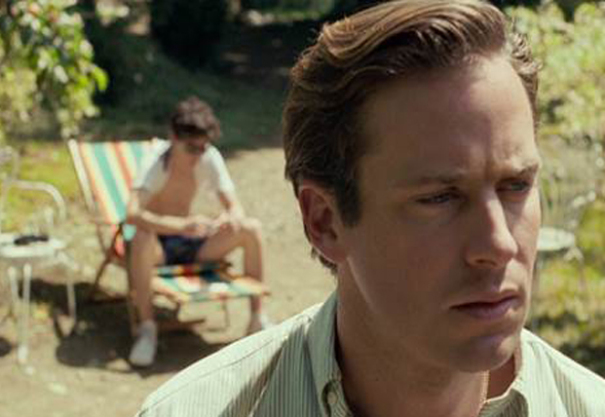


In the summer of 1983, seventeen year-old Elio holidays with his family in their inherited villa in northern Italy. He is, for seventeen, extremely bright: staggeringly well-read, able to speak three languages fluently, and adept at classical music on multiple instruments. He comes by such intellect and talent naturally as his mother speaks four languages fluently and his father is an archaeologist whose specialty is ancient Greco-Roman sculpture. As part of his father's work, the family invite an American graduate student every summer for six weeks for an internship, to help the father with research and cataloging artifacts. So when handsome Oliver arrives for the internship, Elio is swept away by an attraction that one can only assume by his age is something new to him.
And the pair begin a delicate relationship...
Publicity for this film has made much of the universality of this story, that it is not specifically a gay love story but a story of first love anyone can relate to. While that may be true for some, as a gay man who was nineteen years old in 1983, I can tell you that this film is definitely a gay love story, and because of that, and because of parameters that accompany gay life--or that used to--this is also about a very specific kind of pain only known to our community. For years and years, gay men have looked for themselves to be represented and mirrored in books, films, art. I myself have grasped at gay support or bit characters, desperately searching for validation, for visibility...and been disappointed with the sub-par genre of gay films that existed in the 90s and 00s. But things change and this is the first film I can recall that thoroughly does the job: it absolutely, completely feels like a real mainstream film where gay characters and events in their lives are central to the film. And the best part is it does not feel like a "gay" film.
I have not read the source novel for the film, so I can only respond to what was presented to me in the film. I will say that I was a bit surprised at how slowly their relationship develops (they initially display a reluctance toward each other in order to hide attraction) which only serves to heighten the suddenness of their eventual coupling and how short it is. The languid pace of their affair is echoed by a lovely languid pace of storytelling in the film thanks not only to director Guadagnino but to screenwriter James Ivory of Merchant and Ivory fame. The languidness works on other levels as well, echoing the languid pace of rural life in northern Italy. The photography and production design are lovely as well, and are so because they are achieved in a subtle way (it may be 1983 in the film but there were no caricatures or ham-fisted exaggerated cultural references), exactly the way the story unfolds, and exactly the way Hammer and Chalamet play their roles. This understated quality reinforces the verisimilitude of every aspect of the film and story.
When Elio and Oliver do finally connect and act on their passions, we are presented with some very frank ideas of gay sexuality without nudity or actual sex scenes which is rather refreshing. After all, the core of the film is emotional and not physical. But I appreciated the frankness nonetheless as such things are certainly a part of the gay community (Hammer confessed that he needed director Luca Guadagnino to explain them to him!). The beauty of Elio and Oliver together is breathtaking in its natural simplicity, and both actors are utterly committed to that portrayal and to each other. There has also been some external controversy about the age difference between the characters in the story: while Elio is seventeen, Oliver is twenty-three (although to be fair, Hammer does look older). On the press junket for the film, Hammer defended the age gap by saying that the age of consent in Italy now as well as in 1983 is fourteen. But that is a technical answer to a question that deserves to be explored in depth. For this story in particular, Elio is the one who makes the first move. He is not--not--a victim of a predator or pedophile. It is difficult for some heterosexual people to wrap their heads around that. Which leads me to a deeper level: we need to admit that not all seventeen year-olds are created equally. There are some seventeen year-old young men who do not have the capacity to conduct themselves in such a situation. But again, for this story, Elio certainly possesses the capacity--he is not only intelligent but bright (two very different things). What he does not have is experience... experience to keep him from being emotionally hurt. That is an entirely different matter. Experience can be wisdom.
And as I said, since their relationship was a long time coming and their time together so short, the time they had together was even more special. I remember being seventeen and having experiences like this that are so formative, so steeping, so shattering, the way young love can be. I've been living with the film in my head for about 24 hours now and it is haunting me...or perhaps I should say it pains me. Because the languid, romantic spell is broken after the couple must reluctantly part. The two have left the villa on their own to spend a week in a mountainous resort region. They spend their remaining precious time hiking, being physically intimate, and simply being in each other's presence. But their last goodbye is at a train station, in public, and for us gay men who grew up in a certain age, we can relate to having to stifle feelings and yearnings for the comfort and convenience of those around us not to mention our own physical safety (rest in peace all the men--and it is a long list--who have been attacked and murdered--yes, murdered--because they dared to show affection at the wrong time in the wrong place). After this life-and-mind-and-heart-transforming relationship, they are only allowed a brief hug on the platform...a sickening crime visited on these two innocent souls. I support the universal, first-love interpretation of the story until this point in the film. Because here is where I begin to take it really personally and where my true, inner pain begins. And perhaps this is where I identify with Elio until the end of the film. He calls his mother from the train station to come and get him. She drives him back to the villa while he cries in the front seat. At home, his father graces him, in a stunningly tender and devastating monologue, with the knowledge that he knew all along what was going on between the couple. His father also graces him with his love, and more importantly, his blessing. And finally, his father shares the fact that he is envious because there were situations in his own young life where he wanted to, came close to, but never quite got the chance to have such a deep, honest connection with another man.
You see, if the film stopped here, it would be one thing. Our heroes could be substituted with hero and heroine. They loved but were parted, and they can't be together. It's a universal love story. The end. But it is not the end. The next winter, Oliver calls the family (he has clearly kept in touch) and he tells Elio the news that he is getting married. This is heartbreaking to Elio, and to us...and to me. This news, while upsetting to our parallel heroine, is gutting to Elio since it negates what happened between them. Being gay brings a special viewpoint, that of an outsider. If Oliver had found another man to be with (not marry since no one could have predicted such seismic shifts in culture would happen in our lifetime), it would not have been as bad. But Oliver negated not only Elio but what they had, what they shared, what they did, and who Elio is. I know the director has expressed a different opinion, but my interpretation of the final events of the film (where Elio confronts a girl he had sex with and they decide to only be friends) suggests to me that Elio is and will identify as a gay man. He is young enough and smart enough and confident enough to grow up and be himself, and the ensuing decades will be easier on him than they were on Oliver. But he must get over this initial collapse of first love...and the attempted assassination of his entire being. After he hears this news and hangs up, he goes to sit by the fire in the villa's dining room and cries the tears only a seventeen year-old can cry about losing a love. I do not mean that in a trivial way. I mean that at this point, he is untouched by experience, any possible cynicism, or any world-weariness that comes from facing heartbreak and disappointment again and again in one's adult life. His tears are primal. And we watch him cry, in an agonizing, relentless, near-five minute close-up (cosmic kudos to Timothée Chalamet for such raw, visceral talent) while the credits roll and the glorious, precious, sublimely sorrowful song "Visions of Gideon" by Sufjan Stevens plays ("I have loved you for the last time/I have kissed you for the last time").
It is that final layer that pains me. That someone you loved can not only reject you, but who and what you are, an entire state of being. That is the pain that we as gay men have experienced time and time again, not for any innate reasons, but, as I said, for the comfort and convenience of others. If it were a welcoming, understanding world, and Oliver were allowed to continue a relationship with Elio (22 and 29 doesn't seem like such an age gap) without fear of rejection from family and friends and the society he lives in, what would the end of this film have looked like?
http://sonyclassics.com/callmebyyourname/

Because I am a Screen Actors Guild-AFTRA member, this is the time of year where my union sends out "for-your-consideration" screener copies of films that are nominated for a SAG Award so us members can vote in the award ceremony. And I was thrilled when this 2017 film showed up in my mailbox since I had been meaning to see it in theatres (trying to find time to attend the cinema with my life schedule can be challenging).
Directed by Luca Guadagnino (who directed the sensuous "I Am Love" with Tilda Swinton, previously here) and starring Timothée Chalamet and Armie Hammer, this miracle of a film based on the novel by André Aciman of the same name got under my skin and hit me hard. If I write about a film for "Oh, By The Way," I try not to reveal too much about the film since I believe my readers should experience a film the way the filmmaker intended it to be seen, to unfold as a dream. But I find I cannot write meaningfully about this film without speaking about the plot itself. So please be warned, there are complete major spoilers ahead. If you have not yet seen the film, please wait until you have done so, not only so you can absorb the plot freely, but because what I am about to write will not make sense otherwise.


In the summer of 1983, seventeen year-old Elio holidays with his family in their inherited villa in northern Italy. He is, for seventeen, extremely bright: staggeringly well-read, able to speak three languages fluently, and adept at classical music on multiple instruments. He comes by such intellect and talent naturally as his mother speaks four languages fluently and his father is an archaeologist whose specialty is ancient Greco-Roman sculpture. As part of his father's work, the family invite an American graduate student every summer for six weeks for an internship, to help the father with research and cataloging artifacts. So when handsome Oliver arrives for the internship, Elio is swept away by an attraction that one can only assume by his age is something new to him.
And the pair begin a delicate relationship...
Publicity for this film has made much of the universality of this story, that it is not specifically a gay love story but a story of first love anyone can relate to. While that may be true for some, as a gay man who was nineteen years old in 1983, I can tell you that this film is definitely a gay love story, and because of that, and because of parameters that accompany gay life--or that used to--this is also about a very specific kind of pain only known to our community. For years and years, gay men have looked for themselves to be represented and mirrored in books, films, art. I myself have grasped at gay support or bit characters, desperately searching for validation, for visibility...and been disappointed with the sub-par genre of gay films that existed in the 90s and 00s. But things change and this is the first film I can recall that thoroughly does the job: it absolutely, completely feels like a real mainstream film where gay characters and events in their lives are central to the film. And the best part is it does not feel like a "gay" film.
I have not read the source novel for the film, so I can only respond to what was presented to me in the film. I will say that I was a bit surprised at how slowly their relationship develops (they initially display a reluctance toward each other in order to hide attraction) which only serves to heighten the suddenness of their eventual coupling and how short it is. The languid pace of their affair is echoed by a lovely languid pace of storytelling in the film thanks not only to director Guadagnino but to screenwriter James Ivory of Merchant and Ivory fame. The languidness works on other levels as well, echoing the languid pace of rural life in northern Italy. The photography and production design are lovely as well, and are so because they are achieved in a subtle way (it may be 1983 in the film but there were no caricatures or ham-fisted exaggerated cultural references), exactly the way the story unfolds, and exactly the way Hammer and Chalamet play their roles. This understated quality reinforces the verisimilitude of every aspect of the film and story.
When Elio and Oliver do finally connect and act on their passions, we are presented with some very frank ideas of gay sexuality without nudity or actual sex scenes which is rather refreshing. After all, the core of the film is emotional and not physical. But I appreciated the frankness nonetheless as such things are certainly a part of the gay community (Hammer confessed that he needed director Luca Guadagnino to explain them to him!). The beauty of Elio and Oliver together is breathtaking in its natural simplicity, and both actors are utterly committed to that portrayal and to each other. There has also been some external controversy about the age difference between the characters in the story: while Elio is seventeen, Oliver is twenty-three (although to be fair, Hammer does look older). On the press junket for the film, Hammer defended the age gap by saying that the age of consent in Italy now as well as in 1983 is fourteen. But that is a technical answer to a question that deserves to be explored in depth. For this story in particular, Elio is the one who makes the first move. He is not--not--a victim of a predator or pedophile. It is difficult for some heterosexual people to wrap their heads around that. Which leads me to a deeper level: we need to admit that not all seventeen year-olds are created equally. There are some seventeen year-old young men who do not have the capacity to conduct themselves in such a situation. But again, for this story, Elio certainly possesses the capacity--he is not only intelligent but bright (two very different things). What he does not have is experience... experience to keep him from being emotionally hurt. That is an entirely different matter. Experience can be wisdom.
And as I said, since their relationship was a long time coming and their time together so short, the time they had together was even more special. I remember being seventeen and having experiences like this that are so formative, so steeping, so shattering, the way young love can be. I've been living with the film in my head for about 24 hours now and it is haunting me...or perhaps I should say it pains me. Because the languid, romantic spell is broken after the couple must reluctantly part. The two have left the villa on their own to spend a week in a mountainous resort region. They spend their remaining precious time hiking, being physically intimate, and simply being in each other's presence. But their last goodbye is at a train station, in public, and for us gay men who grew up in a certain age, we can relate to having to stifle feelings and yearnings for the comfort and convenience of those around us not to mention our own physical safety (rest in peace all the men--and it is a long list--who have been attacked and murdered--yes, murdered--because they dared to show affection at the wrong time in the wrong place). After this life-and-mind-and-heart-transforming relationship, they are only allowed a brief hug on the platform...a sickening crime visited on these two innocent souls. I support the universal, first-love interpretation of the story until this point in the film. Because here is where I begin to take it really personally and where my true, inner pain begins. And perhaps this is where I identify with Elio until the end of the film. He calls his mother from the train station to come and get him. She drives him back to the villa while he cries in the front seat. At home, his father graces him, in a stunningly tender and devastating monologue, with the knowledge that he knew all along what was going on between the couple. His father also graces him with his love, and more importantly, his blessing. And finally, his father shares the fact that he is envious because there were situations in his own young life where he wanted to, came close to, but never quite got the chance to have such a deep, honest connection with another man.
You see, if the film stopped here, it would be one thing. Our heroes could be substituted with hero and heroine. They loved but were parted, and they can't be together. It's a universal love story. The end. But it is not the end. The next winter, Oliver calls the family (he has clearly kept in touch) and he tells Elio the news that he is getting married. This is heartbreaking to Elio, and to us...and to me. This news, while upsetting to our parallel heroine, is gutting to Elio since it negates what happened between them. Being gay brings a special viewpoint, that of an outsider. If Oliver had found another man to be with (not marry since no one could have predicted such seismic shifts in culture would happen in our lifetime), it would not have been as bad. But Oliver negated not only Elio but what they had, what they shared, what they did, and who Elio is. I know the director has expressed a different opinion, but my interpretation of the final events of the film (where Elio confronts a girl he had sex with and they decide to only be friends) suggests to me that Elio is and will identify as a gay man. He is young enough and smart enough and confident enough to grow up and be himself, and the ensuing decades will be easier on him than they were on Oliver. But he must get over this initial collapse of first love...and the attempted assassination of his entire being. After he hears this news and hangs up, he goes to sit by the fire in the villa's dining room and cries the tears only a seventeen year-old can cry about losing a love. I do not mean that in a trivial way. I mean that at this point, he is untouched by experience, any possible cynicism, or any world-weariness that comes from facing heartbreak and disappointment again and again in one's adult life. His tears are primal. And we watch him cry, in an agonizing, relentless, near-five minute close-up (cosmic kudos to Timothée Chalamet for such raw, visceral talent) while the credits roll and the glorious, precious, sublimely sorrowful song "Visions of Gideon" by Sufjan Stevens plays ("I have loved you for the last time/I have kissed you for the last time").
It is that final layer that pains me. That someone you loved can not only reject you, but who and what you are, an entire state of being. That is the pain that we as gay men have experienced time and time again, not for any innate reasons, but, as I said, for the comfort and convenience of others. If it were a welcoming, understanding world, and Oliver were allowed to continue a relationship with Elio (22 and 29 doesn't seem like such an age gap) without fear of rejection from family and friends and the society he lives in, what would the end of this film have looked like?
http://sonyclassics.com/callmebyyourname/
Tuesday, November 14, 2017
Just watched...
..."Blade Runner 2049."
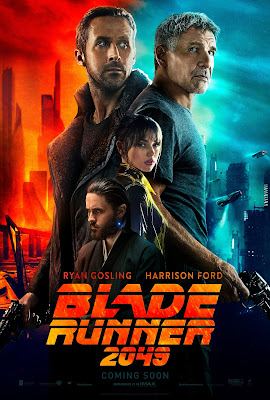
I had been waiting a long while to see this film--and it was a nervous wait since the film could have been fantastic or dreadful. But even before it was released, I saw it has a lot going for it: co-written by Hampton Fancher who co-wrote the original film, produced by Scott Free Productions (founded by Ridley Scott, the director of the original film), and starring Harrison Ford who played Rick Deckard in the original film. Add to this the fact that the film was directed by Denis Villeneuve who did the extraordinary 2016 Amy Adams film "Arrival," and also stars "La La Land"'s Ryan Gosling (a wonderfully understated and versatile actor, seen previously here and here) and Oscar-winner Jared Leto, well,...it seemed to be a sure thing.
And I must say that the film exceeded any expectations I had. It is a stunningly beautiful film--truly a worthy successor to the original, in every way possible. The visuals are as breathtaking as the original and the art direction is ravishing. The story makes complete, utter sense and in no way feels forced--or unnecessary--as many sequels (especially after so many years) can; the story not only references the original, but is completely dependent upon it in an extremely satisfying and plausible way. Thanks to Villeneuve, the pacing of the film is a marvel: perfectly deliberate and eerie, like dreaming. I love that Fancher and Villeneuve and everyone connected with this film dared to forego the current popular film structure paradigm of an explosion or car chase every 5 minutes. Sure, there are some actions scenes, some explosions, some chasing, but it does not feel distracting, sensationalizing, or sophomoric...they are part of the larger, more cerebral story filled with deep connections that one must pay close attention to and for.


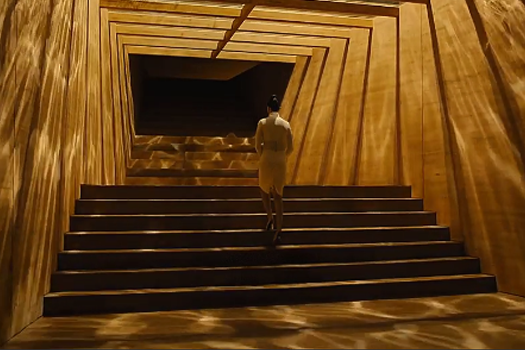


The film presents something else that I just adore: I love when films portray technology that is unrelated to most anything we know now or could possibly imagine. As the great science fiction writer Arthur C. Clarke once said, "Any sufficiently advanced technology is indistinguishable from magic." And Leto's character possesses some magical technology that is simply not explained which makes complete sense: if we show current technology, why would we bother to explain how, for example, an iPhone works? In the future, the tehchnology that seems magical now was built on all that came before it. Have faith, it will get there.
And of course it is a real treat to see Harrison Ford as Deckard once again, along with many familiar faces from the original film. The new additions are marvelous too: Gosling, Leto, Ana de Armas, Sylvia Hoeks, and Robin Wright are expertly cast.
Recommend? YES YES YES! But of course you SHOULD have seen the original first...
http://bladerunnermovie.com/

I had been waiting a long while to see this film--and it was a nervous wait since the film could have been fantastic or dreadful. But even before it was released, I saw it has a lot going for it: co-written by Hampton Fancher who co-wrote the original film, produced by Scott Free Productions (founded by Ridley Scott, the director of the original film), and starring Harrison Ford who played Rick Deckard in the original film. Add to this the fact that the film was directed by Denis Villeneuve who did the extraordinary 2016 Amy Adams film "Arrival," and also stars "La La Land"'s Ryan Gosling (a wonderfully understated and versatile actor, seen previously here and here) and Oscar-winner Jared Leto, well,...it seemed to be a sure thing.
And I must say that the film exceeded any expectations I had. It is a stunningly beautiful film--truly a worthy successor to the original, in every way possible. The visuals are as breathtaking as the original and the art direction is ravishing. The story makes complete, utter sense and in no way feels forced--or unnecessary--as many sequels (especially after so many years) can; the story not only references the original, but is completely dependent upon it in an extremely satisfying and plausible way. Thanks to Villeneuve, the pacing of the film is a marvel: perfectly deliberate and eerie, like dreaming. I love that Fancher and Villeneuve and everyone connected with this film dared to forego the current popular film structure paradigm of an explosion or car chase every 5 minutes. Sure, there are some actions scenes, some explosions, some chasing, but it does not feel distracting, sensationalizing, or sophomoric...they are part of the larger, more cerebral story filled with deep connections that one must pay close attention to and for.


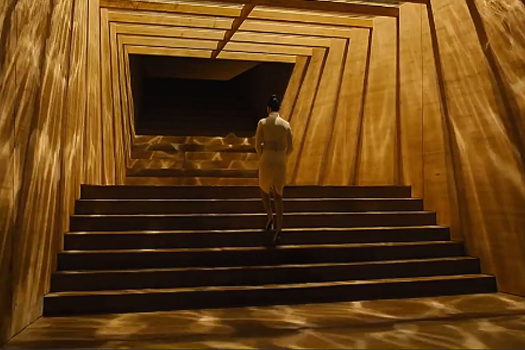


The film presents something else that I just adore: I love when films portray technology that is unrelated to most anything we know now or could possibly imagine. As the great science fiction writer Arthur C. Clarke once said, "Any sufficiently advanced technology is indistinguishable from magic." And Leto's character possesses some magical technology that is simply not explained which makes complete sense: if we show current technology, why would we bother to explain how, for example, an iPhone works? In the future, the tehchnology that seems magical now was built on all that came before it. Have faith, it will get there.
And of course it is a real treat to see Harrison Ford as Deckard once again, along with many familiar faces from the original film. The new additions are marvelous too: Gosling, Leto, Ana de Armas, Sylvia Hoeks, and Robin Wright are expertly cast.
Recommend? YES YES YES! But of course you SHOULD have seen the original first...
http://bladerunnermovie.com/
Saturday, November 11, 2017
Breakfast At Tiffany's
In case you missed it, yesterday was the opening of the new Blue Box Café, a restaurant at the top of Tiffany's in New York City. The fourth floor restaurant looks down Fifth Avenue to where Central Park begins. Of course the idea came from the classic film "Breakfast At Tiffany's" starring the incomparable Audrey Hepburn and George Peppard, based on Truman Capote's story of the same name.
The café is part of a much larger renovation of the flagship store. But the restaurant itself is the crowning jewel in a store full of jewels as it will draw people in. Vice President Creative Director at Tiffany's, Richard Moore said, “Design of the space began from the idea of immersion in Tiffany—not only the feeling of being inside a blue box, but surrounded by Tiffany hospitality."
I love that they found a marble for the walls that contains veins of Tiffany Blue! And I love the etched zinc tables.


And the prix fixe menu looks quite nice.
BREAKFAST AT TIFFANY
Served with a choice of coffee or tea
CROISSANT Nutella, honey butter, winter fruit preserves
SEASONAL FRUIT & BERRIES
Choice of:
SMOKED SALMON & BAGEL STACK Cream cheese smear, beefsteak tomato, red onion, capers
TRUFFLE EGGS Soft eggs, shaved truffles, kunik cheese, smoked bacon
AVOCADO TOAST (V) Radish, nasturtium, sorrel, sunflower seeds & sprouts
BUTTERMILK WAFFLE Poached fruit of the season, Catskills maple syrup
$29
LUNCH
Select a starter and a main course
STARTERS:
MUSHROOM SOUP (V) Sage crisp
BLACK BASS CRUDO Radish, fennel, espelette, olive oil
BLUE BOX CHOPPED SALAD Local greens, cucumber, red pepper, celery, olive, goat feta
MAIN COURSES:
“CHARLES LEWIS TIFFANY” CLT CLUB SANDWICH All-natural chicken, bibb lettuce, beefsteak tomato, rye bread
FIFTY-SEVENTH STREET FLATBREAD Burrata, apple, olive or tomato & fresh mozzarella
GREEN LIGHT (V) Roasted cauliflower, romanesco, pickled mushrooms, truffle vinaigrette
FIFTH AVENUE SALAD Maine lobster, avocado, grapefruit, poppy seed dressing
OLIVE OIL POACHED SKUNA BAY SALMON Osetra caviar, smashed potatoes
$39
TIFFANY TEA
Selection of fine teas by Bellocq
FINGER SANDWICHES:
HERBED CHICKEN SALAD
SMOKED SALMON CREAM CHEESE
CUCUMBER GOAT CHEESE
HUMMUS & OLIVE TAPENADE (V)
SWEETS:
TIFFANY BIRD’S NEST
BLUE BOX PETITS FOURS
COCONUT BROWNIE
LEMON MERINGUE TART
CHOCOLATE INGOT
LEMON JELLY SQUARE
SWEET & SAVORY SCONES Winter fruit preserves, glittery clotted cream, NYC rooftop honey
$49
Audrey approves.

http://www.tiffany.com/Locations/FlagshipStore/NewYork.aspx
The café is part of a much larger renovation of the flagship store. But the restaurant itself is the crowning jewel in a store full of jewels as it will draw people in. Vice President Creative Director at Tiffany's, Richard Moore said, “Design of the space began from the idea of immersion in Tiffany—not only the feeling of being inside a blue box, but surrounded by Tiffany hospitality."
I love that they found a marble for the walls that contains veins of Tiffany Blue! And I love the etched zinc tables.


And the prix fixe menu looks quite nice.
BREAKFAST AT TIFFANY
Served with a choice of coffee or tea
CROISSANT Nutella, honey butter, winter fruit preserves
SEASONAL FRUIT & BERRIES
Choice of:
SMOKED SALMON & BAGEL STACK Cream cheese smear, beefsteak tomato, red onion, capers
TRUFFLE EGGS Soft eggs, shaved truffles, kunik cheese, smoked bacon
AVOCADO TOAST (V) Radish, nasturtium, sorrel, sunflower seeds & sprouts
BUTTERMILK WAFFLE Poached fruit of the season, Catskills maple syrup
$29
LUNCH
Select a starter and a main course
STARTERS:
MUSHROOM SOUP (V) Sage crisp
BLACK BASS CRUDO Radish, fennel, espelette, olive oil
BLUE BOX CHOPPED SALAD Local greens, cucumber, red pepper, celery, olive, goat feta
MAIN COURSES:
“CHARLES LEWIS TIFFANY” CLT CLUB SANDWICH All-natural chicken, bibb lettuce, beefsteak tomato, rye bread
FIFTY-SEVENTH STREET FLATBREAD Burrata, apple, olive or tomato & fresh mozzarella
GREEN LIGHT (V) Roasted cauliflower, romanesco, pickled mushrooms, truffle vinaigrette
FIFTH AVENUE SALAD Maine lobster, avocado, grapefruit, poppy seed dressing
OLIVE OIL POACHED SKUNA BAY SALMON Osetra caviar, smashed potatoes
$39
TIFFANY TEA
Selection of fine teas by Bellocq
FINGER SANDWICHES:
HERBED CHICKEN SALAD
SMOKED SALMON CREAM CHEESE
CUCUMBER GOAT CHEESE
HUMMUS & OLIVE TAPENADE (V)
SWEETS:
TIFFANY BIRD’S NEST
BLUE BOX PETITS FOURS
COCONUT BROWNIE
LEMON MERINGUE TART
CHOCOLATE INGOT
LEMON JELLY SQUARE
SWEET & SAVORY SCONES Winter fruit preserves, glittery clotted cream, NYC rooftop honey
$49
Audrey approves.

http://www.tiffany.com/Locations/FlagshipStore/NewYork.aspx
Tuesday, August 29, 2017
"Loving Vincent"
"Loving Vincent" is the world's first completely painted biographical animated film. Based on the life and death of painter Vincent Van Gogh, each of the film's 65,000 frames is an actual fully realized oil painting on canvas in the style of Van Gogh. It is set for a September 22, 2017 limited release here in the United States.

And here is "The Sower With Setting Sun" from the soundtrack of "Loving Vincent" by Clint Mansell.
The Van Gogh painting The Sower (With Setting Sun).

http://us.lovingvincent.com/

And here is "The Sower With Setting Sun" from the soundtrack of "Loving Vincent" by Clint Mansell.
The Van Gogh painting The Sower (With Setting Sun).

http://us.lovingvincent.com/
Sunday, July 23, 2017
"Awaken" by Tom Lowe
AWAKEN is a feature documentary film by director, cinematographer, editor, and producer Tom Lowe exploring humanity's relationship with technology and the natural world.
Shot over a 5-year period in more than 30 countries, the film pioneers new time-lapse, time-dilation, underwater, and aerial cinematography techniques to give audiences new eyes with which to see our world. Executive produced by Terrence Malick (auteur filmmaker, and creator of the experimental fim "Voyage Of Time, previously here) and Godfrey Reggio (director of the Qatsi trilogy of films: "Koyaanisqatsi," "Powaqqatsi," and "Naqoyqatsi"), AWAKEN is a celebration of the spirit of life, an exploration of the Earth, and an ode to the Cosmos.
Shot over a 5-year period in more than 30 countries, the film pioneers new time-lapse, time-dilation, underwater, and aerial cinematography techniques to give audiences new eyes with which to see our world. Executive produced by Terrence Malick (auteur filmmaker, and creator of the experimental fim "Voyage Of Time, previously here) and Godfrey Reggio (director of the Qatsi trilogy of films: "Koyaanisqatsi," "Powaqqatsi," and "Naqoyqatsi"), AWAKEN is a celebration of the spirit of life, an exploration of the Earth, and an ode to the Cosmos.
Saturday, July 30, 2016
Just watched...
...the long-anticipated film version of "Absolutely Fabulous."

If you, like me, have been a fan of the cult British television show "Absolutely Fabulous" (previously here) starring the talented, hilarious Jennifer Saunders and Joanna Lumley, you won't want to miss this theatrical outing written by Saunders. She created the character of Edina Monsoon and her daughter Saffron with fellow comedienne Dawn French over 25 years ago. And through all that time, Edina and her best friend Patsy Stone (Lumley) have been chugging along.
Some of the criticism leveled at this film adaptation says there is nothing new here, that it's just a longer version of the television show. Well, yeah, that's exactly what fans want and expect. Why would we want something different? Saunders gives us classic Edi, and her chaotic, clueless, boozey mess of a life. It is who Edina is. Patsy here is classic Patsy as well. In fact nearly every series regular makes an appearance in the film and we delight in seeing everyone including Julia Sawalha as Edi's daughter, June Whitfield as Edi's mother, and the masterfully quirky Jane Horrocks as Edi's assistant Bubble. Oh, and a million cameos from the entertainment and fashion worlds ("Game of Thrones" Gwendoline Chrisite and fashion designer Jean Paul Gaultier are just two!). But if you do not have any prior knowledge or exposure to the series, like many critics who have savaged the film, I can see how you would not understand what is happening. It's almost like speaking another language...if you don't speak AbFabese, you won't understand anything at all.
Yes, this is a longer version of an episode of "Absolutely Fabulous" but something that occurred to me after I left the theater is: it was nice to have a full 90 minutes with the gals, and for a story arc to unfold rather than the 30 minute (or less) skits from the television series. The pacing was great and a longer format works quite well for Edi and Patsy.
As far as the story goes, that is classic "Ab Fab" as well. Edina is accused of murdering Kate Moss at a fashion event (she accidentally pushes her into the Thames) and she and Patsy must go on the run from the law. Hijinks, as they say, ensue. And all in Westwood heels! And the ending is a wonderful, deliberate homage to the classic Tony Curtis/ Jack Lemmon/ Marilyn Monroe film "Some Like It Hot."
The series was known for its over-the-top, almost cartoony atmosphere, with whip smart comedy but I found that the film version actually softened Edi in a few spots, and especially at the culmination of the film. It often does not work when a comedy decides to align itself with reality but in this case, it works perfectly. It did not feel incongruous or out of place at all. Well done, Jennifer!
Take a look at the trailer below.


Recommend? Like I said, if you are familiar with the show and these two characters, yes, of course. But if you are not, it might feel a bit like stepping into some kind of alternate universe...
http://www.foxsearchlight.com/absolutelyfabulous/

If you, like me, have been a fan of the cult British television show "Absolutely Fabulous" (previously here) starring the talented, hilarious Jennifer Saunders and Joanna Lumley, you won't want to miss this theatrical outing written by Saunders. She created the character of Edina Monsoon and her daughter Saffron with fellow comedienne Dawn French over 25 years ago. And through all that time, Edina and her best friend Patsy Stone (Lumley) have been chugging along.
Some of the criticism leveled at this film adaptation says there is nothing new here, that it's just a longer version of the television show. Well, yeah, that's exactly what fans want and expect. Why would we want something different? Saunders gives us classic Edi, and her chaotic, clueless, boozey mess of a life. It is who Edina is. Patsy here is classic Patsy as well. In fact nearly every series regular makes an appearance in the film and we delight in seeing everyone including Julia Sawalha as Edi's daughter, June Whitfield as Edi's mother, and the masterfully quirky Jane Horrocks as Edi's assistant Bubble. Oh, and a million cameos from the entertainment and fashion worlds ("Game of Thrones" Gwendoline Chrisite and fashion designer Jean Paul Gaultier are just two!). But if you do not have any prior knowledge or exposure to the series, like many critics who have savaged the film, I can see how you would not understand what is happening. It's almost like speaking another language...if you don't speak AbFabese, you won't understand anything at all.
Yes, this is a longer version of an episode of "Absolutely Fabulous" but something that occurred to me after I left the theater is: it was nice to have a full 90 minutes with the gals, and for a story arc to unfold rather than the 30 minute (or less) skits from the television series. The pacing was great and a longer format works quite well for Edi and Patsy.
As far as the story goes, that is classic "Ab Fab" as well. Edina is accused of murdering Kate Moss at a fashion event (she accidentally pushes her into the Thames) and she and Patsy must go on the run from the law. Hijinks, as they say, ensue. And all in Westwood heels! And the ending is a wonderful, deliberate homage to the classic Tony Curtis/ Jack Lemmon/ Marilyn Monroe film "Some Like It Hot."
The series was known for its over-the-top, almost cartoony atmosphere, with whip smart comedy but I found that the film version actually softened Edi in a few spots, and especially at the culmination of the film. It often does not work when a comedy decides to align itself with reality but in this case, it works perfectly. It did not feel incongruous or out of place at all. Well done, Jennifer!
Take a look at the trailer below.


Recommend? Like I said, if you are familiar with the show and these two characters, yes, of course. But if you are not, it might feel a bit like stepping into some kind of alternate universe...
http://www.foxsearchlight.com/absolutelyfabulous/
Subscribe to:
Posts (Atom)
