Showing posts with label comet. Show all posts
Tuesday, December 23, 2014
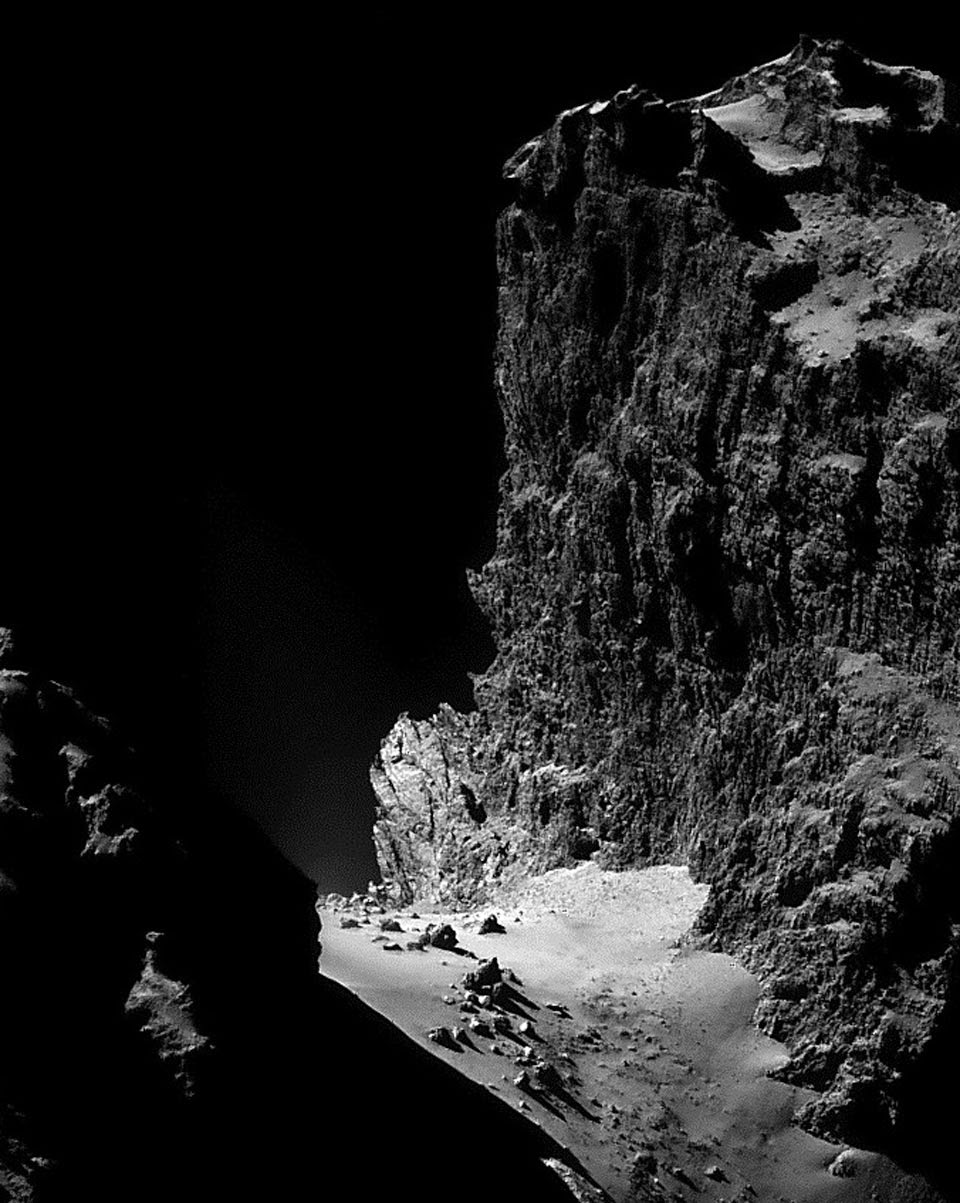
The Cliffs of Comet Churyumov–Gerasimenko
I am interrupting our regularly scheduled holiday programming to bring you a most awesome photo. NASA has a site called "Astronomy Picture of the Day," and today's photo, December 23 2014, is absolutely stunning. Take a look.
From the site:
Explanation: These high cliffs occur on the surface of a comet. They were discovered to be part of the dark nucleus of Comet Churyumov–Gerasimenko (CG) by Rosetta, a robotic spacecraft launched by ESA which began orbiting the comet in early August. The ragged cliffs, as featured here, were imaged by Rosetta about two weeks ago. Although towering about one kilometer high, the low surface gravity of Comet CG would likely make a jump from the cliffs, by a human, survivable. At the foot of the cliffs is relatively smooth terrain dotted with boulders as large as 20 meters across. Data from Rosetta indicates that the ice in Comet CG has a significantly different deuterium fraction -- and hence likely a different origin -- than the water in Earth's oceans. The Rosetta spacecraft is scheduled to continue to accompany the comet as it makes its closest approach to the Sun in 2015 August.
Image Credit & Licence (CC BY-SA 3.0 IGO): ESA, Rosetta spacecraft, NAVCAM; Additional Processing: Stuart Atkinson
Original page here:
http://apod.nasa.gov/apod/ap141223.html
http://apod.nasa.gov/apod/
From the site:
Explanation: These high cliffs occur on the surface of a comet. They were discovered to be part of the dark nucleus of Comet Churyumov–Gerasimenko (CG) by Rosetta, a robotic spacecraft launched by ESA which began orbiting the comet in early August. The ragged cliffs, as featured here, were imaged by Rosetta about two weeks ago. Although towering about one kilometer high, the low surface gravity of Comet CG would likely make a jump from the cliffs, by a human, survivable. At the foot of the cliffs is relatively smooth terrain dotted with boulders as large as 20 meters across. Data from Rosetta indicates that the ice in Comet CG has a significantly different deuterium fraction -- and hence likely a different origin -- than the water in Earth's oceans. The Rosetta spacecraft is scheduled to continue to accompany the comet as it makes its closest approach to the Sun in 2015 August.
Image Credit & Licence (CC BY-SA 3.0 IGO): ESA, Rosetta spacecraft, NAVCAM; Additional Processing: Stuart Atkinson
Original page here:
http://apod.nasa.gov/apod/ap141223.html
http://apod.nasa.gov/apod/
Thursday, November 13, 2014
It Sings
The European Space Agency (ESA) have released audio of the comet upon which us little ol' human beings just landed. And it is not what you would have expected... trilling, gurgling, bubbling...
From the ESA description:
"Rosetta’s Plasma Consortium (RPC) has uncovered a mysterious ‘song’ that Comet 67P/Churyumov-Gerasimenko is singing into space. The comet seems to be emitting a ‘song’ in the form of oscillations in the magnetic field in the comet’s environment. It is being sung at 40-50 millihertz, far below human hearing, which typically picks up sound between 20 Hz and 20 kHz. To make the music audible to the human ear, the frequencies have been increased in this recording. Original data credit: ESA/Rosetta/RPC/RPC-MAG. This sonification of the RPC-Mag data was compiled by German composer Manuel Senfft (www.tagirijus.de). Thumbnail image credit: ESA/Rosetta/NAVCAM – CC BY-SA IGO 3.0"
http://www.esa.int/ESA
From the ESA description:
"Rosetta’s Plasma Consortium (RPC) has uncovered a mysterious ‘song’ that Comet 67P/Churyumov-Gerasimenko is singing into space. The comet seems to be emitting a ‘song’ in the form of oscillations in the magnetic field in the comet’s environment. It is being sung at 40-50 millihertz, far below human hearing, which typically picks up sound between 20 Hz and 20 kHz. To make the music audible to the human ear, the frequencies have been increased in this recording. Original data credit: ESA/Rosetta/RPC/RPC-MAG. This sonification of the RPC-Mag data was compiled by German composer Manuel Senfft (www.tagirijus.de). Thumbnail image credit: ESA/Rosetta/NAVCAM – CC BY-SA IGO 3.0"
http://www.esa.int/ESA
Subscribe to:
Posts (Atom)
