Showing posts with label astronomy picture of the day. Show all posts
Tuesday, December 23, 2014
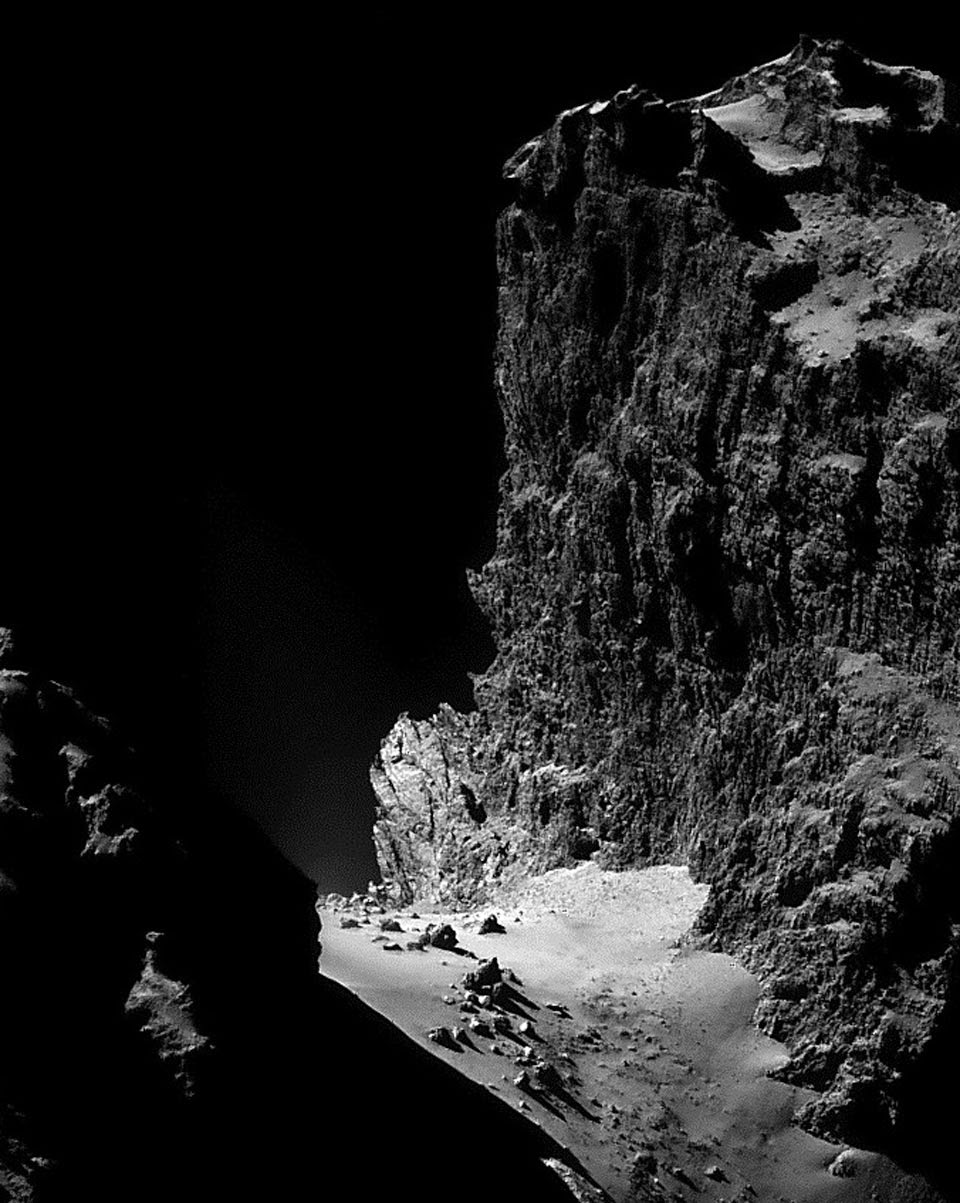
The Cliffs of Comet Churyumov–Gerasimenko
I am interrupting our regularly scheduled holiday programming to bring you a most awesome photo. NASA has a site called "Astronomy Picture of the Day," and today's photo, December 23 2014, is absolutely stunning. Take a look.
From the site:
Explanation: These high cliffs occur on the surface of a comet. They were discovered to be part of the dark nucleus of Comet Churyumov–Gerasimenko (CG) by Rosetta, a robotic spacecraft launched by ESA which began orbiting the comet in early August. The ragged cliffs, as featured here, were imaged by Rosetta about two weeks ago. Although towering about one kilometer high, the low surface gravity of Comet CG would likely make a jump from the cliffs, by a human, survivable. At the foot of the cliffs is relatively smooth terrain dotted with boulders as large as 20 meters across. Data from Rosetta indicates that the ice in Comet CG has a significantly different deuterium fraction -- and hence likely a different origin -- than the water in Earth's oceans. The Rosetta spacecraft is scheduled to continue to accompany the comet as it makes its closest approach to the Sun in 2015 August.
Image Credit & Licence (CC BY-SA 3.0 IGO): ESA, Rosetta spacecraft, NAVCAM; Additional Processing: Stuart Atkinson
Original page here:
http://apod.nasa.gov/apod/ap141223.html
http://apod.nasa.gov/apod/
From the site:
Explanation: These high cliffs occur on the surface of a comet. They were discovered to be part of the dark nucleus of Comet Churyumov–Gerasimenko (CG) by Rosetta, a robotic spacecraft launched by ESA which began orbiting the comet in early August. The ragged cliffs, as featured here, were imaged by Rosetta about two weeks ago. Although towering about one kilometer high, the low surface gravity of Comet CG would likely make a jump from the cliffs, by a human, survivable. At the foot of the cliffs is relatively smooth terrain dotted with boulders as large as 20 meters across. Data from Rosetta indicates that the ice in Comet CG has a significantly different deuterium fraction -- and hence likely a different origin -- than the water in Earth's oceans. The Rosetta spacecraft is scheduled to continue to accompany the comet as it makes its closest approach to the Sun in 2015 August.
Image Credit & Licence (CC BY-SA 3.0 IGO): ESA, Rosetta spacecraft, NAVCAM; Additional Processing: Stuart Atkinson
Original page here:
http://apod.nasa.gov/apod/ap141223.html
http://apod.nasa.gov/apod/
Wednesday, July 27, 2011
I was expecting something darker...
From NASA's "Astronomy Picture of the Day:"
"What color is the universe? More precisely, if the entire sky was smeared out, what color would the final mix be? This whimsical question came up when trying to determine what stars are commonplace in nearby galaxies. The answer is a conditionally perceived shade of beige.

To determine this, astronomers computationally averaged the light emitted by one of the largest sample of galaxies yet analyzed: the 200,000 galaxies of the 2dF survey. The resulting cosmic spectrum has some emission in all parts of the electromagnetic spectrum, but a single perceived composite color. This color has become much less blue over the past 10 billion years, indicating that redder stars are becoming more prevalent. In a contest to better name the color, notable entries included skyvory, univeige, and the winner: cosmic latte."
http://apod.nasa.gov/apod/
"What color is the universe? More precisely, if the entire sky was smeared out, what color would the final mix be? This whimsical question came up when trying to determine what stars are commonplace in nearby galaxies. The answer is a conditionally perceived shade of beige.

To determine this, astronomers computationally averaged the light emitted by one of the largest sample of galaxies yet analyzed: the 200,000 galaxies of the 2dF survey. The resulting cosmic spectrum has some emission in all parts of the electromagnetic spectrum, but a single perceived composite color. This color has become much less blue over the past 10 billion years, indicating that redder stars are becoming more prevalent. In a contest to better name the color, notable entries included skyvory, univeige, and the winner: cosmic latte."
http://apod.nasa.gov/apod/
Labels:
astronomy picture of the day,
color,
cosmic latte,
NASA,
universe
Thursday, April 21, 2011
Happy Birthday, Hubble
Today is the 21st anniversary of the Hubble Telescope in orbit. NASA's Astronomy Picture of the Day celebrates this with the below image and information.
Happy Birthday, Hubble!

Peculiar Galaxies of Arp 273
Credit: NASA, ESA, and the Hubble Heritage Team (STScI / AURA)
Explanation: The spiky stars in the foreground of this sharp cosmic portrait are well within our own Milky Way Galaxy. The two eye-catching galaxies lie far beyond the Milky Way, at a distance of over 300 million light-years. Their distorted appearance is due to gravitational tides as the pair engage in close encounters. Cataloged as Arp 273 (also as UGC 1810), the galaxies do look peculiar, but interacting galaxies are now understood to be common in the universe. In fact, the nearby large spiral Andromeda Galaxy is known to be some 2 million light-years away and approaching the Milky Way. Arp 273 may offer an analog of their far future encounter. Repeated galaxy encounters on a cosmic timescale can ultimately result in a merger into a single galaxy of stars. From our perspective, the bright cores of the Arp 273 galaxies are separated by only a little over 100,000 light-years. The release of this stunning vista celebrates the 21st anniversary of the Hubble Space Telescope in orbit.
NASA Astronomy Picture of the Day site:
http://apod.nasa.gov/apod/archivepix.html
Happy Birthday, Hubble!

Peculiar Galaxies of Arp 273
Credit: NASA, ESA, and the Hubble Heritage Team (STScI / AURA)
Explanation: The spiky stars in the foreground of this sharp cosmic portrait are well within our own Milky Way Galaxy. The two eye-catching galaxies lie far beyond the Milky Way, at a distance of over 300 million light-years. Their distorted appearance is due to gravitational tides as the pair engage in close encounters. Cataloged as Arp 273 (also as UGC 1810), the galaxies do look peculiar, but interacting galaxies are now understood to be common in the universe. In fact, the nearby large spiral Andromeda Galaxy is known to be some 2 million light-years away and approaching the Milky Way. Arp 273 may offer an analog of their far future encounter. Repeated galaxy encounters on a cosmic timescale can ultimately result in a merger into a single galaxy of stars. From our perspective, the bright cores of the Arp 273 galaxies are separated by only a little over 100,000 light-years. The release of this stunning vista celebrates the 21st anniversary of the Hubble Space Telescope in orbit.
NASA Astronomy Picture of the Day site:
http://apod.nasa.gov/apod/archivepix.html
Subscribe to:
Posts (Atom)
