Showing posts with label astronomy. Show all posts

Thursday, March 5, 2026

"Helios" by Luke Jerram

I would love to see this amazing art installation is person! This enormous representation of our star is a companion piece to one of the moon that artist Luke Jerram created in 2017, previously here.  Of this current creation, the artist's website says:

Helios is a touring artwork of the Sun by UK artist Luke Jerram.

Measuring seven metres in diameter, the artwork features 72dpi detailed imagery* of the Sun’s surface. At an approximate scale of 1:200 million, each centimetre of the internally lit spherical sculpture represents 2000km of the Sun’s surface.

It is very dangerous to look at the Sun directly as it can damage our eyesight, so Helios provides a safe opportunity for the public to get up close to, and inspect its extraordinarily detailed surface, including sunspots, spicules and filaments. The sculpture also features the source of the solar flares which caused the Northern lights to be visible from the UK in May 2024.

As well as highlighting the science of the Sun, the artwork allows us to consider its importance in all our lives; for light, warmth, energy for our planet and how our nearest star has inspired culture and religion throughout history, all around the world.

The installation is a fusion of solar imagery, animated lighting and a specially created surround sound composition by Duncan Speakman and Sarah Anderson.

Over its lifetime, Helios will be presented in a number of different locations worldwide, both indoors and outdoors, so altering the experience and interpretation of the artwork. As it travels from place to place, it will collect personal responses, stories and mythologies, as well as highlighting the latest solar science.

Helios also acts as a venue, enabling hosts to create their own programme of Sun inspired events and activities to take place beneath the artwork, including orchestral and choral performances; space science lectures by astronauts; environmental and wellbeing discussions with scientists and activists; yoga; poetry readings; dance and theatre performances.

Helios, in ancient Greek mythology, is the god who personifies the Sun. He drove a four-horse chariot across the sky each day, giving the earth its hours and seasons.

*The imagery for the artwork has been compiled using approximately 400,000 photographs of the Sun provided by Astrophotographer Dr Stuart Green (taken between May 2018 to June 2024) and NASA observations of the Sun, with guidance from solar scientist, Professor Lucie Green of University College London (UCL).


Photo by Bec Hughes
Detail of the surface of Helios
Photo by Hugh Mothersole
Photo by James Dobson
Helios in Bath Assembly Rooms, England, Photo by Thomas Greetham
Helios at the Old Royal Naval College, London
Dinner under Helios
Silent disco under Helios by Jolade Olusanya


For the touring schedule, check Luke Jerram's site below:
https://my-helios.org/

Tuesday, July 5, 2016

Aurora on Jupiter

NASA's Juno probe is finally in orbit around Jupiter!
And just a few days ago, NASA posted to their Instagram feed this video of auroras over Jupiter taken by the Hubble Space Telescope. Amazing...

Bright auroras on Jupiter! This composite video illustrates the auroras on Jupiter relative to their position on the giant planet. As on Earth, auroras are produced by the interaction of a planet's magnetic field with its atmosphere. The Jupiter auroras observed by our Hubble Space Telescope are some of the most active and brightest ever caught by Hubble, reaching intensities over a thousand times brighter than those seen on Earth. Hubble's sensitivity to ultraviolet light captures the glow of the auroras above Jupiter's cloud top. Fourth of July, our solar-powered Juno spacecraft will arrive at Jupiter after an almost five-year journey. In the evening of July 4, Juno will perform a suspenseful orbit insertion maneuver. Once in Jupiter’s orbit, the spacecraft will circle the Jovian world 37 times during 20 months, skimming to within 3,100 miles (5,000 km) above the cloud tops. This is the first time a spacecraft will orbit the poles of Jupiter, providing new answers to ongoing mysteries about the planet’s core, composition and magnetic fields. Credit: NASA, ESA, J. Nichols (University of Leicester), and G. Bacon (STScI) #nasa #space #hubble #hst #astronomy #jupiter #juno #science #planet #nasabeyond #solarsystem
A video posted by NASA (@nasa) on


https://www.instagram.com/nasa/
http://www.nasa.gov/

Friday, May 27, 2016

Gemini, The Twins

To look at Gemini is to look away from the Milky Way...


Gemini is dominated by Castor and Pollux, two bright stars that appear relatively very closely together forming an o shape, encouraging the mythological link between the constellation and twinship.


Today is my birthday. I often wonder if I had a twin in the womb that somehow never happened...and I have a deep, subconscious feeling that I still miss him...not that I miss a "sibling" but that there is another me that should be here.

Thursday, February 11, 2016

Proven: Black Holes and Gravitational Waves!

This is fantastic news. Just think: if we could come to an understanding of dark matter, there's no telling what we could accomplish and create.

Gravitational waves from black holes detected
By Pallab Ghosh
Science correspondent, BBC News


Scientists are claiming a stunning discovery in their quest to fully understand gravity.

They have observed the warping of space-time generated by the collision of two black holes more than a billion light-years from Earth.

The international team says the first detection of these gravitational waves will usher in a new era for astronomy.

It is the culmination of decades of searching and could ultimately offer a window on the Big Bang.

Being able to detect gravitational waves enables astronomers finally to probe what they call "dark Universe" - the majority part of the cosmos that is invisible to the light telescopes in use today.

Not only will they be able to investigate black holes and strange objects known as neutron stars (giant suns that have collapsed to the size of cities), they should also be able to "look" much deeper into the Universe - and thus farther back in time. It may even be possible eventually to sense the moment of the Big Bang.


Read the full article here:
http://www.bbc.com/news/science-environment-35524440

Tuesday, December 23, 2014

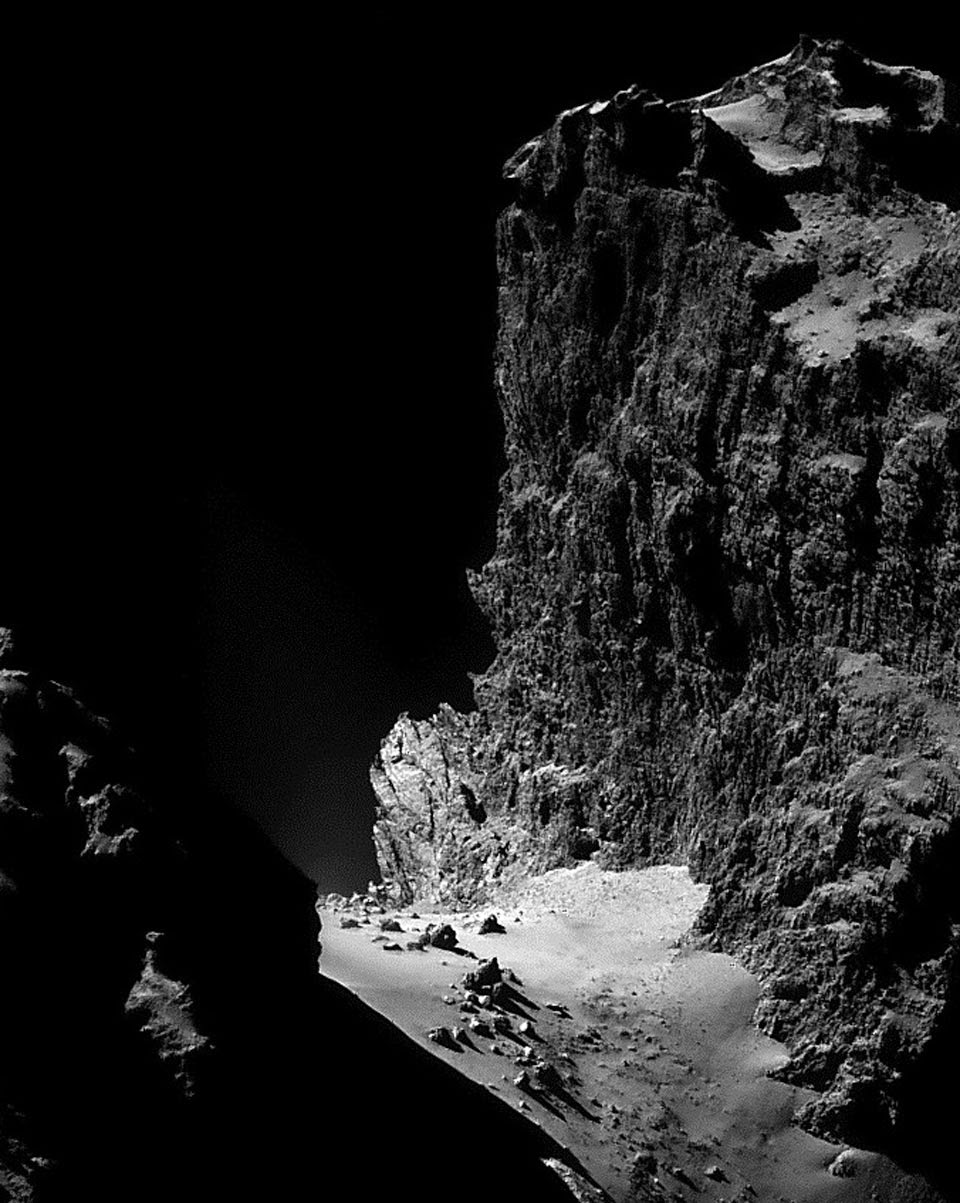
The Cliffs of Comet Churyumov–Gerasimenko

I am interrupting our regularly scheduled holiday programming to bring you a most awesome photo. NASA has a site called "Astronomy Picture of the Day," and today's photo, December 23 2014, is absolutely stunning. Take a look.


From the site:

Explanation: These high cliffs occur on the surface of a comet. They were discovered to be part of the dark nucleus of Comet Churyumov–Gerasimenko (CG) by Rosetta, a robotic spacecraft launched by ESA which began orbiting the comet in early August. The ragged cliffs, as featured here, were imaged by Rosetta about two weeks ago. Although towering about one kilometer high, the low surface gravity of Comet CG would likely make a jump from the cliffs, by a human, survivable. At the foot of the cliffs is relatively smooth terrain dotted with boulders as large as 20 meters across. Data from Rosetta indicates that the ice in Comet CG has a significantly different deuterium fraction -- and hence likely a different origin -- than the water in Earth's oceans. The Rosetta spacecraft is scheduled to continue to accompany the comet as it makes its closest approach to the Sun in 2015 August.

Image Credit & Licence (CC BY-SA 3.0 IGO): ESA, Rosetta spacecraft, NAVCAM; Additional Processing: Stuart Atkinson


Original page here:
http://apod.nasa.gov/apod/ap141223.html

http://apod.nasa.gov/apod/

Thursday, November 13, 2014

It Sings

The European Space Agency (ESA) have released audio of the comet upon which us little ol' human beings just landed. And it is not what you would have expected... trilling, gurgling, bubbling...


From the ESA description:
"Rosetta’s Plasma Consortium (RPC) has uncovered a mysterious ‘song’ that Comet 67P/Churyumov-Gerasimenko is singing into space. The comet seems to be emitting a ‘song’ in the form of oscillations in the magnetic field in the comet’s environment. It is being sung at 40-50 millihertz, far below human hearing, which typically picks up sound between 20 Hz and 20 kHz. To make the music audible to the human ear, the frequencies have been increased in this recording. Original data credit: ESA/Rosetta/RPC/RPC-MAG. This sonification of the RPC-Mag data was compiled by German composer Manuel Senfft (www.tagirijus.de). Thumbnail image credit: ESA/Rosetta/NAVCAM – CC BY-SA IGO 3.0"

http://www.esa.int/ESA

Tuesday, September 9, 2014

Let's Talk About Size 2

Reminiscent of a previous post about the relative size of the planets and stars, here is another reminder about how incedibly big our star is...


Sunday, September 7, 2014

Laniakea

This is amazing scientific news. In a recent study for Nature, scientists R. Brent Tully, Hélène Courtois, Yehuda Hoffman, and Daniel Pomarède at the University of Hawaii mapped thousands of galaxies in the immediate vicinity of our own Milky Way, and discovered that we are part of a truly massive "supercluster" of galaxies that they named Laniakea (which means "immeasurable heavens" in Hawaiian).


They also mapped galaxies expanding outward and galaxies which are being pulled toward each other. After mapping their trajectories, they discovered these galaxies, including our own, are being pulled toward a mysterious, super-dense area called "The Great Attractor."


And in another mind-boggling leap, our supercluster structure Laniakea borders another supercluster structure called Perseus-Pisces! I think it is astounding how the structures almost mirror each other, as though a supercluster of galaxies naturally take a certain shape...


http://www.nature.com/nature/journal/v513/n7516/full/nature13674.html#videos

Wednesday, March 19, 2014

Evolution Really Happened

I am currently watching the new "Cosmos: A Spacetime Odyssey" with astrophysicist Neil de Grasse Tyson on the National Geographic Channel, a follow up to the original "Cosmos: A Personal Voyage" with Carl Sagan. This new version is produced by Seth MacFarlane and Ann Druyan who is Sagan's widow.
Such a worthy show... both of them.


http://channel.nationalgeographic.com/channel/cosmos-a-spacetime-odyssey/
http://www.haydenplanetarium.org/tyson/

Tuesday, March 18, 2014

Proof of The Big Bang

A huge scientific breakthrough was announced yesterday. The twisting gravity waves from the Big Bang have been detected and seen for the first time! This is being hailed as Nobel worthy and will certainly add to the knowledge base for a Unified Theory of Everything! VERY exciting!


Cosmic inflation: 'Spectacular' discovery hailed
By Jonathan Amos Science correspondent, BBC News


Scientists say they have extraordinary new evidence to support a Big Bang Theory for the origin of the Universe.

Researchers believe they have found the signal left in the sky by the super-rapid expansion of space that must have occurred just fractions of a second after everything came into being.

It takes the form of a distinctive twist in the oldest light detectable with telescopes.

The work will be scrutinised carefully, but already there is talk of a Nobel.

"This is spectacular," commented Prof Marc Kamionkowski, from Johns Hopkins University.

"I've seen the research; the arguments are persuasive, and the scientists involved are among the most careful and conservative people I know," he told BBC News.

The breakthrough was announced by an American team working on a project known as BICEP2.

This has been using a telescope at the South Pole to make detailed observations of a small patch of sky.

The aim has been to try to find a residual marker for "inflation" - the idea that the cosmos experienced an exponential growth spurt in its first trillionth, of a trillionth of a trillionth of a second.


Complete article from BBC News here:
http://www.bbc.com/news/science-environment-26605974
and the BICEP2 findings here:
http://bicepkeck.org/index.html#papers

Monday, January 20, 2014

The Universal Web

I was very excited to see this story in the news today about how astronomers have, for the first time ever, obtained actual photographic proof of dark matter and have presented their findings in Nature.com, an international weekly journal of science. They have seen, thanks to the intense glow of a quasar, the underlying structure of the universe itself! And that structure is, of course, a web. The photographic evidence looks like neurons in the human brain. We are all part of a web, a net. This could end up explaining a lot, and perhaps proving some ideas that are considered "metaphysical." They even have proof of "dark galaxies!" Th implications are staggering.


Cosmic 'web' seen for first time
By Simon Redfern Reporter, BBC News

The hidden tendrils of dark matter that underlie the visible Universe may have been traced out for the first time.

Cosmology theory predicts that galaxies are embedded in a cosmic web of "stuff", most of which is dark matter.

Astronomers obtained the first direct images of a part of this network, by exploiting the fact that a luminous object called a quasar can act as a natural "cosmic flashlight".

Details of the work appear in the journal Nature.

The quasar illuminates a nearby gas cloud measuring two million light-years across.

And the glowing gas appears to trace out filaments of underlying dark matter.

The quasar, which lies 10 billion light-years away, shines light in just the right direction to reveal the cold gas cloud.

For some years, cosmologists have been running computer simulations of the structure of the universe to build the "standard model of cosmology".

They use the cosmic microwave background, corresponding to observations of the very earliest Universe that can be seen, and recorded by instruments such as the Planck space observatory, as a starting point.

Their calculations suggest that as the Universe grows and forms, matter becomes clustered in filaments and nodes under the force of gravity, like a giant cosmic web.

The new results from the 10-metre Keck telescope in Hawaii, are reported by scientists from the University of California, Santa Cruz and the Max Planck Institute for Astronomy in Heidelberg.

They are the first direct observations of cold gas decorating such cosmic web filaments.

The cosmic web suggested by the standard model is mainly made up of mysterious "dark matter". Invisible in itself, dark matter still exerts gravitational forces on visible light and ordinary matter nearby.

Massive clumps of dark matter bend light that passes close by through a process called gravitational lensing, and this had allowed previous measurements of its distribution.

But it is difficult to use this method to see very distant dark matter, and cold ordinary matter remains tricky to detect as well.

The glowing hydrogen illuminated by the distant quasar in these new observations traces out an underlying filament of dark matter that it is attracted to it by gravity, according to the researchers' analysis.

BBC News/ Science article:
http://www.bbc.co.uk/news/science-environment-25809967

Original article:
http://www.nature.com/nature/journal/vaop/ncurrent/full/nature12898.html

Wednesday, July 24, 2013

Peek-a-boo, peek-a-boo, little Earth...


From NASA:

View of Earth From Saturn
In this rare image taken on July 19, 2013, the wide-angle camera on NASA's Cassini spacecraft has captured Saturn's rings and our planet Earth and its moon in the same frame...
Earth, which is 898 million miles (1.44 billion kilometers) away in this image, appears as a blue dot at center right; the moon can be seen as a fainter protrusion off its right side. An arrow indicates their location in the annotated version...
This is only the third time ever that Earth has been imaged from the outer solar system. The acquisition of this image, along with the accompanying composite narrow- and wide-angle image of Earth and the moon and the full mosaic from which both are taken, marked the first time that inhabitants of Earth knew in advance that their planet was being imaged.

Hello, earth.
Hello, earth.
With just one hand held up high
I can blot you out,
Out of sight.

--Kate Bush, "Hello Earth"


http://www.nasa.gov/mission_pages/cassini/main/index.html#.UfCkx_XaIyb

Friday, February 15, 2013

Oh, hello there, 2012 DA14!

We (and by we, I mean the planet) did not even know of the existence of this asteroid until February 23, 2012 and now here we are being so intimate so quickly!

Today, February 15, 2013, the asteroid 2012 DA14 is passing us quite closely...a mere 17,200 miles from the surface of Earth which is a record close approach for a known object of this size. This is closer than satellites in geosynchronous orbit!

Images from NASA/JPL

NASA is tracking the trajectory of 2012 DA14. Watch it live here:
http://www.ustream.tv/nasajpl2

http://www.nasa.gov/

Tuesday, March 1, 2011

Let's Talk About Size

We are tiny little specks...


Tuesday, December 14, 2010

One Step Closer To Other Universes

Astronomers Find First Evidence Of Other Universes


There's something exciting afoot in the world of cosmology. Last month, Roger Penrose at the University of Oxford and Vahe Gurzadyan at Yerevan State University in Armenia announced that they had found patterns of concentric circles in the cosmic microwave background, the echo of the Big Bang.

This, they say, is exactly what you'd expect if the universe were eternally cyclical. By that, they mean that each cycle ends with a big bang that starts the next cycle. In this model, the universe is a kind of cosmic Russian Doll, with all previous universes contained within the current one.

That's an extraordinary discovery: evidence of something that occurred before the (conventional) Big Bang.

Today, another group says they've found something else in the echo of the Big Bang. These guys start with a different model of the universe called eternal inflation. In this way of thinking, the universe we see is merely a bubble in a much larger cosmos. This cosmos is filled with other bubbles, all of which are other universes where the laws of physics may be dramatically different to ours.

These bubbles probably had a violent past, jostling together and leaving "cosmic bruises" where they touched. If so, these bruises ought to be visible today in the cosmic microwave background.

Now Stephen Feeney at University College London and a few pals say they've found tentative evidence of this bruising in the form of circular patterns in cosmic microwave background. In fact, they've found four bruises, implying that our universe must have smashed into other bubbles at least four times in the past.

Again, this is an extraordinary result: the first evidence of universes beyond our own.

So, what to make of these discoveries. First, these effects could easily be a trick of the eye. As Feeney and co acknowledge: "it is rather easy to find all sorts of statistically unlikely properties in a large dataset like the CMB." That's for sure!

There are precautions statisticians can take to guard against this, which both Feeney and Penrose bring to bear in various ways.

But these are unlikely to settle the argument. In the last few weeks, several groups have confirmed Pernose's finding while others have found no evidence for it. Expect a similar pattern for Feeney's result.

The only way to settle this will be to confirm or refute the findings with better data. As luck would have it, new data is forthcoming thanks to the Planck spacecraft that is currently peering into the cosmic microwave background with more resolution and greater sensitivity than ever.

Cosmologists should have a decent data set to play with in a couple of years or so. When they get it, these circles should either spring into clear view or disappear into noise (rather like the mysterious Mars face that appeared in pictures of the red planet taken by Viking 1 and then disappeared in the higher resolution shots from the Mars Global Surveyor).

Planck should settle the matter; or, with any luck, introduce an even better mystery. In the meantime, there's going to be some fascinating discussion about this data and what it implies about the nature of the Universe. We'll be watching.

From the Physics arXiv blog, on the Technology Review published by MIT
http://www.technologyreview.com/blog/arxiv/26132/

Thursday, December 2, 2010

One Step Closer To Infinity

Starry, Starry, Starry Night: Star Count May Triple!

WASHINGTON – The universe may glitter with far more stars than even Carl Sagan imagined when he rhapsodized about billions upon billions. A new study suggests there are a mind-blowing 300 sextillion of them, or three times as many as scientists previously calculated. That is a 3 followed by 23 zeros. Or 3 trillion times 100 billion.

The estimate, contained in a study published online Wednesday in the journal Nature, is based on findings that there are many more red dwarf stars--the most common star in the universe--than once thought.

But the research goes deeper than that. The study by Yale University astronomer Pieter van Dokkum and Harvard astrophysicist Charlie Conroy questions a key assumption that astronomers often use: that most galaxies have the same properties as our Milky Way. And that conclusion is deeply unsettling to astronomers who want a more orderly cosmos.

When scientists previously estimated the total number of stars, they assumed that all galaxies had the same ratio of dwarf stars as the Milky Way, which is spiral-shaped. Much of our understanding of the universe is based on observations made inside our own galaxy and then extrapolated to other galaxies.

But about one-third of the galaxies in the universe are elliptical, not spiral, and van Dokkum found they aren't really made up the same way as ours.

Using the Keck telescope in Hawaii, van Dokkum and a colleague gazed into eight distant, elliptical galaxies and looked at their hard-to-differentiate light signatures. The scientists calculated that elliptical galaxies have more red dwarf stars than predicted. A lot more.

"We're seeing 10 or 20 times more stars than we expected," van Dokkum said.

Generally scientists believe there are 100 billion to a trillion galaxies in the universe. And each galaxy — the Milky Way included — was thought to have 100 billion to a trillion stars. Sagan, the Cornell University scientist and best-selling author who was often impersonated by comedians as saying "billions and billions," usually said there were 100 billion galaxies, each with 100 billion stars.

Van Dokkum's work takes these numbers and adjusts them. That's because some of those galaxies — the elliptical ones, which account for about a third of all galaxies — have as many as 1 trillion to 10 trillion stars, not a measly 100 billion. When van Dokkum and Conroy crunched the incredibly big numbers, they found that it tripled the estimate of stars in the universe from 100 sextillion to 300 sextillion.

That's a huge number to grasp, even for astronomers who are used to dealing in light years and trillions, Conroy said.

"It's fun because it gets you thinking about these large numbers," Conroy said. Conroy looked up how many cells are in the average human body — 50 trillion or so — and multiplied that by the 6 billion people on Earth. And he came up with about 300 sextillion.

So the number of stars in the universe "is equal to all the cells in the humans on Earth — a kind of funny coincidence," Conroy said.

For the past month, astronomers have been buzzing about van Dokkum's findings, and many aren't too happy about them, said astronomer Richard Ellis of the California Institute of Technology.

Saturday, November 13, 2010

One Step Closer To Dark Matter

Astronomers have created a new, incredibly detailed map of dark matter by using the Hubble Space Telescope to peer through a huge cluster of galaxies as if it were a cosmic magnifying glass.
Though invisible, dark matter makes its presence known through its gravitational tug on normal stuff. Scientists now calculate that dark matter could make up 80 percent of all the matter in the universe.
The new dark matter map could reveal secrets not just about dark matter, but about its equally enigmatic sibling, dark energy. This is the name given to the perplexing force that is pulling against gravity, causing the universe to balloon in size ever more rapidly.
The dark matter map was created with observations from the Hubble telescope of a large galaxy cluster called Abell 1689, located 2.2 billion light-years from Earth. This cluster is famous as a stunning example of gravitational lensing – a phenomenon predicted by Einstein that happens when massive objects warp the space-time around them, causing even light to travel on a bent path when it passes by.
When astronomers look at Abell 1689, they can see distorted pictures of the galaxies that lie beyond it in our line of sight: As those galaxies' light travels from them to us, it passes through Abell 1689 and is bent and magnified.
By studying this so-called lensing effect, scientists can deduce the mass that is causing the warping.
Astronomer Dan Coe of NASA's Jet Propulsion Laboratory in Pasadena, Calif., and Edward Fuselier of the United States Military Academy at West Point teamed up to apply a new mathematical formulation to Hubble observations of Abell 1689. The result is the most accurate, detailed calculation so far of the cluster's mass distribution, including the mass that can't be accounted for by the visible matter – meaning, the dark matter.
"The lensed images are like a big puzzle," Coe said. "Here we have figured out, for the first time, a way to arrange the mass of Abell 1689 such that it lenses all of these background galaxies to their observed positions."
Above: the new map of dark matter

12 November 2010
01:29 pm ET