Showing posts with label NASA. Show all posts

Saturday, May 9, 2026

NASA Climate Spiral 1880-Present

NASA Climate Spiral 1880-Present

Released Wednesday, November 15, 2023
Last updated Wednesday, April 15, 2026 at 4:39 PM EDT
Visualizations by: Mark SubbaRao


The visualization presents monthly global temperature anomalies. This visualization is updated roughly two weeks after the end of each month.

Temperature anomalies are deviations from a long term global average. In this case the period 1951-1980 is used to define the baseline for the anomaly. These temperatures are based on the GISS Surface Temperature Analysis (GISTEMP v4), an estimate of global surface temperature change. The data file used to create this visualization is publicly accessible here.

The term 'climate spiral' describes an animated radial plot of global temperatures. Climate scientist Ed Hawkins from the National Centre for Atmospheric Science, University of Reading popularized this style of visualization in 2016.

The Goddard Institute for Space Studies (GISS) in New York is a NASA laboratory managed by the Earth Sciences Division of the agency’s Goddard Space Flight Center in Greenbelt, Maryland. The laboratory is affiliated with Columbia University’s Earth Institute and School of Engineering and Applied Science in New York.


Link to NASA page:
https://svs.gsfc.nasa.gov/5190/

Sunday, April 12, 2026

Artemis II Wisdom

I was quite moved by NASA's recent Artemis II mission. Here are some great quotes from the crew of the lunar fly-by:

NASA astronauts Reid Wiseman and Victor Glover show a photo of Earth taken just moments
after the Orion spacecraft ignited its thrusters for a final burn for 8 seconds, producing a change
in velocity of 4.2 feet-per-second and pushing Artemis II toward Earth. | Photo: NASA


"Houston, if you could give me about 20 new superlatives in the mission summary for tomorrow that will help out my vocabulary a little bit, that would be great. Thank you."

“If you’ve ever seen the top of the spotlight of the top of the Luxor at night in Vegas, this looks like what it wants to be when it grows up.”

"To all of you on Earth, and around the Earth ... we love you, from the moon."

"You can see the surface of the Moon ... we just went sci fi."

"It is so great to see Earth again. To Asia, Africa, and Oceania: we are looking back at you. We hear you can look up and see the moon right now. We see you too."

"We will always choose Earth. We will always choose each other."

“It’s a bright spot on the moon, and we would like to call it Carroll.”

"I said that we do not leave Earth, but we choose it. And that is true."

"Christina has been sleeping head down in the middle of the vehicle, kind of like a bat"

"It's really fun to be floatin' around, it just makes me feel like a little kid."

"Trust us, you look amazing, you look beautiful."

"'Homo Sapiens' is all of us, no matter where you're from or what you look like. We're all one people."

"I'm proud to call myself the Space Plumber."

"I know I haven’t learned everything that this journey has yet to teach me but there’s one new thing I know, and that is planet Earth: You are a crew."


https://www.nasa.gov/mission/artemis-ii/

Thursday, March 5, 2026

"Helios" by Luke Jerram

I would love to see this amazing art installation is person! This enormous representation of our star is a companion piece to one of the moon that artist Luke Jerram created in 2017, previously here.  Of this current creation, the artist's website says:

Helios is a touring artwork of the Sun by UK artist Luke Jerram.

Measuring seven metres in diameter, the artwork features 72dpi detailed imagery* of the Sun’s surface. At an approximate scale of 1:200 million, each centimetre of the internally lit spherical sculpture represents 2000km of the Sun’s surface.

It is very dangerous to look at the Sun directly as it can damage our eyesight, so Helios provides a safe opportunity for the public to get up close to, and inspect its extraordinarily detailed surface, including sunspots, spicules and filaments. The sculpture also features the source of the solar flares which caused the Northern lights to be visible from the UK in May 2024.

As well as highlighting the science of the Sun, the artwork allows us to consider its importance in all our lives; for light, warmth, energy for our planet and how our nearest star has inspired culture and religion throughout history, all around the world.

The installation is a fusion of solar imagery, animated lighting and a specially created surround sound composition by Duncan Speakman and Sarah Anderson.

Over its lifetime, Helios will be presented in a number of different locations worldwide, both indoors and outdoors, so altering the experience and interpretation of the artwork. As it travels from place to place, it will collect personal responses, stories and mythologies, as well as highlighting the latest solar science.

Helios also acts as a venue, enabling hosts to create their own programme of Sun inspired events and activities to take place beneath the artwork, including orchestral and choral performances; space science lectures by astronauts; environmental and wellbeing discussions with scientists and activists; yoga; poetry readings; dance and theatre performances.

Helios, in ancient Greek mythology, is the god who personifies the Sun. He drove a four-horse chariot across the sky each day, giving the earth its hours and seasons.

*The imagery for the artwork has been compiled using approximately 400,000 photographs of the Sun provided by Astrophotographer Dr Stuart Green (taken between May 2018 to June 2024) and NASA observations of the Sun, with guidance from solar scientist, Professor Lucie Green of University College London (UCL).


Photo by Bec Hughes
Detail of the surface of Helios
Photo by Hugh Mothersole
Photo by James Dobson
Helios in Bath Assembly Rooms, England, Photo by Thomas Greetham
Helios at the Old Royal Naval College, London
Dinner under Helios
Silent disco under Helios by Jolade Olusanya


For the touring schedule, check Luke Jerram's site below:
https://my-helios.org/

Friday, March 31, 2017

BEAUTY: Sculpture-Installation--Luke Jerram

English multi-media artist Luke Jerram has created a jaw-dropping sculpture that is currently on tour:

"Museum of the Moon is a new touring artwork by UK artist Luke Jerram.

Measuring seven metres in diameter, the moon features 120dpi detailed NASA imagery of the lunar surface. At an approximate scale of 1:500,000, each centimetre of the internally lit spherical sculpture represents 5km of the moon’s surface*.

Over its lifetime, the Museum of the Moon will be presented in a number of different ways both indoors and outdoors, so altering the experience and interpretation of the artwork. As it travels from place to place, it will gather new musical compositions and an ongoing collection of personal responses, stories and mythologies, as well as highlighting the latest moon science.

The installation is a fusion of lunar imagery, moonlight and surround sound composition created by BAFTA and Ivor Novello award winning composer Dan Jones. Each venue also programmes their own series lunar inspired events beneath the moon.

From the beginning of human history, the moon has acted as a ‘cultural mirror’ to our beliefs, understanding and ways of seeing. Over the centuries, the moon has been interpreted as a god and as a planet. It has been used as a timekeeper, calendar and to aid nighttime navigation. Throughout history the moon has inspired artists, poets, scientists, writers and musicians the world over. The ethereal blue light cast by a full moon, the delicate crescent following the setting sun, or the mysterious dark side of the moon has evoked passion and exploration. Different cultures around the world have their own historical, cultural, scientific and religious relationships to the moon.

Over the coming years Museum of the Moon will be presented in art exhibitions, science, music and light festivals around the world. As the artwork tours, new audio compositions will be created and performed by a range of established composers and musicians, so adding to the Museum of the Moon collection.

Museum of the Moon will next be presented at:

Norfolk & Norwich Festival, UK. 12 – 21 May 2017
Oerol Festival, Netherlands. 9 – 18 June 2017
Greenwich+Docklands Festival, UK. 23 – 25 June 2017
Festival Les TombĂ©es de la Nuit, Rennes, France. June – July 2017
Thinktank, Birmingham, UK. July – August 2017
GOGBOT Festival, Enschede, Netherlands. 7 – 10 September 2017"


Here is Museum of the Moon in its latest installation at the University of Bristol in The Great Hall...


...and then magically suspended over a side street in Rotterdam.


https://www.lukejerram.com/
https://my-moon.org/

Tuesday, July 5, 2016

Aurora on Jupiter

NASA's Juno probe is finally in orbit around Jupiter!
And just a few days ago, NASA posted to their Instagram feed this video of auroras over Jupiter taken by the Hubble Space Telescope. Amazing...

Bright auroras on Jupiter! This composite video illustrates the auroras on Jupiter relative to their position on the giant planet. As on Earth, auroras are produced by the interaction of a planet's magnetic field with its atmosphere. The Jupiter auroras observed by our Hubble Space Telescope are some of the most active and brightest ever caught by Hubble, reaching intensities over a thousand times brighter than those seen on Earth. Hubble's sensitivity to ultraviolet light captures the glow of the auroras above Jupiter's cloud top. Fourth of July, our solar-powered Juno spacecraft will arrive at Jupiter after an almost five-year journey. In the evening of July 4, Juno will perform a suspenseful orbit insertion maneuver. Once in Jupiter’s orbit, the spacecraft will circle the Jovian world 37 times during 20 months, skimming to within 3,100 miles (5,000 km) above the cloud tops. This is the first time a spacecraft will orbit the poles of Jupiter, providing new answers to ongoing mysteries about the planet’s core, composition and magnetic fields. Credit: NASA, ESA, J. Nichols (University of Leicester), and G. Bacon (STScI) #nasa #space #hubble #hst #astronomy #jupiter #juno #science #planet #nasabeyond #solarsystem
A video posted by NASA (@nasa) on


https://www.instagram.com/nasa/
http://www.nasa.gov/

Saturday, November 28, 2015

Inverted Spaces Wallcovering

I love using wallpaper in projects for my interior design clients. Those of a certain age shudder at the mere mention of wallpaper, having mental connections to mom's foil-covered powder room or grandma's floral kitchen. But current wallpaper is artistic, expressive, unique, luxurious, and interesting. Read the product description below from the website of Brooklyn-based Calico Wallpaper about their "Inverted Spaces" wallcovering.

"Created in collaboration with Amsterdam-based design studio BCXSY, Inverted Spaces is a non-repeating wall mural conceived from archival NASA space photography. The concept is an exploration of celestial spaces, both imagined and real, and celebrates the fascination of the infinity that has surrounded us since the dawn of mankind."

This gorgeous, completely bespoke product comes in six colorways. Each order is custom printed to fit project dimensions and is seamless and non-repeating when installed


http://calicowallpaper.com/
http://www.bcxsy.com/

Monday, June 1, 2015

BEAUTY: Photography--Ellie Davies

I previously posted Ellie Davies' work here in 2011 and she has been working last year and this year on a newer series of photographs called Stars 2014 - 2015. Her Artist Statement about the series says it best:

"Stars, 2014 explores my desire to find some balance between a relationship with the wild places of my youth, and a pervasive sense of disconnectedness with the natural world.

The Western landscape tradition embodies a pairing that James Elkins calls ‘the subject-object relationship’. Typified by the ‘scenic viewpoint’ or tourist panoramic overlook, we gaze, often through binoculars or telescopes, at wide vistas and dramatic seascapes, awed and overwhelmed. But this landscape experience often alienates the viewer from the scene and, just as the landscape itself becomes an object, a separation arises between them.

Today the majority of people live in urban or semi-urban environments, experiencing the landscape from a distanced position mediated through various media and technology. From this viewpoint the notion of the landscape in all its sensuous materiality, our being within it rather than outside it, seems beyond reach.

Stars, 2014 addresses this distancing by drawing the viewer right into the heart of a forest which still holds mystery, and offers the potential for discovery and exploration. The series considers the fragility of our relationship with the natural world, and the temporal and finite nature of landscape as a human construct.

Mature and ancient forest landscapes are interposed with images of the Milky Way, Omega Centauri, the Norma Galaxy and Embryonic stars in the Nebula NGC 346 captured by the Hubble Telescope. Each image links forest landscapes with the intangible and unknown universe creating a juxtaposition that reflects my personal experiences of the forest; its physicality and tactility set against a profound and fundamental otherness, an alienation that separates us from a truly immersive relationship with the natural world."


http://www.elliedavies.co.uk/

Friday, May 29, 2015

Chirs Hadfield on The Overview Effect

Canadian astronaut Chris Hadfield has flown a space shuttle to Mir and stayed aboard the International Space Station where he created a series of popular YouTube videos, including one in which he sang David Bowie's classic song "Space Oddity." Hadfield is now retired but recently gave an interview to BBC Travel's Jim Benning. The most moving part of the interview was when Benning asked Hadfield if his time in space looking down on the planet has increased his desire to see more of the earth by traveling and visiting far-flung locales. Hadfield's beautiful, heart-felt answer references The Overview Effect, something I have written about several times here on "Oh, By The Way" (most notably here and here).

Astronaut Chris Hadfield conducts a "fit check" inside the Soyuz TMA-07M spacecraft (Photo credit: NASA/Victor Zelentsov)

"It’s not so much my wanderlust that’s changed, it’s more a respect for the absolute commonality of the human experience. Yes, there’s a strong local influence – our own history and culture and sets of laws – but when you go around the world every 92 minutes, the sameness overwhelms the differences. The repeated pattern of human habitation. How we set up cities. How that pattern looks whether it’s a city in Alberta or Africa or Australia. You’re passing over Canada and in 20 minutes you’re over Africa. You see the commonalities much more strongly than you see the differences.

I think that is actually the reality of the world – the shared common nature of our experience. We tend to exaggerate our differences and become extremely used to our own set of biases. But travel teaches you the shared nature of being human. And it’s extremely important, because so much of our bad decision-making – at personal, business, national and planetary levels – is driven by myopia and a lack of understanding of anything beyond our normal confines. The more people can see of the world, the better their decision-making will be."


Read the entire original interview at:
http://www.bbc.com/travel/story/20150511-why-i-love-the-world-astronaut-chris-hadfield

Tuesday, December 23, 2014

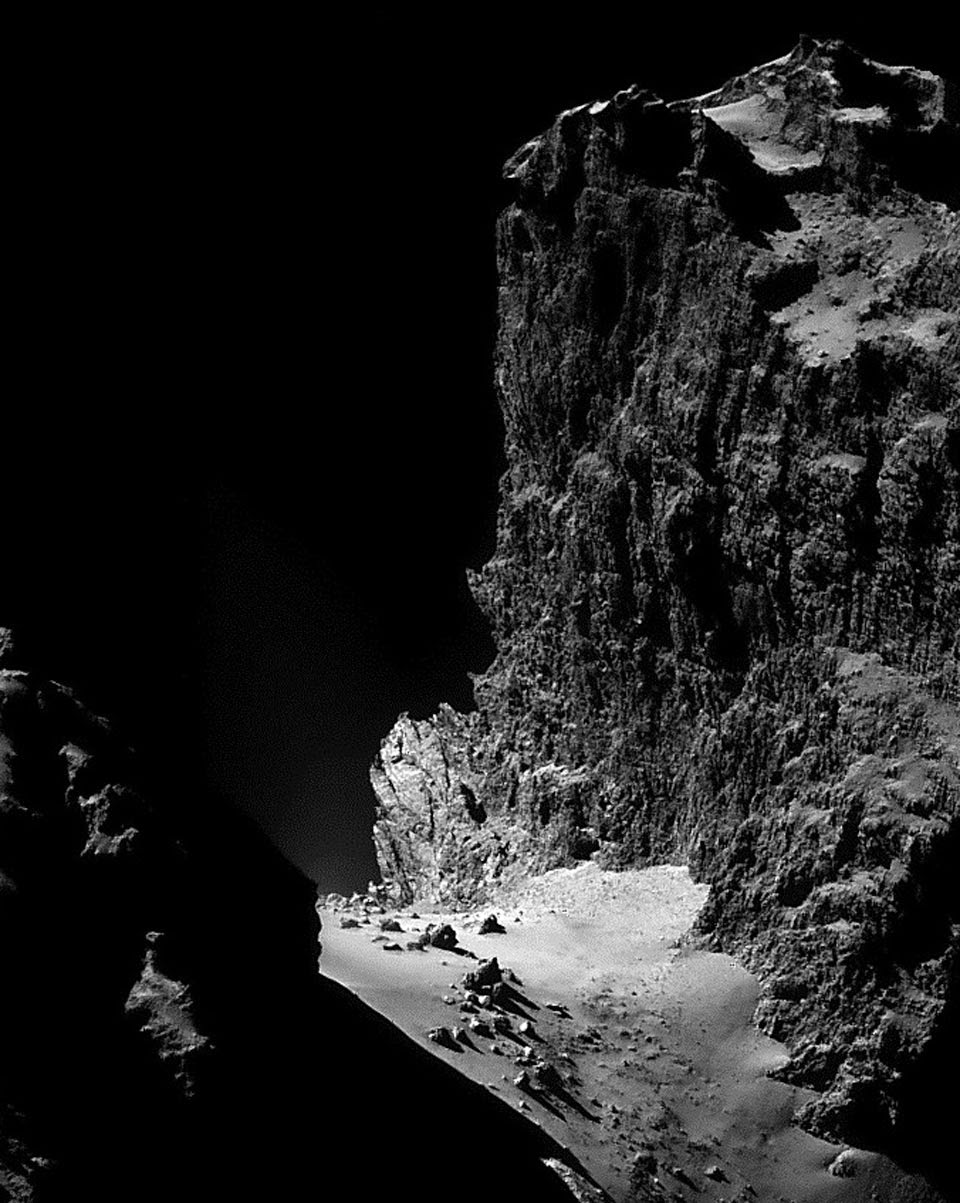
The Cliffs of Comet Churyumov–Gerasimenko

I am interrupting our regularly scheduled holiday programming to bring you a most awesome photo. NASA has a site called "Astronomy Picture of the Day," and today's photo, December 23 2014, is absolutely stunning. Take a look.


From the site:

Explanation: These high cliffs occur on the surface of a comet. They were discovered to be part of the dark nucleus of Comet Churyumov–Gerasimenko (CG) by Rosetta, a robotic spacecraft launched by ESA which began orbiting the comet in early August. The ragged cliffs, as featured here, were imaged by Rosetta about two weeks ago. Although towering about one kilometer high, the low surface gravity of Comet CG would likely make a jump from the cliffs, by a human, survivable. At the foot of the cliffs is relatively smooth terrain dotted with boulders as large as 20 meters across. Data from Rosetta indicates that the ice in Comet CG has a significantly different deuterium fraction -- and hence likely a different origin -- than the water in Earth's oceans. The Rosetta spacecraft is scheduled to continue to accompany the comet as it makes its closest approach to the Sun in 2015 August.

Image Credit & Licence (CC BY-SA 3.0 IGO): ESA, Rosetta spacecraft, NAVCAM; Additional Processing: Stuart Atkinson


Original page here:
http://apod.nasa.gov/apod/ap141223.html

http://apod.nasa.gov/apod/

Monday, November 11, 2013

Wednesday, July 24, 2013

Peek-a-boo, peek-a-boo, little Earth...


From NASA:

View of Earth From Saturn
In this rare image taken on July 19, 2013, the wide-angle camera on NASA's Cassini spacecraft has captured Saturn's rings and our planet Earth and its moon in the same frame...
Earth, which is 898 million miles (1.44 billion kilometers) away in this image, appears as a blue dot at center right; the moon can be seen as a fainter protrusion off its right side. An arrow indicates their location in the annotated version...
This is only the third time ever that Earth has been imaged from the outer solar system. The acquisition of this image, along with the accompanying composite narrow- and wide-angle image of Earth and the moon and the full mosaic from which both are taken, marked the first time that inhabitants of Earth knew in advance that their planet was being imaged.

Hello, earth.
Hello, earth.
With just one hand held up high
I can blot you out,
Out of sight.

--Kate Bush, "Hello Earth"


http://www.nasa.gov/mission_pages/cassini/main/index.html#.UfCkx_XaIyb

Friday, March 22, 2013

Older and Slower! Now With More Dark Matter!


(CNN) -- How cute was our universe as a baby? We now know better than ever: The picture of our early universe just got sharper and tells scientists with greater precision many important facts about how the universe evolved.

This new photogenic moment, released Thursday, comes courtesy of the European Space Agency's Planck space telescope, which detects cosmic microwave background radiation -- the light left over from the Big Bang. Scientists used data from Planck to create an artificially colored map of temperature variations across the sky in the early universe, in more detail than ever before.

"It's a big deal," said Charles Lawrence, Planck project scientist at NASA's Jet Propulsion Laboratory, in a news briefing. He added, "We can tie together a whole range of phenomena that couldn't be tied together so well before, and the sum total of that, the impact, is felt in many, many ways."

The light is technically from 380,000 years after the Big Bang, but that's still infancy when you consider that, according to the new data, the age of the universe is about 13.8 billion years.

"By the matching observations from Planck to predictions from models, we can assemble a surprisingly detailed picture of the universe as it was one nano-nano-nano-nanosecond after the Big Bang," said Marc Kamionkowski, professor of physics and astronomy at John Hopkins University.

Kamionkowski compared the Planck map to the Human Genome Project in terms of its importance for cosmology.

After analyzing the new data, scientists now believe that the universe is about 100 million years older than they thought.

The universe's light started out as a white hot glow and would have been blindingly bright if anyone had been around to see it, Lawrence said.

But since the Big Bang, that hot light has cooled significantly, and the universe itself has expanded by a factor of 1,100. The light has cooled so much that we can't see it, but Planck can detect subtle variations in temperature, which give scientists a wealth of information. By subtle, we mean about one-hundred-millionth of a degree.

The colors in the temperature map image that scientists released Thursday were arbitrarily chosen to show these intensity variations, Lawrence said. Red means a little bit warmer than average, blue means cooler than average, and white is average.

Planck data also suggest that our universe has more dark matter than previously thought. A full 26.8% appears to be dark matter, an invisible phenomenon that scientists have only been able to detect indirectly; experiments both in space and at the Large Hadron Collider are hoping to pin it down.

It appears that ordinary matter -- all of the stuff that we can see, such as planets and stars -- makes up only 4.9% of all the universe.

The rest of the universe is an even more mysterious phenomenon called dark energy, which has also never been detected and appears to be in less abundance than researchers thought.

Scientists said the rate at which the universe is expanding, based on these observations, is 67.15 kilometers per second per megaparsec, a unit of vast distance in space (1 megaparsec = 3.3 million light years). That's significantly less than what had been calculated previously (73.8 km/sec/Mpc). This number, known as the Hubble constant, describes the acceleration of the stretching of spacetime.

The discrepancy between these Hubble constants will likely attract a lot of attention in the scientific community and is one of the most exciting parts of the new data, said Martin White, a scientist with the Planck mission based at the University of California, Berkeley.

"The hope would be that this is actually pointing toward some deficiency in the models, or some extra physics that we're not aware of, and maybe spark a whole new research direction," White said.

One theory that could be explored is that the nature of dark energy, which scientists think is causing the accelerated expansion of the universe, is different from the simplest human-calculated models. Is dark energy increasing with time over some volume of space? That's a radical theory, though, White said, and there are other possibilities.

Another anomaly of these results is that temperature fluctuations are not uniform across the sky map. There are more variations in one direction than in another.

"Perhaps we could say that our universe has thrown us a curve ball, and it rarely fails to surprise us," said Krzysztof Gorski, Planck scientist at NASA's Jet Propulsion Laboratory.

Scientists ran 10 million computer simulations and chose from among them the best match to the new data, White said. Out of those, they found a good match describing important statistics about the universe.

The Planck telescope is aboard a spacecraft that launched in May 2009. It is not circling the Earth but orbits a point in the Sun-Earth system called the second Lagrange point.

The Planck mission helps to nail down many of the parameters that other experiments must know to explore aspects of the universe, such as its expansion history, White said.

New analyses are based on the first 15.5 months of data from this mission, which is run principally by the European Space Agency. NASA is a partner of the project.

Planck represents the third generation of attempts to map the cosmic microwave background. The first was COBE, launched in 1989, followed by WMAP, launched in 2001. Comparing the resulting maps shows just how much better the maps have gotten with each successive satellite.

"This is a beautiful illustration of how science works," Lawrence said. "Make a measurement, learn from it, make a better measurement, learn from it."

By Elizabeth Landau
http://www.cnn.com/2013/03/21/tech/innovation/universe-planck-map/index.html?hpt=hp_c3

Friday, February 15, 2013

Oh, hello there, 2012 DA14!

We (and by we, I mean the planet) did not even know of the existence of this asteroid until February 23, 2012 and now here we are being so intimate so quickly!

Today, February 15, 2013, the asteroid 2012 DA14 is passing us quite closely...a mere 17,200 miles from the surface of Earth which is a record close approach for a known object of this size. This is closer than satellites in geosynchronous orbit!

Images from NASA/JPL

NASA is tracking the trajectory of 2012 DA14. Watch it live here:
http://www.ustream.tv/nasajpl2

http://www.nasa.gov/

Saturday, October 15, 2011

Commander Kelly Talks To Bono

This makes me weep. Don't make me explain to you why...


From the NASA website:

"NASA Commander Mark Kelly Appears at U2360° in Seattle
06.06.11

U2 delivered a surprise to the crowds at Quest Field, Seattle last night with a video message from Commander Mark E. Kelly. Bono dedicated 'Beautiful Day' to Gabby Giffords, before asking, “Imagine a man looking down on us from 200 miles up. Looking down at our beautiful crowded planet… What would he say to us…? What is on your mind Commander Kelly?”

Commander Kelly, on a 16-day mission with the Endeavour crew, recorded the message aboard the International Space Station, 'Hello Seattle… from the International Space Station.' Before finishing on a line from David Bowie's 'Space Oddity' : 'I’m looking forward to coming home. Tell my wife I love her very much… she knows.'"


http://www.u2.com/index/home
http://www.nasa.gov/topics/shuttle_station/features/U2_ISS.html

Wednesday, July 27, 2011

I was expecting something darker...

From NASA's "Astronomy Picture of the Day:"

"What color is the universe? More precisely, if the entire sky was smeared out, what color would the final mix be? This whimsical question came up when trying to determine what stars are commonplace in nearby galaxies. The answer is a conditionally perceived shade of beige.


To determine this, astronomers computationally averaged the light emitted by one of the largest sample of galaxies yet analyzed: the 200,000 galaxies of the 2dF survey. The resulting cosmic spectrum has some emission in all parts of the electromagnetic spectrum, but a single perceived composite color. This color has become much less blue over the past 10 billion years, indicating that redder stars are becoming more prevalent. In a contest to better name the color, notable entries included skyvory, univeige, and the winner: cosmic latte."

http://apod.nasa.gov/apod/

Tuesday, April 26, 2011

The Universe Is A Fractal


These cloud formations show that fractals are everywhere. I have always thought that fractals are an expression of the universal mind. Everything is a fractal. If we could see from above, out of time, I believe that we would see ourselves making fractal patterns as we move across the face of the planet, we would see the patterns of our molecules making fractals, the molecules of our ancestors making up one big fractal as we evolve, the planets and galaxies making fractal patterns... it is the secret of the universe...

From the NASA Goddard Photo and Video photostream at Flickr:

"Large-scale Fractal Motion of Clouds

NASA image acquired September 15, 1999
This Landsat 7 image of clouds off the Chilean coast near the Juan Fernandez Islands (also known as the Robinson Crusoe Islands) on September 15, 1999, shows a unique pattern called a “von Karman vortex street.” This pattern has long been studied in the laboratory, where the vortices are created by oil flowing past a cylindrical obstacle, making a string of vortices only several tens of centimeters long. Study of this classic “flow past a circular cylinder” has been very important in the understanding of laminar and turbulent fluid flow that controls a wide variety of phenomena, from the lift under an aircraft wing to Earth’s weather.

Here, the cylinder is replaced by Alejandro Selkirk Island (named after the true “Robinson Crusoe,” who was stranded here for many months in the early 1700s). The island is about 1.5 km in diameter, and rises 1.6 km into a layer of marine stratocumulus clouds. This type of cloud is important for its strong cooling of the Earth’s surface, partially counteracting the Greenhouse warming. An extended, steady equatorward wind creates vortices with clockwise flow off the eastern edge and counterclockwise flow off the western edge of the island. The vortices grow as they advect hundreds of kilometers downwind, making a street 10,000 times longer than those made in the laboratory. Observing the same phenomenon extended over such a wide range of sizes dramatizes the “fractal” nature of atmospheric convection and clouds. Fractals are characteristic of fluid flow and other dynamic systems that exhibit “chaotic” motions.

Both clockwise and counter-clockwise vortices are generated by flow around the island. As the flow separates from the island’s leeward (away from the source of the wind) side, the vortices “swallow” some of the clear air over the island. (Much of the island air is cloudless due to a local “land breeze” circulation set up by the larger heat capacity of the waters surrounding the island.) The “swallowed” gulps of clear island air get carried along within the vortices, but these are soon mixed into the surrounding clouds."


http://www.flickr.com/photos/gsfc/

Thursday, April 21, 2011

Happy Birthday, Hubble

Today is the 21st anniversary of the Hubble Telescope in orbit. NASA's Astronomy Picture of the Day celebrates this with the below image and information.
Happy Birthday, Hubble!


Peculiar Galaxies of Arp 273
Credit: NASA, ESA, and the Hubble Heritage Team (STScI / AURA)

Explanation: The spiky stars in the foreground of this sharp cosmic portrait are well within our own Milky Way Galaxy. The two eye-catching galaxies lie far beyond the Milky Way, at a distance of over 300 million light-years. Their distorted appearance is due to gravitational tides as the pair engage in close encounters. Cataloged as Arp 273 (also as UGC 1810), the galaxies do look peculiar, but interacting galaxies are now understood to be common in the universe. In fact, the nearby large spiral Andromeda Galaxy is known to be some 2 million light-years away and approaching the Milky Way. Arp 273 may offer an analog of their far future encounter. Repeated galaxy encounters on a cosmic timescale can ultimately result in a merger into a single galaxy of stars. From our perspective, the bright cores of the Arp 273 galaxies are separated by only a little over 100,000 light-years. The release of this stunning vista celebrates the 21st anniversary of the Hubble Space Telescope in orbit.

NASA Astronomy Picture of the Day site:
http://apod.nasa.gov/apod/archivepix.html