No, it's not nostalgia...it's a new song, "Ruby Church" from legendary punk band X, in their original line-up! Taken from their new --and final-- record "Smoke & Fiction," it has the same urgent edge of their original material. I recall very well hearing for the first time their incredible 1980 debut album titled "Los Angeles." The sound was punk but had elements that no other band of the time had: the compellingly off-kilter harmony between lead singers John Doe (with his smooth, almost-lounge voice) and Exene Cervenka (with her amazing deranged, flat tone), a truly startling literary sense in the lyrics, and despite their "punk" allegiance and association, a pure, crystalline guitar and drum sound that was quite sophisticated and verged into Rockabilly-adjacent territory. I was lucky enough to see them in 1981 on their "Wild Gift" tour and it's hard to explain how revolutionary and powerful their sound was at the time...after you hear "Ruby Church," take a listen to "Los Angeles" here and be ready for the explosion of the first track "Your Phone's Off The Hook, But You're Not."
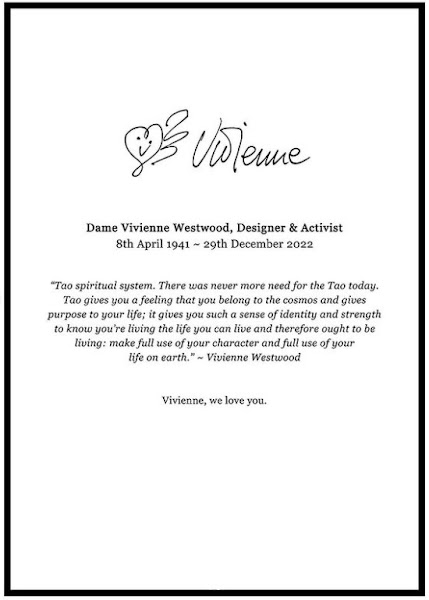
The BBC has published a lovely obit article about Dame Vivienne Westwood following her death yesterday.
Dame Vivienne Westwood - the godmother of punk
Photo by Francois Durand
She was the anarchic idealist who stormed the battlements of the status quo and transformed Britain.
She was a would-be revolutionary, fired by a hatred of corruption and global injustice, who despaired at the indolent passivity of youth.
Vivienne Westwood gave birth to punk, conquered high-fashion and built a global empire. She invented New Romantics, sent Naomi Campbell down the catwalk wearing a traffic cone and turned up to meet the Queen having left her underwear behind.
For Westwood, fashion was a weapon. Of course, she thought, clothes made people sexy. But the point was to shake things up, to destroy miserable conformity and make a better world.
Vivienne Isabel Swire was born on 8 April 1941 in the Derbyshire village of Tintwistle, the oldest of three children.
Her working class parents were good with their hands. They encouraged her to make things, which she did with enthusiasm. But they were deeply puzzled by their daughter's addiction to reading, once paying her to destroy her library card.
She had an enviable self-confidence, believing herself an exceptional craftswoman. At grammar school in Glossop, she saw herself as "a kind of champion". "Honestly", she later said, "at the age of five, I could have made a pair of shoes".
The family moved to North London in 1958. Vivienne dabbled in silversmithing at the local school of art but quit after a single term. Self-confident she may have been, but she failed to see how a working-class girl could make a living like that.
She qualified as a primary school teacher, then married Derek Westwood - handsome Hoover factory apprentice by day and flamboyant Mod by night. Westwood made her own wedding dress and jewellery. A year later, she gave birth to their son.
Then, a chance meeting changed everything. Her brother, Gordon, brought a 19-year-old, fellow art student round to her flat in Harrow. He had red hair and a face whitened with talcum powder. His name was Malcolm McLaren: self-declared genius and godfather of punk.
So began one of Britain's great creative partnerships. They moved into a tiny flat in Clapham, had a child and launched a cultural revolution that shook, and sometimes frightened, the world.
McLaren was impossible. His mother was a sex worker and he had been brought up by his eccentric grandmother, who lived by the motto "to be bad is to be good and to be good is just boring".
He was a peacock: intent on blinding small people with his brilliance, affronting an older generation he detested and belittling everyone but himself - especially Vivienne.
He took six days to visit her in hospital after the birth of their son, refused to be called 'Dad' and threatened to cart the child to Barnardo's when asked to pitch in. Westwood retreated to a caravan in Wales; hunting for wild vegetables while he ran riot in London and married another art student.
But attraction overcame everything. Her childhood had been happy, but a cultural desert. Creatively, McLaren was an awakening; introducing her to art, music and helping her transform "from dolly bird into a chic, confident dresser". Westwood rekindled the partnership, blossomed artistically and simply ignored the abuse.
Then came the Sex Pistols, snarling at the 1970s. McLaren embraced them as an angry pot-shot at the hippy movement he hated. Westwood opened a shop on the King's Road, conjuring the look the Pistols made famous. A bewildered world gasped and named it Punk.
She called the shop, 'Let It Rock', then changed the name to 'Too Fast To Live, Too Young To Die'. Finally, it was re-branded simply as 'SEX' - the huge pink sign above the door meant only the brave went in.
Inside, the staff were intimidating. There was Chrissie Hyde, Toyah Wilcox and, most terrifying of all, 'Jordan': a woman who actually received an Arts Council grant to be her indomitable self.
The clothes, of course, were like nothing else. They were radical and individualistic, sticking two-fingers up at rival street-fashions like flower-power, Teddy Boy and Mod.
It was as much anthropology as style. Bondage trousers and swastika jackets were, she explained, "sex translated into fashion becoming fetish". It was, she declared, "the very embodiment of youth's assumption of immortality".
Westwood's parents hated Malcolm and were deeply shocked; but they gave her the money to get started and loyally offered practical help while "our Vivienne" filled the racks with studs, chains and nipple zips.
Westwood's rubber negligee, spiky hair, stilettos and pornographic T-shirt literally stopped traffic. She was having a ball, feeling like a "princess from another planet."
Later, McLaren would boast he was a "con man", a Svengali who twisted popular culture into nothing more than a convenient marketing gimmick. For Westwood, the movement was more profound; seeing it as as counter-cultural youth insurgency against the corruption of the old world order.
Punk, she earnestly believed, was more than fashion. The movement was political; the aim was revolution. When the young showed no inclination to stop spitting and build barricades, Westwood was bitterly disappointed.
She fell out with the Sex Pistols' lead singer Johnny Rotten: both claiming to have inspired the idea and title of Anarchy In The UK. But what frustrated her was that the spiky-haired musician had missed the message.
The clothes and music were supposed to channel rage and bring about change. But the young simply ignored global injustice, stuck safety-pins in their nose and moshed to the music. While Westwood and McLaren were full of revolution, it never happened. Westwood felt let-down, became disillusioned and, eventually, drifted on.
Instead, she took her subversive ideas and stormed the catwalks of London and Paris. Working alone on a little sewing-machine in her front room, Westwood put the pieces together using her own body as a template.
Intellectually inspired by a Canadian art historian, Gary Ness, she researched the history of fashion, reworked it with vengeance and dared the world of haute-couture to reject her. She put models in Harris Tweed, fine knitting, 'mini-crinis' and corsets that pushed their busts almost up to the chin.
The public sniggered. Westwood threatened to walk out of one BBC interview when the audience kept laughing. It didn't help that Russell Harty, a fellow guest, described one girl as a "walking chip shop." The Pistols sneered too, accusing her of abandoning punk and making "posh frocks for Ascot".
It wasn't easy; at times she came close to bankruptcy but the fashion world came to love her. Alongside McLaren, she put on legendary collections with names like Pirate, Savages and Nostalgia of Mud. And when he pushed off, she continued solo: kick-starting New Romanticism with designs that parodied the establishment. The establishment lapped it up.
In the end, she made a fortune. One show in Paris was over in the time it takes to hard boil an egg, but featured clothes worth more than one million pounds. When Sex and the City's Carrie Bradshaw wanted a wedding dress, she turned to Westwood. The woman who ran a shop on the King's Road had become a major global brand.
In 1989, the hugely influential Women's Wear Daily magazine rated her one of the six best designers of the twentieth century; the only woman, alongside Armani, Lagerfeld and Saint Laurent. "As far as I was concerned," she said, "it was a statement of fact." When Naomi Campbell fell off her nine-inch purple platforms on the catwalk, the shoes simply flew off the shelves.
Westwood's success did not mean she had given up on revolution. Deeply political, her art had a purpose. She dressed models as punked-up debutantes, thumbing her nose at the ruling classes. Her clothes subverted the fashions that had historically subjected woman. She made T-shirts emblazoned with profane political slogans, selling them at a price.
Westwood loathed Tony Blair and Margaret Thatcher with a passion and threw herself into a life-long crusade to promote individual liberty, rid the world of nuclear weapons and combat the threat of climate change.
She supported Aids Research, PETA and Oxfam, gave hundreds of thousands to the Green Party and became a regular visitor to Julian Assange during his seven-year stint in the Ecuadorian embassy. She even parked a white tank outside David Cameron's house in a protest against fracking.
Given an OBE in 1992, Westwood turned up without any knickers on, giving photographers the shock of their lives as she gave a twirl. If Her Majesty was not amused, she didn't show it and Westwood was back at the Palace a few years later when the legendary rebel became a Dame.
In 1992, Westwood married again, this time to an Austrian fashion student half her age. Andreas Kronthaler was calm and supportive: indeed everything that McLaren was not. The pair formed a new creative partnership, for years still working from Westwood's Spartan, ex-council flat.
Westwood said her favourite quotation was from Aldous Huxley, although it has been attributed to Bertrand Russell. "Orthodoxy", he said, "is the grave of intelligence". The shop she opened on the King's Road still operates. It's now called World's End, selling archive designs and slogan T-shirts, in memory of an icon determined to wage war against conformity.
The godmother of punk, empress of global fashion and Dame of the British Empire certainly did that.
Dame Vivienne Westwood (previously here) has died today at the age of 81. It is reported that she died peacefully at home, surrounded by her family.
She was a genius who lived, worked, and protested on her own terms, always. In his 1989 book CHIC SAVAGES, Women's Wear Daily editor John Fairchild said Westwood was one of the six most influential designers of the 20th century, along with Yves Saint Laurent, Karl Lagerfeld, Giorgio Armani, Christian Lacroix and Emanuel Ungaro.
In a 2017 post, here, about her FW '17-'18 collection, I noted "I'm so glad there is a Dame Vivienne Westwood in the world. She makes me happy and her creations brighten up the landscape quite a bit."
She, her talent, and creations will be greatly missed.
The house will continue with her husband and collaborator Andreas Kronthaler at the helm.
I am not a fan of country music. AT ALL. There are a variety of reasons for that, some personal, some political, some social. But there was a time when country music was simply a genre and not a political statement. When I was growing up, my mom listened to Country and Western artists (as the genre was referred to then) like Patsy Cline, Dolly Parton and Porter Wagoner, and of course early Rockabilly-Country Elvis.
And singer-songwriter Orville Peck is a new artist who is attempting to bring back a certain feeling and sound of that kind of country music. He has deliberately cultivated a mystery about who he is by wearing a fringed, leather Lone Ranger mask. And while a bit of sleuthing on-line can reveal his actual identity, I will not reveal here who he is when he is not Orville Peck...because there is something about him, his persona, and his sound that is appealing to me, despite my aversion to country music. The more I discovered about the actual man beneath the mask, I realized why I am drawn to him and the sound. He is Canadian, a former drummer in punk bands, a classically stage-trained actor (he studied mask-making in this capacity and now makes his own fringed masks for Orville Peck), and openly gay. All of that tempers the music...he allows a lot of different influences--punk, shoegaze, early Country and Western--to blend together into something unique. This is reflected in his delightful, kitschy video for his single, "Turn To Hate." And that deep, velvety voice...like Johnny Cash.
Take a look at this song played live with his band on KEXP.
And then do take a moment to watch this charming, funny interview of Peck playing "Would You Rather?"
He is currently on tour through the end of 2019. Check out his site to see if he will be in a city near you! https://www.orvillepeck.com/
Punk rock and bisexual icon Pete Shelley has died at the too-young age of 63. After the success of his punk band Buzzcocks (contemporaries of The Sex Pistols), he went solo and in 1981, he recorded a genre-defying song that mixed both acoustic guitar and synthesizers (which were being heavily explored in music at this time) in a propulsive, effervescent gay anthem called "Homosapien." The mix of acoustic and electronic instruments sounds amazingly fresh and sparkling even today. I used to hear this song played while waiting to see bands like Frankie Goes to Hollywood and Ultravox at The Kabuki Nightclub in San Francisco in the early 80s!
I'm the shy boy, you're the coy boy
And you know we're Homosapien too
I'm the cruiser, you're the loser
Me and you sir, Homosapien too
Homosuperior in my interior
But from the skin out
I'm Homosapien too
And you're Homosapien too
And I'm Homosapien like you
And we're Homosapien too
And I think of your eyes in the dark
And I see the star
And I look to the light
And I might wonder right where you are
All the Gods in the sky, way up high
See the earth spinning 'round
But the sun and the moon
And the stars are so far from the ground
I'm the shy boy, you're the coy boy
And you know we're Homosapien too
I'm the cruiser, you're the loser
Me and you sir, Homosapien too
Homosuperior in my interior
But from the skin out
I'm Homosapien too
And you're Homosapien too
And I'm Homosapien like you
And we're Homosapien too
And the world's built of age are a stage
Where we act out our lives
And the words in the script seem to fit
'Cept we have some surprise
I just want this to last
Or my future is past and all gone
And if this is the case
Then I'll lose in life's race from now on
Homosuperior in my interior
But from the skin out
I'm Homosapien too
And you're Homosapien too
And I'm Homosapien like you
And we're Homosapien too
And I just hope and pray
That the day of our love is at hand
You and I, me and you
We will be one from two, understand?
And the world is so wrong
That I hope that we'll be strong enough
For we are on our own
And the only thing known is our love
I don't wanna classify you
Like an animal in the zoo
But it seems good to me to know
That you're Homosapien too
I'm the shy boy, you're the coy boy
I don't wanna classify you
Like an animal in the zoo
But it seems good to me to know
That you're Homosapien too
I don't wanna classify you
Like an animal in the zoo
But it seems good to me to know
That you're Homosapien too
I don't wanna classify you
Like an animal in the zoo
But it seems good to me to know
That you're Homosapien too
At London Fashion Week, Matthew Miller showed a sharp SS '18 collection in St. Sepulchre's Church. Miller said it was 1) inspired by the young generation who just became of age to vote and their "unadulterated freedom" (here is a staggering and encouraging statistic: a whopping 72% of 18 to 24 year-olds came out to vote in the recent British election last week, a sure sign that young people can prevent governments from veering to the Right, and creeping more and more toward Fascism)...and 2) a reaction against the current, oppressive, tired obsession with "streetwear" in fashion. While we optimistically celebrate #1, I personally thank you for #2, Mr. Miller! I have been bemoaning the "streetwear" and "sportswear" trend for several seasons now.
Although he playfully referred to his collection as "degenerate," with obvious references to Goth and Punk subcultures (bondage straps and smeared black lipstick), the garments themselves are elegantly tailored. Just take a look at the slim, well-cut trousers,tuxedo jackets, and that most-British of staples, the trench coat which in this collection was made in collaboration with British brand Hancock! Fashion journalist Sarah Mower says, "In a Brexit situation, supporting working-class specialist skills in local areas is among the most relevant stances a fashion designer can take."
"Oh, By The Way" is my digital scrap book of things I like, things I would share with a close friend and say: “Oh, by the way, do you know of this artist/ clothing or interior designer/ model/ singer/ actor/ gorgeous man… or, have you seen this video/ photo/ film... or heard (or do you remember) this song/ band... or, read this book/ poem/ inspiring quote... or, visited this place/ museum/ restaurant/ famous building... or, have you heard of this amazing new scientific discovery?”
I am dedicated to posting the positive, the fascinating, the beautiful, the interesting, the moving, and the inspiring and uplifting. Sometimes I post cultural as well as personal observations, milestones, and remembrances. And just like life, all of these things may often have a bit of melancholy or even sadness in them, which is what makes our time here so lovely and bittersweet and precious.
Some of the photos, art, poetry, and prose are my own original work, credited with my initials, JEF. When it isn't, I always try to post links to the original source material, but often I find photos on the web that are not linked or other material that is not sourced. In these instances, I post them without malice since it is assumed that such things, by being globally posted on something as uncontrollable as the internet to begin with, are in the public domain. If you identify the source of an image that is not linked, please politely let me know (without accusing me of theft, please) and I will be happy to provide a link. If you are the owner of an image and would prefer it be removed, I am happy to do that as well (again, without accusing me of theft, please).
I hope to inspire and entertain my readers with things that inspire and entertain me. There is a startling amount of beauty and creativity in the world and it enriches us all to participate in it.
All-time Favorite Films
2001: A Space Odyssey (Kubrick)
After Hours (Hysterical, hair-raising ride through NYC at night)
Amelie
American Beauty (Alan Ball)
Baraka (Stunning, transcending—the "spiritus mundi" on film)
Belle et Bete (Cocteau)
Big Sleep, The (The epitome of film noir)
Bringing Up Baby (Hepburn & Grant—the epitome of screwball comedy)
Cook, The Thief, His Wife, and Her Lover, The (Greenaway)
Crash (Cronenberg—DIFFICULT subject, not for everyone)
Don’t Look Now (Nicolas Roeg—ultimate modern gothic horror)
Drowning By Numbers (Greenaway)
Easy Rider
Edward II (Derek Jarman)
Erendira (From magic realist Marquez’ brilliant short story)
Eyes Wide Shut (Kubrick's last film)
Fearless (Jeff Bridges—life and death)
Funny Bones (Leslie Caron, Jerry Lewis, and the brilliant Lee Evans)
Holiday (Hepburn & Grant)
Howard’s End (The ultimate statement of the unfairness of class systems)
Hunger, The
Ice Storm, The
Inland Empire (David Lynch)
Interiors (Woody Allen's ode to Bergman)
Jetée, La (French short that inspired Gilliam's "12 Monkeys")
Jules et Jim (Truffaut)
Juliet of the Spirits (My favorite Fellini)
Kwaidan (4 Japanese ghost stories)
L’Age d’Or (Bunuel)
Last Temptation of Christ, The (Jesus was a shaman)
Latcho Drom (Beautiful visual documentary of Romany culture around the world)
Lion in Winter, The (Hepburn!—Like “Who’s Afraid of Virginia Woolf” but circa 1183)
Living End, The
Logan's Run
Lost Highway (David Lynch)
Magnolia
Maurice (Boy gets boy, they live happily ever after!!!!!)
Men Don’t Leave (Jessica Lange’s gorgeous delicate performance)
Mirror, The (achingly beautiful stream of consciousness Tarkovsky)
Nights of Cabiria, The (Fellini)
Orlando (Tilda Swinton’s pristine performance and Sally Potter’s ravishing visuals)
Orphée (HEAVEN! Cocteau was a genius)
Pennies From Heaven (Steve Martin/ stunning Edward Hopper sets!)
Philadelphia Story, The (Hepburn)
Pillow Book, The (Greenaway)
Planet of the Apes (1968...NOT 2001!)
Postman Always Rings Twice, The (Nicholson/Lange--WOW)
Prospero’s Books (Greenaway)
Rebel Without a Cause ("I got the bullets!")
Satyricon (Fellini)
Shining, The (Kubrick)
Solaris (atmospheric, haunting Andrei Tarkovsky sci-fi)
Stalker (chilling Andrei Tarkovsky sci-fi)
Thin Red Line, The (Terrence Malick--existential poetry cleverly disguised as a war film)
Titus (Julie Taymor does Shakespeare)
Tommy (Brilliant, audacious Ken Russell film of The Who's rock opera)
Tree Of Life, The (Terrence Malick masterpiece)
Un Chien Andalou (Bunuel and Dali, need more be said?)
Wall,The (Pink Floyd)
Wings of Desire (All the feelings of the entire human race in one film)
Woman of the Year (Dated yet charming Hepburn vehicle)
Zabriskie Point (Empty, open, classic early 70s)
ZOO, A Zed and Two Noughts (Greenaway)
The Sounds My Soul Makes: Music
Annie Lennox
Brian Eno
Cocteau Twins
David Bowie
David Sylvian
Dead Can Dance
Durutti Column
Elbow
Everything But the Girl
Gang of Four
Gem Club
Goldfrapp
Joni Mitchell
José González
Junip
Kate Bush
Laurie Anderson
M83
Morrissey
Nine Inch Nails
Peter Gabriel
Peter Murphy
Rickie Lee Jones
Sigur Ros
Simple Minds
Smiths, The
Sufjan Stevens
Talk Talk
Tears For Fears
This Mortal Coil
Tori Amos
Ultravox
William Orbit
Zero 7
Important Books That Have Influenced Me
100 Years of Solitude—Gabriel Garcia Marquez
A Wrinkle in Time, A Wind in the Doorway (for young people but worth it)—Madeleine L’Engle