Showing posts with label fashion designer. Show all posts
Thursday, September 4, 2025
R.I.P. Giorgio Armani
I am very saddened to learn of the death of a legend...Giorgio Armani.
He had just celebrated his 91st birthday in July but had been ill in hospital for a bit.
It is impossible to exaggerate his achievements and contribution to culture, to design (not only of clothing, but of home furnishings and architecture), and to fashion history during his fifty year career. Along with names who changed silhouettes and shapes and ushered in new cuts and styles and materials, Armani takes his place in the pantheon. He deconstructed the men's suit in the 80s, turning it into something soft and sensual, something sexy and flowing, without altering the basic concept of what it was. He removed layers of felting inside suits, making them relaxed and able to behave like thin silk. Just take a look at the iconic clothing from the film "American Gigolo" and you will see what I mean. It was soft and casual with a sense of effortless power. This revolution rippled out into the industry and we see its waves even now: designers still grapple with ways to make suiting less stiff, to make clothing more luxe without being precious, and to make pieces with more innate ease without being sloppy. In short, to make clothes more Armani. But no one does Armani like Armani. Clean lined and impeccably tailored, Armani's sensibility is about luxe fabrics and the way a garment hangs and drapes on the body (of both men and women). But there is something else that I really respond to in each Armani collection and that is a vague sense, a shadow, an echo of historical fashion. The way a jacket or coat is cut or its stance, the inclusion of waistcoats, belted outerwear, loose cut and high waisted trousers...it all reminds me of...what, the 1920s and 30s? The 1880s and 1890s? The 1940s and 50s? Yes to all of it.
Thank you, sincerely, for all the beauty you brought into the world, Signor Armani. You will missed.
Labels:
death,
fashion,
fashion designer,
Giorgio Armani,
grief,
italian,
italy,
legend,
legendary,
r.i.p.,
revolutionary
Friday, December 30, 2022
"Dame Vivienne Westwood - the godmother of punk"
The BBC has published a lovely obit article about Dame Vivienne Westwood following her death yesterday.
Dame Vivienne Westwood - the godmother of punk
She was the anarchic idealist who stormed the battlements of the status quo and transformed Britain.
She was a would-be revolutionary, fired by a hatred of corruption and global injustice, who despaired at the indolent passivity of youth.
Vivienne Westwood gave birth to punk, conquered high-fashion and built a global empire. She invented New Romantics, sent Naomi Campbell down the catwalk wearing a traffic cone and turned up to meet the Queen having left her underwear behind.
For Westwood, fashion was a weapon. Of course, she thought, clothes made people sexy. But the point was to shake things up, to destroy miserable conformity and make a better world.
Vivienne Isabel Swire was born on 8 April 1941 in the Derbyshire village of Tintwistle, the oldest of three children.
Her working class parents were good with their hands. They encouraged her to make things, which she did with enthusiasm. But they were deeply puzzled by their daughter's addiction to reading, once paying her to destroy her library card.
She had an enviable self-confidence, believing herself an exceptional craftswoman. At grammar school in Glossop, she saw herself as "a kind of champion". "Honestly", she later said, "at the age of five, I could have made a pair of shoes".
The family moved to North London in 1958. Vivienne dabbled in silversmithing at the local school of art but quit after a single term. Self-confident she may have been, but she failed to see how a working-class girl could make a living like that.
She qualified as a primary school teacher, then married Derek Westwood - handsome Hoover factory apprentice by day and flamboyant Mod by night. Westwood made her own wedding dress and jewellery. A year later, she gave birth to their son.
Then, a chance meeting changed everything. Her brother, Gordon, brought a 19-year-old, fellow art student round to her flat in Harrow. He had red hair and a face whitened with talcum powder. His name was Malcolm McLaren: self-declared genius and godfather of punk.
So began one of Britain's great creative partnerships. They moved into a tiny flat in Clapham, had a child and launched a cultural revolution that shook, and sometimes frightened, the world.
McLaren was impossible. His mother was a sex worker and he had been brought up by his eccentric grandmother, who lived by the motto "to be bad is to be good and to be good is just boring".
He was a peacock: intent on blinding small people with his brilliance, affronting an older generation he detested and belittling everyone but himself - especially Vivienne.
He took six days to visit her in hospital after the birth of their son, refused to be called 'Dad' and threatened to cart the child to Barnardo's when asked to pitch in. Westwood retreated to a caravan in Wales; hunting for wild vegetables while he ran riot in London and married another art student.
But attraction overcame everything. Her childhood had been happy, but a cultural desert. Creatively, McLaren was an awakening; introducing her to art, music and helping her transform "from dolly bird into a chic, confident dresser". Westwood rekindled the partnership, blossomed artistically and simply ignored the abuse.
Then came the Sex Pistols, snarling at the 1970s. McLaren embraced them as an angry pot-shot at the hippy movement he hated. Westwood opened a shop on the King's Road, conjuring the look the Pistols made famous. A bewildered world gasped and named it Punk.
She called the shop, 'Let It Rock', then changed the name to 'Too Fast To Live, Too Young To Die'. Finally, it was re-branded simply as 'SEX' - the huge pink sign above the door meant only the brave went in.
Inside, the staff were intimidating. There was Chrissie Hyde, Toyah Wilcox and, most terrifying of all, 'Jordan': a woman who actually received an Arts Council grant to be her indomitable self.
The clothes, of course, were like nothing else. They were radical and individualistic, sticking two-fingers up at rival street-fashions like flower-power, Teddy Boy and Mod.
It was as much anthropology as style. Bondage trousers and swastika jackets were, she explained, "sex translated into fashion becoming fetish". It was, she declared, "the very embodiment of youth's assumption of immortality".
Westwood's parents hated Malcolm and were deeply shocked; but they gave her the money to get started and loyally offered practical help while "our Vivienne" filled the racks with studs, chains and nipple zips.
Westwood's rubber negligee, spiky hair, stilettos and pornographic T-shirt literally stopped traffic. She was having a ball, feeling like a "princess from another planet."
Later, McLaren would boast he was a "con man", a Svengali who twisted popular culture into nothing more than a convenient marketing gimmick. For Westwood, the movement was more profound; seeing it as as counter-cultural youth insurgency against the corruption of the old world order.
Punk, she earnestly believed, was more than fashion. The movement was political; the aim was revolution. When the young showed no inclination to stop spitting and build barricades, Westwood was bitterly disappointed.
She fell out with the Sex Pistols' lead singer Johnny Rotten: both claiming to have inspired the idea and title of Anarchy In The UK. But what frustrated her was that the spiky-haired musician had missed the message.
The clothes and music were supposed to channel rage and bring about change. But the young simply ignored global injustice, stuck safety-pins in their nose and moshed to the music. While Westwood and McLaren were full of revolution, it never happened. Westwood felt let-down, became disillusioned and, eventually, drifted on.
Instead, she took her subversive ideas and stormed the catwalks of London and Paris. Working alone on a little sewing-machine in her front room, Westwood put the pieces together using her own body as a template.
Intellectually inspired by a Canadian art historian, Gary Ness, she researched the history of fashion, reworked it with vengeance and dared the world of haute-couture to reject her. She put models in Harris Tweed, fine knitting, 'mini-crinis' and corsets that pushed their busts almost up to the chin.
The public sniggered. Westwood threatened to walk out of one BBC interview when the audience kept laughing. It didn't help that Russell Harty, a fellow guest, described one girl as a "walking chip shop." The Pistols sneered too, accusing her of abandoning punk and making "posh frocks for Ascot".
It wasn't easy; at times she came close to bankruptcy but the fashion world came to love her. Alongside McLaren, she put on legendary collections with names like Pirate, Savages and Nostalgia of Mud. And when he pushed off, she continued solo: kick-starting New Romanticism with designs that parodied the establishment. The establishment lapped it up.
In the end, she made a fortune. One show in Paris was over in the time it takes to hard boil an egg, but featured clothes worth more than one million pounds. When Sex and the City's Carrie Bradshaw wanted a wedding dress, she turned to Westwood. The woman who ran a shop on the King's Road had become a major global brand.
In 1989, the hugely influential Women's Wear Daily magazine rated her one of the six best designers of the twentieth century; the only woman, alongside Armani, Lagerfeld and Saint Laurent. "As far as I was concerned," she said, "it was a statement of fact." When Naomi Campbell fell off her nine-inch purple platforms on the catwalk, the shoes simply flew off the shelves.
Westwood's success did not mean she had given up on revolution. Deeply political, her art had a purpose. She dressed models as punked-up debutantes, thumbing her nose at the ruling classes. Her clothes subverted the fashions that had historically subjected woman. She made T-shirts emblazoned with profane political slogans, selling them at a price.
Westwood loathed Tony Blair and Margaret Thatcher with a passion and threw herself into a life-long crusade to promote individual liberty, rid the world of nuclear weapons and combat the threat of climate change.
She supported Aids Research, PETA and Oxfam, gave hundreds of thousands to the Green Party and became a regular visitor to Julian Assange during his seven-year stint in the Ecuadorian embassy. She even parked a white tank outside David Cameron's house in a protest against fracking.
Given an OBE in 1992, Westwood turned up without any knickers on, giving photographers the shock of their lives as she gave a twirl. If Her Majesty was not amused, she didn't show it and Westwood was back at the Palace a few years later when the legendary rebel became a Dame.
In 1992, Westwood married again, this time to an Austrian fashion student half her age. Andreas Kronthaler was calm and supportive: indeed everything that McLaren was not. The pair formed a new creative partnership, for years still working from Westwood's Spartan, ex-council flat.
Westwood said her favourite quotation was from Aldous Huxley, although it has been attributed to Bertrand Russell. "Orthodoxy", he said, "is the grave of intelligence". The shop she opened on the King's Road still operates. It's now called World's End, selling archive designs and slogan T-shirts, in memory of an icon determined to wage war against conformity.
The godmother of punk, empress of global fashion and Dame of the British Empire certainly did that.
Link to original article:
https://www.bbc.com/news/entertainment-arts-44683514
Dame Vivienne Westwood - the godmother of punk
![]() |
| Photo by Francois Durand |
She was the anarchic idealist who stormed the battlements of the status quo and transformed Britain.
She was a would-be revolutionary, fired by a hatred of corruption and global injustice, who despaired at the indolent passivity of youth.
Vivienne Westwood gave birth to punk, conquered high-fashion and built a global empire. She invented New Romantics, sent Naomi Campbell down the catwalk wearing a traffic cone and turned up to meet the Queen having left her underwear behind.
For Westwood, fashion was a weapon. Of course, she thought, clothes made people sexy. But the point was to shake things up, to destroy miserable conformity and make a better world.
Vivienne Isabel Swire was born on 8 April 1941 in the Derbyshire village of Tintwistle, the oldest of three children.
Her working class parents were good with their hands. They encouraged her to make things, which she did with enthusiasm. But they were deeply puzzled by their daughter's addiction to reading, once paying her to destroy her library card.
She had an enviable self-confidence, believing herself an exceptional craftswoman. At grammar school in Glossop, she saw herself as "a kind of champion". "Honestly", she later said, "at the age of five, I could have made a pair of shoes".
The family moved to North London in 1958. Vivienne dabbled in silversmithing at the local school of art but quit after a single term. Self-confident she may have been, but she failed to see how a working-class girl could make a living like that.
She qualified as a primary school teacher, then married Derek Westwood - handsome Hoover factory apprentice by day and flamboyant Mod by night. Westwood made her own wedding dress and jewellery. A year later, she gave birth to their son.
Then, a chance meeting changed everything. Her brother, Gordon, brought a 19-year-old, fellow art student round to her flat in Harrow. He had red hair and a face whitened with talcum powder. His name was Malcolm McLaren: self-declared genius and godfather of punk.
So began one of Britain's great creative partnerships. They moved into a tiny flat in Clapham, had a child and launched a cultural revolution that shook, and sometimes frightened, the world.
McLaren was impossible. His mother was a sex worker and he had been brought up by his eccentric grandmother, who lived by the motto "to be bad is to be good and to be good is just boring".
He was a peacock: intent on blinding small people with his brilliance, affronting an older generation he detested and belittling everyone but himself - especially Vivienne.
He took six days to visit her in hospital after the birth of their son, refused to be called 'Dad' and threatened to cart the child to Barnardo's when asked to pitch in. Westwood retreated to a caravan in Wales; hunting for wild vegetables while he ran riot in London and married another art student.
But attraction overcame everything. Her childhood had been happy, but a cultural desert. Creatively, McLaren was an awakening; introducing her to art, music and helping her transform "from dolly bird into a chic, confident dresser". Westwood rekindled the partnership, blossomed artistically and simply ignored the abuse.
Then came the Sex Pistols, snarling at the 1970s. McLaren embraced them as an angry pot-shot at the hippy movement he hated. Westwood opened a shop on the King's Road, conjuring the look the Pistols made famous. A bewildered world gasped and named it Punk.
She called the shop, 'Let It Rock', then changed the name to 'Too Fast To Live, Too Young To Die'. Finally, it was re-branded simply as 'SEX' - the huge pink sign above the door meant only the brave went in.
Inside, the staff were intimidating. There was Chrissie Hyde, Toyah Wilcox and, most terrifying of all, 'Jordan': a woman who actually received an Arts Council grant to be her indomitable self.
The clothes, of course, were like nothing else. They were radical and individualistic, sticking two-fingers up at rival street-fashions like flower-power, Teddy Boy and Mod.
It was as much anthropology as style. Bondage trousers and swastika jackets were, she explained, "sex translated into fashion becoming fetish". It was, she declared, "the very embodiment of youth's assumption of immortality".
Westwood's parents hated Malcolm and were deeply shocked; but they gave her the money to get started and loyally offered practical help while "our Vivienne" filled the racks with studs, chains and nipple zips.
Westwood's rubber negligee, spiky hair, stilettos and pornographic T-shirt literally stopped traffic. She was having a ball, feeling like a "princess from another planet."
Later, McLaren would boast he was a "con man", a Svengali who twisted popular culture into nothing more than a convenient marketing gimmick. For Westwood, the movement was more profound; seeing it as as counter-cultural youth insurgency against the corruption of the old world order.
Punk, she earnestly believed, was more than fashion. The movement was political; the aim was revolution. When the young showed no inclination to stop spitting and build barricades, Westwood was bitterly disappointed.
She fell out with the Sex Pistols' lead singer Johnny Rotten: both claiming to have inspired the idea and title of Anarchy In The UK. But what frustrated her was that the spiky-haired musician had missed the message.
The clothes and music were supposed to channel rage and bring about change. But the young simply ignored global injustice, stuck safety-pins in their nose and moshed to the music. While Westwood and McLaren were full of revolution, it never happened. Westwood felt let-down, became disillusioned and, eventually, drifted on.
Instead, she took her subversive ideas and stormed the catwalks of London and Paris. Working alone on a little sewing-machine in her front room, Westwood put the pieces together using her own body as a template.
Intellectually inspired by a Canadian art historian, Gary Ness, she researched the history of fashion, reworked it with vengeance and dared the world of haute-couture to reject her. She put models in Harris Tweed, fine knitting, 'mini-crinis' and corsets that pushed their busts almost up to the chin.
The public sniggered. Westwood threatened to walk out of one BBC interview when the audience kept laughing. It didn't help that Russell Harty, a fellow guest, described one girl as a "walking chip shop." The Pistols sneered too, accusing her of abandoning punk and making "posh frocks for Ascot".
It wasn't easy; at times she came close to bankruptcy but the fashion world came to love her. Alongside McLaren, she put on legendary collections with names like Pirate, Savages and Nostalgia of Mud. And when he pushed off, she continued solo: kick-starting New Romanticism with designs that parodied the establishment. The establishment lapped it up.
In the end, she made a fortune. One show in Paris was over in the time it takes to hard boil an egg, but featured clothes worth more than one million pounds. When Sex and the City's Carrie Bradshaw wanted a wedding dress, she turned to Westwood. The woman who ran a shop on the King's Road had become a major global brand.
In 1989, the hugely influential Women's Wear Daily magazine rated her one of the six best designers of the twentieth century; the only woman, alongside Armani, Lagerfeld and Saint Laurent. "As far as I was concerned," she said, "it was a statement of fact." When Naomi Campbell fell off her nine-inch purple platforms on the catwalk, the shoes simply flew off the shelves.
Westwood's success did not mean she had given up on revolution. Deeply political, her art had a purpose. She dressed models as punked-up debutantes, thumbing her nose at the ruling classes. Her clothes subverted the fashions that had historically subjected woman. She made T-shirts emblazoned with profane political slogans, selling them at a price.
Westwood loathed Tony Blair and Margaret Thatcher with a passion and threw herself into a life-long crusade to promote individual liberty, rid the world of nuclear weapons and combat the threat of climate change.
She supported Aids Research, PETA and Oxfam, gave hundreds of thousands to the Green Party and became a regular visitor to Julian Assange during his seven-year stint in the Ecuadorian embassy. She even parked a white tank outside David Cameron's house in a protest against fracking.
Given an OBE in 1992, Westwood turned up without any knickers on, giving photographers the shock of their lives as she gave a twirl. If Her Majesty was not amused, she didn't show it and Westwood was back at the Palace a few years later when the legendary rebel became a Dame.
In 1992, Westwood married again, this time to an Austrian fashion student half her age. Andreas Kronthaler was calm and supportive: indeed everything that McLaren was not. The pair formed a new creative partnership, for years still working from Westwood's Spartan, ex-council flat.
Westwood said her favourite quotation was from Aldous Huxley, although it has been attributed to Bertrand Russell. "Orthodoxy", he said, "is the grave of intelligence". The shop she opened on the King's Road still operates. It's now called World's End, selling archive designs and slogan T-shirts, in memory of an icon determined to wage war against conformity.
The godmother of punk, empress of global fashion and Dame of the British Empire certainly did that.
Link to original article:
https://www.bbc.com/news/entertainment-arts-44683514
Labels:
Activist,
BBC,
beauty: clothing,
clothing,
Dame Vivienne Westwood,
death,
england,
fashion,
fashion designer,
grief,
icon,
London,
loss,
men's clothing,
men's fashion,
obituary,
punk,
r.i.p.,
womenswear
Thursday, December 29, 2022
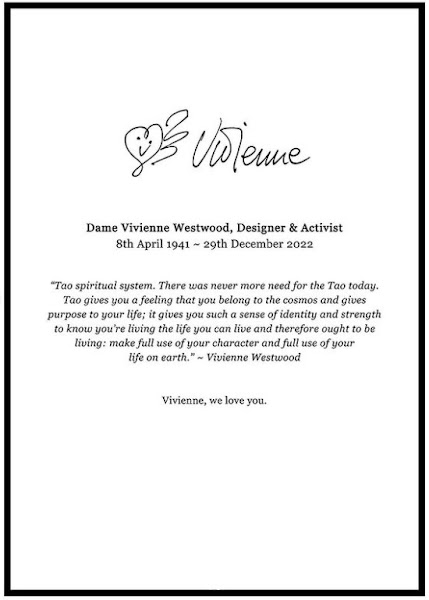
R.I.P. Dame Vivienne Westwood
Dame Vivienne Westwood (previously here) has died today at the age of 81. It is reported that she died peacefully at home, surrounded by her family.
She was a genius who lived, worked, and protested on her own terms, always. In his 1989 book CHIC SAVAGES, Women's Wear Daily editor John Fairchild said Westwood was one of the six most influential designers of the 20th century, along with Yves Saint Laurent, Karl Lagerfeld, Giorgio Armani, Christian Lacroix and Emanuel Ungaro.
In a 2017 post, here, about her FW '17-'18 collection, I noted "I'm so glad there is a Dame Vivienne Westwood in the world. She makes me happy and her creations brighten up the landscape quite a bit."
She, her talent, and creations will be greatly missed.
The house will continue with her husband and collaborator Andreas Kronthaler at the helm.
https://www.viviennewestwood.com/
She was a genius who lived, worked, and protested on her own terms, always. In his 1989 book CHIC SAVAGES, Women's Wear Daily editor John Fairchild said Westwood was one of the six most influential designers of the 20th century, along with Yves Saint Laurent, Karl Lagerfeld, Giorgio Armani, Christian Lacroix and Emanuel Ungaro.
In a 2017 post, here, about her FW '17-'18 collection, I noted "I'm so glad there is a Dame Vivienne Westwood in the world. She makes me happy and her creations brighten up the landscape quite a bit."
She, her talent, and creations will be greatly missed.
The house will continue with her husband and collaborator Andreas Kronthaler at the helm.
https://www.viviennewestwood.com/
Labels:
Activist,
beauty: clothing,
clothing,
Dame Vivienne Westwood,
death,
england,
fashion,
fashion designer,
grief,
icon,
London,
loss,
men's clothing,
men's fashion,
punk,
r.i.p.,
womenswear
Tuesday, May 24, 2022
Vogue's Objects of Affection with Rick Owens
A severe, retro-futuristic, monastic, travertine box. And we get to see the Owenscorp cantina!
https://www.rickowens.eu/en
Labels:
apartment,
cafe,
clothing,
fashion,
fashion designer,
home,
house,
men's clothing,
men's fashion,
Owenscorp,
Rick owens,
vogue,
women's clothing,
women's fashion
Tuesday, June 8, 2021
Neil Barrett and Carlo Barone Lumaga's Apartment in Milan
I've been going through a mass of interior design magazines that have stacked up here in my studio, and have found some treasures to share. First up is the Milanese apartment clothing designer Neil Barrett (previously here) shares with his husband Carlo Barone Lumaga. I love the dark drama (note: the walls appear black but are actually a deep, sable brown!) and restraint of their home...the play of textures and materials along with the juxtaposition of antique and modern makes it seem luxurious and intriguing.
https://www.neilbarrett.com/it/
Photos from https://www.elledecor.com/design-decorate/house-interiors/a28482724/designer-neil-barrett-milan-home-tour/
Subscribe to:
Posts (Atom)