The marvelous series "Great Art Explained," created and produced by gallerist and art historian James Payne, covers Edward Hopper's creation of Nighthawks.
Edward Hopper’s world was New York, and he understood that city more than most people. He understood that, even though you may live in one of the most crowded and busy cities on earth, it is still possible to feel entirely alone.
This painting, was completed on January 21st, 1942, just weeks after the bombing of Pearl Harbour and America’s entry into World War two.
That’s not to say the war was a direct influence, but the feeling of dread many Americans had, surely infused the painting.
Afraid of air raid attacks, New York had blackout drills, and lights were dimmed in public spaces. Streets emptied out and Hopper’s city was effectively dark, and silent.
"Great art is the outward expression of an inner life in the artist, ad this inner life will result in his personal vision of the world."
--Edward Hopper
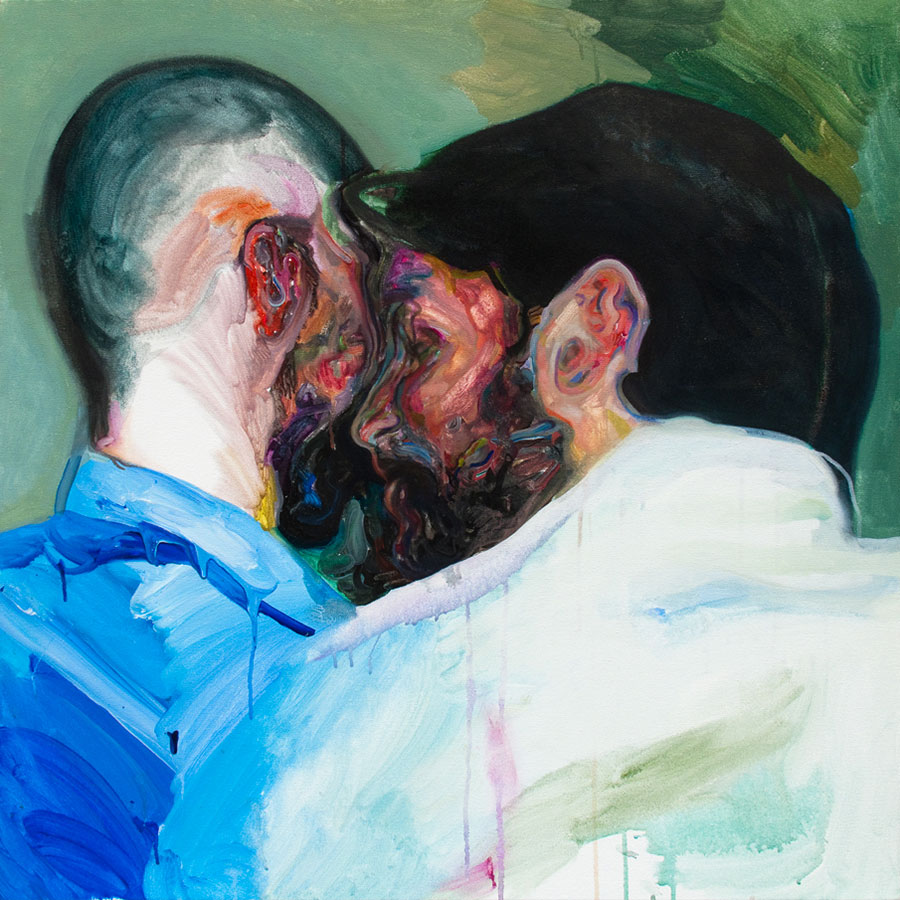
Winston Sito Chmielinski's figurative and portrait work is fascinating--a little Matisse, a little Francis Bacon. The chaotic scribbles on top of or within a figure and the colors...oh, those colors...it's all arresting.
Top to bottom: Geyser; High Tide; Low To The Ground; Oasis; Phases; Portrait 3; Switch; Tattoos For The Colorblind; The End Or Just Before; To Pause; White Noise
Vaccine mandates are controversial. They’re also an effective way to save lives.
By David Leonhardt and Ian Prasad Philbrick | The New York Times
July 23, 2021
How to save lives
Vaccine mandates are controversial. They’re also effective.
Before Houston Methodist became one of the first hospital systems in the U.S. to mandate Covid-19 vaccines, about 85 percent of its employees were vaccinated. After the mandate, the share rose to about 98 percent, with the remaining 2 percent receiving exemptions for medical or religious reasons, Bloomberg’s Carey Goldberg reported. Only about 0.6 percent of employees quit or were fired.
Schools — including Indiana University and many private colleges — that require students and workers to get vaccinated have reported extremely high uptake.
A recent Kaiser Family Foundation survey of Americans who had been opposed to getting vaccinated and later changed their minds found that mandates — or restrictions on the unvaccinated — were one common reason. One 51-year-old man told Kaiser that he began to feel as if he had “limited options without it.”
The French government will soon require that people show proof of vaccination or a recent negative test to eat at a restaurant, attend a movie or participate in many other activities. After President Emmanuel Macron announced the policy last week, the number of vaccine appointments surged. Italy announced a similar policy yesterday, The Times’s Marc Santora explains.
It’s true that these mandates often generate intense criticism. In France, more than 100,000 people marched to protest Macron’s policy. In the U.S., critics sued, unsuccessfully so far, to stop Indiana University’s mandate. Some Republican politicians have also tried to stop mandates, including Gov. Ron DeSantis of Florida and Gov. Mike DeWine of Ohio.
The mandates are also not 100 percent effective. Some people will receive exemptions, as was the case at Houston Methodist. A small number may forge vaccine records. And some vaccinated people will still contract mild versions of Covid, through so-called breakthrough infections.
But even with the opposition and the exceptions, mandates can play a major role in reducing the spread of Covid and saving lives. That’s especially true now that the Delta variant is fueling a rise in cases. “The takeaway message remains, if you’re vaccinated, you are protected,” Dr. Céline Gounder, an infectious disease specialist, told our colleague Apoorva Mandavilli. “You are not going to end up with severe disease, hospitalization or death.”
A ‘staggering’ success
Covid is a new disease, and the debates over Covid policy can seem new, as well. But they’re often not wholly new. They instead echo longstanding debates. Vaccine mandates fall into this category.
Throughout history, societies have struggled with when and how to require vaccines. Opponents of mandates have argued that individuals should be allowed to make their own health decisions — and bear the consequences: What, they ask, is more personal than deciding whether to inject a medicine into one’s body? Supporters of mandates have replied that society has a duty to protect its citizens, including those who cannot be inoculated (like young children and some immunocompromised people, in the case of Covid) and are therefore put at risk by people who voluntarily refuse vaccines.
For these reasons, vaccine mandates cause intense disputes. But when supporters win the argument, public health has often benefited. Guy Nicolette, an administrator at the University of California, Berkeley, pointed out to The Washington Post that colleges have long required other vaccines, like the one for measles. “It’s staggering how well a mandate works on a college campus,” he said.
Dr. Aaron Carroll, Indiana University’s chief health officer, has noted that the country’s victories over many diseases — including smallpox, polio, mumps, rubella and diphtheria — have depended on vaccine mandates by states or local governments. “That’s how the country achieves real herd immunity,” Carroll wrote in The Times. (In the U.S., a national mandate may be unconstitutional.)
When states and school districts have opted not to require vaccines, a disease can often spread needlessly, Carroll explained. That has been the case with human papillomavirus, a sexually transmitted disease known as HPV that can cause cancer. It’s also been the case with influenza, which kills about 35,000 Americans in a typical flu season.
Covid now seems certain to join influenza and HPV as diseases that American society chooses to accept. But it is a choice. Companies, schools and communities that decide to enact vaccine mandates will almost certainly save American lives by doing so.
Mark Barnes, a former health official in New York City, told Bloomberg that he expected the number of these mandates to grow in coming months. “We’re going to see more vaccine mandates by large organizations of all kinds,” he predicted.
The sun cuts through forests of fog and haze in the stunning work of German photographer Kilian Schönberger. These hushed, spiritual images feel like they are moments from magical stories or fairytales...
This is some deliciously dark, growling dance music: "Return To Danger Bay" by Robert Mason. I'd love to lose myself on a dance floor to this tune...flashing lights, sweat, hypnotized...it's the kind of music you'd dance to in The Matrix before Trinity and Neo come and tear up the place (welcome back T and N, missed ya, see ya soon).
Ian Strange uses light to interrupt reality. His most recent iteration of Light Intersection just closed in Sydney, Australia. The artist says:
Commissioned by the City of Sydney, LIGHT INTERSECTIONS II inserts beams of light through the facade of a late 19th century Victorian terrace home. Appearing to puncture the building across two perspective planes, the lines of light are drawn from the building's perspective lines, abstracted and inserted back into the architecture. The series explores the hand-drawn line in the landscape. In particular, perspective lines and their relationship to art and architecture as a way of understanding, interpreting and affecting landscape.
One-man-band Eagle Eye Williamson released this amazing track five years ago and it has lost none of its punch. "Snake Charmer" is a fantastic, dark, psychedelic groove that seems to evoke sounds and feelings from rock n' roll past, but is resolutely itself.
I don’t know where I’m going
I don’t know where I’ve been
I’ve been told there’s a place
That no one has ever seen
If your travels take you there
You’ll never come back again
Stars have all been delayed
Causing your course to stray
What was once dark and grey
Has become bright blue and green
When the machine becomes you
And you become a dream
Now you finally closed the door
Start trying to find your way home
And you look all around
Don’t know which way to go
Interior designer Stephen Shadley lovingly restored a dilapidated house in the Catskills. I love how he used a combination of red and black, not a palette one usually associates with Catskills homes, but wow, does it work. The house as a whole is gorgeous and evokes an early 1900s sense when homes in the Adirondacks referenced a just-past Victorian sensibility. The home was profiled in Architectural Digest and they wrote:
It was decades ago when AD100 designer Stephen Shadley first glimpsed a burned-out stone ruin, perched cinematically on Potic Mountain, just a few miles from his home in Catskill, New York. “Everyone in the area referred to it as ‘the castle,’” he recalls of the fascinating site that, after a fire in the 1970s, had turned into an illicit hangout spot, covered in graffiti. “All that was left was the foundation and a couple of chimneys, a little road leading up to the 16-acre property, and this view that was just breathtaking to behold.”
After he got his hands on some photos of the original 1913 structure—a three-story, Arts and Crafts–style summer house designed by Wilfred Buckland for a pair of English sisters—Shadley vowed that if he ever had the opportunity to purchase the property, he would rebuild the house to its former glory. Many years later, he received a call from a woman who had inherited the property. She was ready to sell.
Shadley, who had lived in the area since the 1980s, bought the place 12 years ago. But the process of rebuilding it took time. After several years of research and design, he hired a local mason to repair the stonework. “The house is visible from some of the roads down below and I wanted it to evoke the image of what had been here,” says Shadley, who—with guidance from his mentor, interior designer Robert Bray, and an eye toward the environmentally sensitive approach of Frank Lloyd Wright—followed the lines of the original foundation. Ultimately, that meant conjuring what looks like an old Adirondacks lodge, accented with bright red windows—a look he lifted from a book of old lodges that became something of an homage to Wright, who often used a similar hue.
Largely, what’s inside either reflects or makes space for the scenery out the window. Shadley, tapping into his roots as a scenic painter, created several murals based on 19th-century photographs of nearby sites; at the entry, he hung a vintage photograph of hemlock trees that was made for the National Parks Service. Perhaps the most striking pieces in the home are hewn from the literal ground it sits on. Two huge pieces of bluestone—scavenged from the property when the team blasted away a bit of the mountain to create space for a garage—were brought in on a forklift and embedded in the concrete floors as tables.
Ultimately, however, the most jaw-dropping decorations in this house are what lie out the windows. And after five years of living there—with a year-plus of around-the-clock time at home—Shadley has had the chance to really soak it all in. “Deer walk through in hordes, [plus] foxes, porcupines, wild turkeys, everything imaginable,” he says. “Just looking out the windows can be a fun experience. It’s pretty phenomenal.” Also phenomenal? Now, when Shadley gazes up at Potic from town, what he sees is not a total ruin but a castle, standing tall.
"Oh, By The Way" is my digital scrap book of things I like, things I would share with a close friend and say: “Oh, by the way, do you know of this artist/ clothing or interior designer/ model/ singer/ actor/ gorgeous man… or, have you seen this video/ photo/ film... or heard (or do you remember) this song/ band... or, read this book/ poem/ inspiring quote... or, visited this place/ museum/ restaurant/ famous building... or, have you heard of this amazing new scientific discovery?”
I am dedicated to posting the positive, the fascinating, the beautiful, the interesting, the moving, and the inspiring and uplifting. Sometimes I post cultural as well as personal observations, milestones, and remembrances. And just like life, all of these things may often have a bit of melancholy or even sadness in them, which is what makes our time here so lovely and bittersweet and precious.
Some of the photos, art, poetry, and prose are my own original work, credited with my initials, JEF. When it isn't, I always try to post links to the original source material, but often I find photos on the web that are not linked or other material that is not sourced. In these instances, I post them without malice since it is assumed that such things, by being globally posted on something as uncontrollable as the internet to begin with, are in the public domain. If you identify the source of an image that is not linked, please politely let me know (without accusing me of theft, please) and I will be happy to provide a link. If you are the owner of an image and would prefer it be removed, I am happy to do that as well (again, without accusing me of theft, please).
I hope to inspire and entertain my readers with things that inspire and entertain me. There is a startling amount of beauty and creativity in the world and it enriches us all to participate in it.
All-time Favorite Films
2001: A Space Odyssey (Kubrick)
After Hours (Hysterical, hair-raising ride through NYC at night)
Amelie
American Beauty (Alan Ball)
Baraka (Stunning, transcending—the "spiritus mundi" on film)
Belle et Bete (Cocteau)
Big Sleep, The (The epitome of film noir)
Bringing Up Baby (Hepburn & Grant—the epitome of screwball comedy)
Cook, The Thief, His Wife, and Her Lover, The (Greenaway)
Crash (Cronenberg—DIFFICULT subject, not for everyone)
Don’t Look Now (Nicolas Roeg—ultimate modern gothic horror)
Drowning By Numbers (Greenaway)
Easy Rider
Edward II (Derek Jarman)
Erendira (From magic realist Marquez’ brilliant short story)
Eyes Wide Shut (Kubrick's last film)
Fearless (Jeff Bridges—life and death)
Funny Bones (Leslie Caron, Jerry Lewis, and the brilliant Lee Evans)
Holiday (Hepburn & Grant)
Howard’s End (The ultimate statement of the unfairness of class systems)
Hunger, The
Ice Storm, The
Inland Empire (David Lynch)
Interiors (Woody Allen's ode to Bergman)
Jetée, La (French short that inspired Gilliam's "12 Monkeys")
Jules et Jim (Truffaut)
Juliet of the Spirits (My favorite Fellini)
Kwaidan (4 Japanese ghost stories)
L’Age d’Or (Bunuel)
Last Temptation of Christ, The (Jesus was a shaman)
Latcho Drom (Beautiful visual documentary of Romany culture around the world)
Lion in Winter, The (Hepburn!—Like “Who’s Afraid of Virginia Woolf” but circa 1183)
Living End, The
Logan's Run
Lost Highway (David Lynch)
Magnolia
Maurice (Boy gets boy, they live happily ever after!!!!!)
Men Don’t Leave (Jessica Lange’s gorgeous delicate performance)
Mirror, The (achingly beautiful stream of consciousness Tarkovsky)
Nights of Cabiria, The (Fellini)
Orlando (Tilda Swinton’s pristine performance and Sally Potter’s ravishing visuals)
Orphée (HEAVEN! Cocteau was a genius)
Pennies From Heaven (Steve Martin/ stunning Edward Hopper sets!)
Philadelphia Story, The (Hepburn)
Pillow Book, The (Greenaway)
Planet of the Apes (1968...NOT 2001!)
Postman Always Rings Twice, The (Nicholson/Lange--WOW)
Prospero’s Books (Greenaway)
Rebel Without a Cause ("I got the bullets!")
Satyricon (Fellini)
Shining, The (Kubrick)
Solaris (atmospheric, haunting Andrei Tarkovsky sci-fi)
Stalker (chilling Andrei Tarkovsky sci-fi)
Thin Red Line, The (Terrence Malick--existential poetry cleverly disguised as a war film)
Titus (Julie Taymor does Shakespeare)
Tommy (Brilliant, audacious Ken Russell film of The Who's rock opera)
Tree Of Life, The (Terrence Malick masterpiece)
Un Chien Andalou (Bunuel and Dali, need more be said?)
Wall,The (Pink Floyd)
Wings of Desire (All the feelings of the entire human race in one film)
Woman of the Year (Dated yet charming Hepburn vehicle)
Zabriskie Point (Empty, open, classic early 70s)
ZOO, A Zed and Two Noughts (Greenaway)
The Sounds My Soul Makes: Music
Annie Lennox
Brian Eno
Cocteau Twins
David Bowie
David Sylvian
Dead Can Dance
Durutti Column
Elbow
Everything But the Girl
Gang of Four
Gem Club
Goldfrapp
Joni Mitchell
José González
Junip
Kate Bush
Laurie Anderson
M83
Morrissey
Nine Inch Nails
Peter Gabriel
Peter Murphy
Rickie Lee Jones
Sigur Ros
Simple Minds
Smiths, The
Sufjan Stevens
Talk Talk
Tears For Fears
This Mortal Coil
Tori Amos
Ultravox
William Orbit
Zero 7
Important Books That Have Influenced Me
100 Years of Solitude—Gabriel Garcia Marquez
A Wrinkle in Time, A Wind in the Doorway (for young people but worth it)—Madeleine L’Engle