
Producer-composer-musician Clark has created a spooky, 21st century version of the song "Superstar," from his new album "In Camera."
The song was written by Bonnie Bramlett and Leon Russell, and the narrative is from the perspective of a sad, slightly deranged fan of an unnamed rock star. Considering the problematic issue of Parasocial Interaction on social media, the topic is timely. The Carpenters made the song famous in 1971, and Bette Midler recorded a heartfelt version in 1972 for her "The Divine Miss M" release. I recall hearing both versions at the time and they were sweet downtempo ballads until one realized the real story.
But this video for Clark's cover adds another layer to the story of fame and one's possible relationship to it. Writer-director Naqqash Khalid re-edited his debut film "In Camera" for Clark. The film stars Nabhaan Rizwan as an actor who is attempting to make a living at acting and become successful. But the industry at most levels does not encourage and support, it uses up and wrings out actors--especially actors of color who are only able to approach such a vicious industry on their backfoot. Constant rejection for a chance to start all over again from the bottom after each audition or job is wearing (I can attest to that from over 25 years of personal experience) and it seems "Superstar" is sung here to a distorted idea of success or, if one allows oneself to truly dream, stardom.
https://throttleclark.com/
Showing posts with label composer. Show all posts
Showing posts with label composer. Show all posts
Sunday, September 29, 2024

Wednesday, May 8, 2024
"Try" by Keaton Henson and Daniel Herskedal
Keaton Henson's new song "Try" with brass musician Daniel Herskedal, from his soon-to-be-released "Somnambulant Cycles" out May 31st, 2024. The achingly beautiful sound of existence, a trip to the end of the world...just look out the window and see.
https://keatonhenson.com/
https://keatonhenson.com/
Sunday, April 2, 2023
R.I.P. Ryuichi Sakamoto
I feel sad about the death of talented and prolific musician, composer, record producer, and actor Ryuichi Sakamoto (previously here). As a musician, he started the band Yellow Magic Orchestra (YMO) in 1978 with bandmates Haruomi Hosono and Yukihiro Takahashi, influencing and pioneering a number of electronic music genres. As a solo artist, he created lovely albums, frequently collaborating with David Sylvian (previously here). As a film composer, he scored the films "Merry Christmas, Mr. Lawrence," "The Last Emperor," "The Sheltering Sky," "Little Buddha," and "The Revenant," winning an Oscar, a BAFTA, a Grammy, and 2 Golden Globe Awards. As an actor he starred alongside the legendary David Bowie (previously here) in "Merry Christmas, Mr. Lawrence." In 2009, he was awarded the Ordre des Arts et des Lettres from the Ministry of Culture of France for his contributions to music.
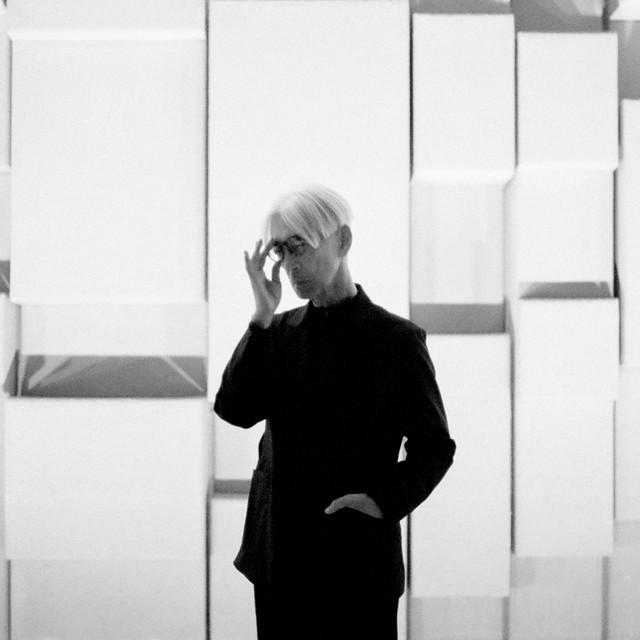
Ryuichi Sakamoto died March 28, 2023 at the age of 71.
R.I.P. Mr. Sakamoto.

Ryuichi Sakamoto died March 28, 2023 at the age of 71.
R.I.P. Mr. Sakamoto.
Monday, May 3, 2021
"Zero" by Ólafur Arnalds
Wowsa, just take a look at this video for "Zero" by modern composer Ólafur Arnalds. I have been so interested in what drones can do for film, from a photography perspective, and did not even think of what drones can do for lighting! As the dancers move through the forest in this video, they are lit by some local stationary lights, but the motion and atmosphere come from the shifting lights overhead on a drone, making the shadows of the branches swirl around them. UTTERLY MAGICAL.

https://olafurarnalds.com/

https://olafurarnalds.com/
Monday, November 4, 2019
"Breathing Out" by Keaton Henson
Exquisite, achingly beautiful and agonizingly intense music. This is "Breathing Out," the last movement of Six Lethargies, a 70-minute orchestral piece by singer-songwriter-and-now-composer Keaton Henson (previously here, here, and here).
"Six Lethargies is a six part, long form work for string orchestra, written by musician, composer, writer and visual artist Keaton Henson. The album explores themes of trauma, empathy, mental illness, and the relationship between music and emotion. It was created intensively over three years, during intense episodes of the very themes it explores. He used his personal experience to plot out six distinct elements of trauma, anxiety and emotional difficulties.
Unable himself to read or write music, Henson first created maps of his personal experience, using complex linear drawings and paintings which he then translated into themes and melodies. A common theme throughout his work is always the element of emotion and vulnerable honesty; he shares the darkest and most complex parts of his personal experiences via his art, leading to work of breathtaking emotional resonance. By contrast, Henson himself is generally reclusive, revealing little else of himself, wherever possible avoiding interviews or public appearances.
As the Six Lethargies project began to take shape, Henson reached out to neuroscientists, psychologists and music theorists, to learn more about the acute relationship between music and emotion, and specifically its effect on us physiologically. ‘Thrill engineer’ and bio-data expert Brendan Walker worked closely with Henson to investigate this relationship and developed software to monitor electrodermal activity (EDA) in order to create a real time visual representation of the link between feelings, anxiety and music.
In fact, when Six Lethargies made its stunning sold out debut at London’s Barbican in July 2018, a portion of the audience were hooked up to ‘galvanic skin response monitors’, which read their anxiety levels in real time whilst listening to the performance, this in turn was fed to the lighting desk and it was this that controlled the colour and intensity of the venue’s lighting rig. As a result the audience were effectively watching how they were feeling while listening to the music, and as a result this amplified the emotional response of the audience to the music.
Known for his past struggles to perform live due to anxiety disorders, Henson himself watched from the sidelines as the audience reacted to an Orchestra performing the work with lighting controlled by their emotions.
This show marked the first new work by Henson for several years, he had released a number of indie/folk albums in previous years – resulting in plays on Radio 1 and huge critical praise, but due in part to the challenges posed by this growing renown and constant demands for him to perform live and appear publicly he had instead decided to retreat from the public eye, disappearing from the world of music and art. However, following the success of the Barbican event, performances at Sydney Opera House and the National Concert Hall Dublin followed. These shows were immersive, measurable experiences which showed how music can physiologically affect the body. They also illustrated how anxiety can be monitored and how it’s triggers could be potentially monitored or predicted, perhaps even eventually controlled, an important factor to consider when dealing with anxiety.
The success of these shows led to the recording of the Six Lethargies album, recorded earlier this year with the Liverpool Philharmonic at The Friary in Liverpool. Through its six movements the finished recording conveys both a personal, internal experience but it also seeks to create the possibility of a similar physiological response in the listener.
Six Lethargies is a profound and intense musical experience, but it is also, completely tonal, musical and ultimately an enjoyable listen on various levels. In spite of its subject matter and meticulous design, it is music that can be listened to as you would Henson’s compositional heroes such as Vaughan Williams, Elgar, Barber and Pärt. However, it can also be listened to as a cathartic and purgative experience, unbroken from beginning to end, taking the mind and body through a series of peaks and troughs and eventually leaving it in a stimulated but calm state."
from thankfolkforthat.com, https://thankfolkforthat.com/new-release-video-keaton-henson-breathing-out/

http://keatonhenson.com/
"Six Lethargies is a six part, long form work for string orchestra, written by musician, composer, writer and visual artist Keaton Henson. The album explores themes of trauma, empathy, mental illness, and the relationship between music and emotion. It was created intensively over three years, during intense episodes of the very themes it explores. He used his personal experience to plot out six distinct elements of trauma, anxiety and emotional difficulties.
Unable himself to read or write music, Henson first created maps of his personal experience, using complex linear drawings and paintings which he then translated into themes and melodies. A common theme throughout his work is always the element of emotion and vulnerable honesty; he shares the darkest and most complex parts of his personal experiences via his art, leading to work of breathtaking emotional resonance. By contrast, Henson himself is generally reclusive, revealing little else of himself, wherever possible avoiding interviews or public appearances.
As the Six Lethargies project began to take shape, Henson reached out to neuroscientists, psychologists and music theorists, to learn more about the acute relationship between music and emotion, and specifically its effect on us physiologically. ‘Thrill engineer’ and bio-data expert Brendan Walker worked closely with Henson to investigate this relationship and developed software to monitor electrodermal activity (EDA) in order to create a real time visual representation of the link between feelings, anxiety and music.
In fact, when Six Lethargies made its stunning sold out debut at London’s Barbican in July 2018, a portion of the audience were hooked up to ‘galvanic skin response monitors’, which read their anxiety levels in real time whilst listening to the performance, this in turn was fed to the lighting desk and it was this that controlled the colour and intensity of the venue’s lighting rig. As a result the audience were effectively watching how they were feeling while listening to the music, and as a result this amplified the emotional response of the audience to the music.
Known for his past struggles to perform live due to anxiety disorders, Henson himself watched from the sidelines as the audience reacted to an Orchestra performing the work with lighting controlled by their emotions.
This show marked the first new work by Henson for several years, he had released a number of indie/folk albums in previous years – resulting in plays on Radio 1 and huge critical praise, but due in part to the challenges posed by this growing renown and constant demands for him to perform live and appear publicly he had instead decided to retreat from the public eye, disappearing from the world of music and art. However, following the success of the Barbican event, performances at Sydney Opera House and the National Concert Hall Dublin followed. These shows were immersive, measurable experiences which showed how music can physiologically affect the body. They also illustrated how anxiety can be monitored and how it’s triggers could be potentially monitored or predicted, perhaps even eventually controlled, an important factor to consider when dealing with anxiety.
The success of these shows led to the recording of the Six Lethargies album, recorded earlier this year with the Liverpool Philharmonic at The Friary in Liverpool. Through its six movements the finished recording conveys both a personal, internal experience but it also seeks to create the possibility of a similar physiological response in the listener.
Six Lethargies is a profound and intense musical experience, but it is also, completely tonal, musical and ultimately an enjoyable listen on various levels. In spite of its subject matter and meticulous design, it is music that can be listened to as you would Henson’s compositional heroes such as Vaughan Williams, Elgar, Barber and Pärt. However, it can also be listened to as a cathartic and purgative experience, unbroken from beginning to end, taking the mind and body through a series of peaks and troughs and eventually leaving it in a stimulated but calm state."
from thankfolkforthat.com, https://thankfolkforthat.com/new-release-video-keaton-henson-breathing-out/

http://keatonhenson.com/
Thursday, July 20, 2017
"fullmoon" by Ryuichi Sakamoto
After the previous posting of "Life, Life" by Ryuichi Sakamoto from his new release "async" here, let's listen to another profound track called "fullmoon." Another transcendent track.
"Because we don't know when we will die, we get to think of life as an inexhaustible well. Yet everything happens only a certain number of times, and a very small number, really. How many more times will you remember a certain afternoon of your childhood, some afternoon that's so deeply a part of your being that you can't even conceive of your life without it? Perhaps four or five times more, perhaps not even that. How many more times will you watch the full moon rise? Perhaps twenty, and yet it all seems limitless."
IT is limitless.
YOU are not.
But YOU are a part of IT.
This is the paradox.
Don't waste your time here.
Be a part of IT.
http://www.sitesakamoto.com/
"Because we don't know when we will die, we get to think of life as an inexhaustible well. Yet everything happens only a certain number of times, and a very small number, really. How many more times will you remember a certain afternoon of your childhood, some afternoon that's so deeply a part of your being that you can't even conceive of your life without it? Perhaps four or five times more, perhaps not even that. How many more times will you watch the full moon rise? Perhaps twenty, and yet it all seems limitless."
IT is limitless.
YOU are not.
But YOU are a part of IT.
This is the paradox.
Don't waste your time here.
Be a part of IT.
http://www.sitesakamoto.com/
Monday, July 10, 2017
"Life, Life" by Ryuichi Sakamoto and David Sylvian
Earlier this year, legendary musician-composer-producer-actor-activist Ryuichi Sakamoto released "async," a new collection of music. The lushly spiritual "Life, Life" is from that collection, and it features a delicate spoken word performance by equally legendary musician and prior collaborator David Sylvian of a poem by the Russian poet Arseny Tarkovsky, father of the filmmaker Andrei Tarkovsky (previously here). This is transcendent work.
And this I dreamt, and this I dream,
And some time this I will dream again,
And all will be repeated, all be re-embodied.
You will dream everything I have seen in dream.
To one side from ourselves, to one side from the world,
Wave follows wave to break on the shore.
On each wave is a star, a person, a bird,
Dreams, reality, death - on wave after wave.
No need for a date: I was, I am, and I will be.
Life is a wonder of wonders, and to wonder
I dedicate myself, on my knees, like an orphan,
Alone - among mirrors - fenced in by reflections:
Cities and seas, iridescent, intensified.
A mother in tears takes a child on her lap.
http://www.sitesakamoto.com
http://www.davidsylvian.com
And this I dreamt, and this I dream,
And some time this I will dream again,
And all will be repeated, all be re-embodied.
You will dream everything I have seen in dream.
To one side from ourselves, to one side from the world,
Wave follows wave to break on the shore.
On each wave is a star, a person, a bird,
Dreams, reality, death - on wave after wave.
No need for a date: I was, I am, and I will be.
Life is a wonder of wonders, and to wonder
I dedicate myself, on my knees, like an orphan,
Alone - among mirrors - fenced in by reflections:
Cities and seas, iridescent, intensified.
A mother in tears takes a child on her lap.
http://www.sitesakamoto.com
http://www.davidsylvian.com
Thursday, April 7, 2016
"Piano Concerto 1: I. Preludium: Andante con moto" by Wojciech Kilar
I have been transfixed by this piece of music for some time now and I only just realized I have yet to post it. The "Piano Concerto 1" (1996) by Polish composer Wojciech Kilar (1932-2013, probably best known for his film music for "Bram Stoker's Dracula" and "The Pianist" for which he won a César in 2003) is simply miraculous. The first movement is what seizes my heart. It starts in a gentle place, contemplative but mysterious. Soon a tension emerges, strings hanging and shimmering high above us making us hold our breath, as this contemplation turns to melancholy and sorrow but not of the paralyzing, inactive kind: the mood is ramped up into one of pounding, agonizing emotion. Kilar wants us to break, to cry, to find the ultimate cosmic compassion for all of creation. As soon as this threshold is reached, we are released...
Here is a recording of the first movement played by Waldemar Malicki and conducted by Antoni Wit with the Warsaw Philharmonic Orchestra.
Here is a recording of the first movement played by Waldemar Malicki and conducted by Antoni Wit with the Warsaw Philharmonic Orchestra.
Wednesday, May 15, 2013
Happy Birthday, Brian Eno!
Accidental musician, Glam Rock dandy, experimental composer, alternative pop music front man, producer extraordinaire, conceptual multimedia artist, and father of Ambient Music, Brian Eno celebrates his 65th birthday today. If you are not familiar with Eno, chances are you are familiar with his work. He was a member of Roxy Music from 1971 to 1973, released solo albums of electronic pop music ("Here Come the Warm Jets," "Taking Tiger Mountain (By Strategy)," "Another Green World" and "Before and After Science"), invented a tape delay instrument with Robert Fripp called "Frippertronics" for their release "No Pussyfooting," invented the musical genre known as "Ambient," collaborated on Bowie's legendary Berlin trio ("Low," "Heroes," and "Lodger"), recorded the precursor to the surge in World Music "My Life In The Bush Of Ghosts" which also pioneered the concept and method of "sampling" music, and produced material for Talking Heads, U2, Devo, Ultravox, James, Jane Siberry, Nico, Genesis, Coldplay, Grace Jones, and James Blake. Surprisingly, he created the six-second start-up music-sound of the Microsoft Windows 95 operating system. He has created art work for galleries around the world including video installations as well as a set of divination cards entitled "Oblique Strategies" intended to stimulate the creative process in any medium. Critic Jason Ankeny at Allmusic argues that Eno "forever altered the ways in which music is approached, composed, performed, and perceived, and everything from punk to techno to new age bears his unmistakable influence."


 Above, top row: two views of early "Glam" Eno. Middle Row: Eno with Bowie in the studio in Berlin; Eno with the members of U2 recording as The Passengers; Eno in the studio with David Byrne during the recording of "My Life In The Bush Of Ghosts." Bottom row: Eno earlier and later.
Here is one of the four tracks from his iconic Ambient release, "Music For Airports." This track was HUGELY influential to me when it first came out in 1978.
And here are all sixty glorious minutes and fifty-seven seconds of "Thursday Afternoon," Eno's "holographic" Ambient work. A hologram image is visible because each point in the object illuminates all of the hologram. This means that the whole image can be reconstructed from a small part of the hologram. Put another way, a hologram can be broken up into small pieces and each one will enable the whole of the original object to be imaged. Eno used this idea to structure this Ambient masterpiece. Play any fragment of it, and you will hear what the entire piece is like. If you have not heard this, do yourself a favor: close the door, close your eyes, relax in your chair, and let this waft down into your consciousness.
Happy birthday, Brian Eno! Thank you for your imagination and precious body of work. You have enriched my life and I thank you.
http://brian-eno.net.org/artists/brian_eno/


Here is one of the four tracks from his iconic Ambient release, "Music For Airports." This track was HUGELY influential to me when it first came out in 1978.
And here are all sixty glorious minutes and fifty-seven seconds of "Thursday Afternoon," Eno's "holographic" Ambient work. A hologram image is visible because each point in the object illuminates all of the hologram. This means that the whole image can be reconstructed from a small part of the hologram. Put another way, a hologram can be broken up into small pieces and each one will enable the whole of the original object to be imaged. Eno used this idea to structure this Ambient masterpiece. Play any fragment of it, and you will hear what the entire piece is like. If you have not heard this, do yourself a favor: close the door, close your eyes, relax in your chair, and let this waft down into your consciousness.
Happy birthday, Brian Eno! Thank you for your imagination and precious body of work. You have enriched my life and I thank you.
http://brian-eno.net.org/artists/brian_eno/
Subscribe to:
Posts (Atom)
