This is simply exquisite. Dreamy, shimmering, bittersweet...
The music of course is lovely but so is the wonderfully cinematic, masterfully crafted video.
With references to Voguing/Ball culture, here is the insanely upbeat and deliriously energetic "All Night" by Swedish duo Icona Pop (previously here).
Tens across the board, darling...
...SKIN GAME, the most recent novel in the Harry Dresden series by Jim Butcher.
In a past review of another Dresden book, I was going to write that the Dresden Files books are a guilty pleasure of mine, but when I stop to think about that turn of phrase, I simply don't feel guilty. I like them--even though I am not a "fan-boy," a role-playing gamer, or a Comic-Con attendee. Jim Butcher has created a total world with a stunning variety of creatures, animals, people, places, and history that are all based on or around ideas of "magic." For those unfamiliar, Harry Dresden is a Private Investigator and modern day wizard in Chicago, and across fourteen--now fifteen--books, we have discovered wizards, monsters, vampires, fairies, ghosts, goblins, ghouls, angels, shape shifters, and other supernatural beings, in a sort of hybrid of Sam Spade and "The X-Files." Lest this sound a tad too Dungeons and Dragons/ role play for some, Butcher has a wonderful way of presenting these stories rooted in reality. He makes everything seem so utterly possible and believable... and I will tell you again that I am not a D&D fan. What I particularly like about the Dresden series is that everything is true: Butcher puts in everyone's gods and monsters, from across all time and all cultures. Greek gods are real, Norse gods are real, Native American beliefs are real, there is a heaven and a hell, but then the rest of the world as well as the supernatural world operates as if there is no heaven or hell. It's all true and it all exists side by side. I wouldn't be surprised if, in some future book, we meet Krishna, Shiva, or Ganesh!
This newest installation in the series, SKIN GAME, is just as fast (it moves at break-neck speed), fun, entertaining, suspenseful, funny, and wildly imaginative as the fourteen that came before it. Jim Butcher is one of those writers who knows exactly how to end a chapter so that you can't wait to start the next one... which leads to many late nights ("Oh, I'll just read one more chapter, then go to bed..." and this is of course followed by, "Well, just this one more, this will be the last one..."). He has a talent for ending chapters in mid-action, mid-plot, mid-secret-being-revealed, so one MUST start the next chapter. As you can imagine, this makes it hard to actually turn the light out and go to sleep when reading at night.
If you haven't followed any of the Dresden books, I certainly recommend them and it is not too late to get caught up. Butcher plans twenty-ish books in the Dresden Files series which will be finalized with a trilogy he has already titled (and presumably outlined!). In this installation, Harry, in his role as Winter Knight to Mab the Queen of Air and Dark, is loaned out to a rival to pay off a debt. But the rival turns out to be a demon Harry has fought in the past. And this demon's plan is to break into a vault and steal one of the most precious and powerful objects in all space and time. Regular readers have the pleasure of catching up with old characters, some of whom come to occupy a very central place in the supernatural world once again. I won't say any more for fear of spoiling the twisty plot and surprises. Even at four hundred and some pages, it was a fast read, for precisely the reasons I mentioned above.
Recommend? Yes! But just like anything in a series, you must read the others first. None of the Dresden Files books are stand-alone affairs. The series is a continuing unfolding of events and you need to be up to speed. It makes no sense to come in without any prior knowledge: you need to grasp the importance and history of certain places, people, and things. Go to Butcher's site and see the list of HARRY DRESDEN books in order, starting with STORM FRONT: http://www.jim-butcher.com/books/dresden/
It's been a while since I have posted another installation of my "Masterpieces of Pop" series in which I explore the songs that I consider to be seminal moments or highlights in pop music. Now, as I said in my very first post in the series (which surveyed Bobbie Gentry's masterpiece "Ode To Billie Joe" seen here), my definition of pop for this exercise is quite broad; it includes music from genres such as country and western, and soul/ R&B. For my purpose here, “pop” means any music, after the start of rock n’ roll, that was “popular.”
Another measure of a "Masterpiece of Pop" for me are the issues of subject matter and brevity. Every song I have surveyed packs a tremendous amount of meaning, whether outright or by inference, into a small space of four or five minutes (sometimes less!). Just look at the profundity that reverberates out past the edges of the song in pieces like The Beatles' "Eleanor Rigby," or Sly Stone's "Family Affair," or even something as seemingly simple as "I Only Have Eyes For You" by The Flamingos. A Masterpiece of Pop can and should evoke a sense, a place, a time, an emotion, a psychological state. It should be a signpost to something larger, like any good piece of art, whether a film, a novel, a painting, or a poem, which is what these gems of music are.
And with all of that in mind, the following abstract musical expression certainly deserves a place on this list: the phenomenal "Rock On" written and performed by David Essex.
Essex recorded his first song in 1963 for the Fontana record label (a subsidiary of Phillips in Europe and Mercury in the US) called "And The Tears Came Tumblin' Down" at the shockingly young age of 16. After recording a few more songs and touring with a group called David Essex and the Mood Indigo, he explored an acting career by appearing in a few films. Finally, he got the lead role in a stage production of "Godspell" in 1971. But it wasn't until 1973 that he recorded and released his most famous song, "Rock On." Fueled by his angelic yet sexy looks, and a vague sense of the kind of Glam Rock that was wildly popular at the time, the song shot to #1 in Canada, #3 in the UK, and #5 in the United States.
The song starts with a very eerie bass line approximation of a human heart beat. This heartbeat gets folded into the melodic bass line as the song starts. The addition of cymbals and bongos immediately gives the song a sinuous, sultry, even sinister feeling that sets the tone for the entire piece. Then Essex issues a warning: a moan and a "sshhhh" before launching into a minor-chord, spaced-out ode to the birth of rock n' roll in the 1950s as well as the youth culture and celebrities that grew from it. With references to Elvis ("Blue Suede Shoes"), actor James Dean, Marilyn Monroe (although she is not specifically named in the song, it is assumed that the "blue jean baby queen" who is the prettiest girl ever seen on a movie screen refers to Norma JEAN, aka Marilyn), and early rock n' roll pioneer Eddie Cochran's classic song "Summertime Blues."
Ooooh Ssssshhhhh Hey, kid, rock 'n' roll, rock on Ooh, my soul Hey kid, ya boogie too, did ya? Hey, shout, Summertime Blues Jump up and down in your blue suede shoes Hey, did ya rock 'n' roll, rock on And where do we go from here? Which is a way that's clear? Still looking for that blue jean baby queen Prettiest girl I ever seen See her shake on the movie screen, Jimmy Dean (James Dean) And where do we go from here? Which is the way that's clear? Still looking for that blue jean baby queen Prettiest girl I ever seen See her shake on the movie screen, Jimmy Dean Jimmy Dean Rock on Rock on Rock on Rock on Hey, kid, rock 'n' roll, rock on...
Given the subject matter, one would think that a song called "Rock On" would be a sound-alike celebration of the optimistic energy and exuberance of 1950s rock n' roll, yet it ends up being anything but. Instead of the bouncy, joyful naïveté of those early days of rock, we have a dark, almost cynical hallucination of the time period. And after the failure of the 1960s protest movements to try to turn the world into a better place, after Vietnam, after the Kent State shootings, after the assassinations of Bobby Kennedy and Martin Luther King, after Altamont, and the rise of the Black Panthers, it's easy to see how things got to be a little darker, a little more cynical, and a lot more disheartened. It is exactly this contrast, this conflict, this disconnection that gives the song its unsettling power. The lyrics can be seen as a mourning for what is perceived, in hindsight, as a lighter, less troubled time...given all that came after, we indeed were asking "Where do we go from here? Which is the way that's clear?" This is a song about the destruction of innocence.
The entirely sparse arrangement features so much disturbing space around each instrument. Chilling, mournful strings and an understated bare-bones horn section are the only sounds aside from Herbie Flowers' insidious bass line and the vocals. In fact, a very important part of the texture and success of this song is the echo or reverb which is applied to the bass and vocals. But it is more--or less--than an echo. It is a lurching, throbbing delay...and it gives the bass its distinctive roiling, slapping sound. And Essex' vocals are not so much treated with an echo as much as they are simply doubled, giving the disconcerting effect of a doppelgänger clearly coming from the right channel a heartbeat after the main vocal.
The track unfolds without a true verse or chorus; even the structure of classic rock n' roll songs is disassembled and subverted here. After an unexpected full-stop silence at the 2:21 mark in which the world seems to stop and hold its breath, the song loosens, the strings join in, the drums become more intense, Essex growls the song's title, and the whole thing inches toward a dissolution of control, a sense of tribal abandon, a spooky kind of trance...
Molos Morina is a multi-disciplinary artist who has created a series of small busts--most are around three inches high--slathered and dripping with ceramic glazes. His amazing organic, petal-like faces and figures remind me of the work of Alison Schulnik, especially in her video entitled "Mound," previously seen here.
Using his signature material of wood, artist Henrique Oliveira (previously here) just installed his largest work to date at the Museu de Arte Contemporânea da Universidade in São Paulo, Brazil. A series of tunnels snakes through the cavernous galleries which Oliveira covered with thinly sliced pieces of flexible wood leftover from construction debris. And museum goers are invited to walk the tunnels. Experiencing this stunning interactive installation must feel like burrowing into a subterranean world only moles see... as if you are actually within the root systems of a forest!
And in a powerful political statement concerning the ideas of refuse, economics, and how society treats poverty, Oliveira morphs the wooden tunnels into a replica of the shantytowns/slums or favelas in Brazil.
Michael Lipsey makes collages featuring paint and photos topped with his original witty quotes. It reminds me a bit of some of the work of Michael Dumontier and Neil Farber (previously here, here, here, here, here, and here).
I feel so lucky to live where I do. Northern California is one of the most beautiful places in the United States. We have so many different landscapes and climates: ocean vistas, beaches, mountains, redwood forests, vast expanses of fields, rolling golden hills. Cool and foggy, warm and sunny...
This is one of the many reasons why most of the country wants to move here, and why our real estate bubble never really burst. It is a highly desirable area.
This Memorial Day, a friend and I hiked trails in a local redwood forest. It was a perfect day with perfect weather, and I feel doubly lucky to have such a gorgeous area so close.
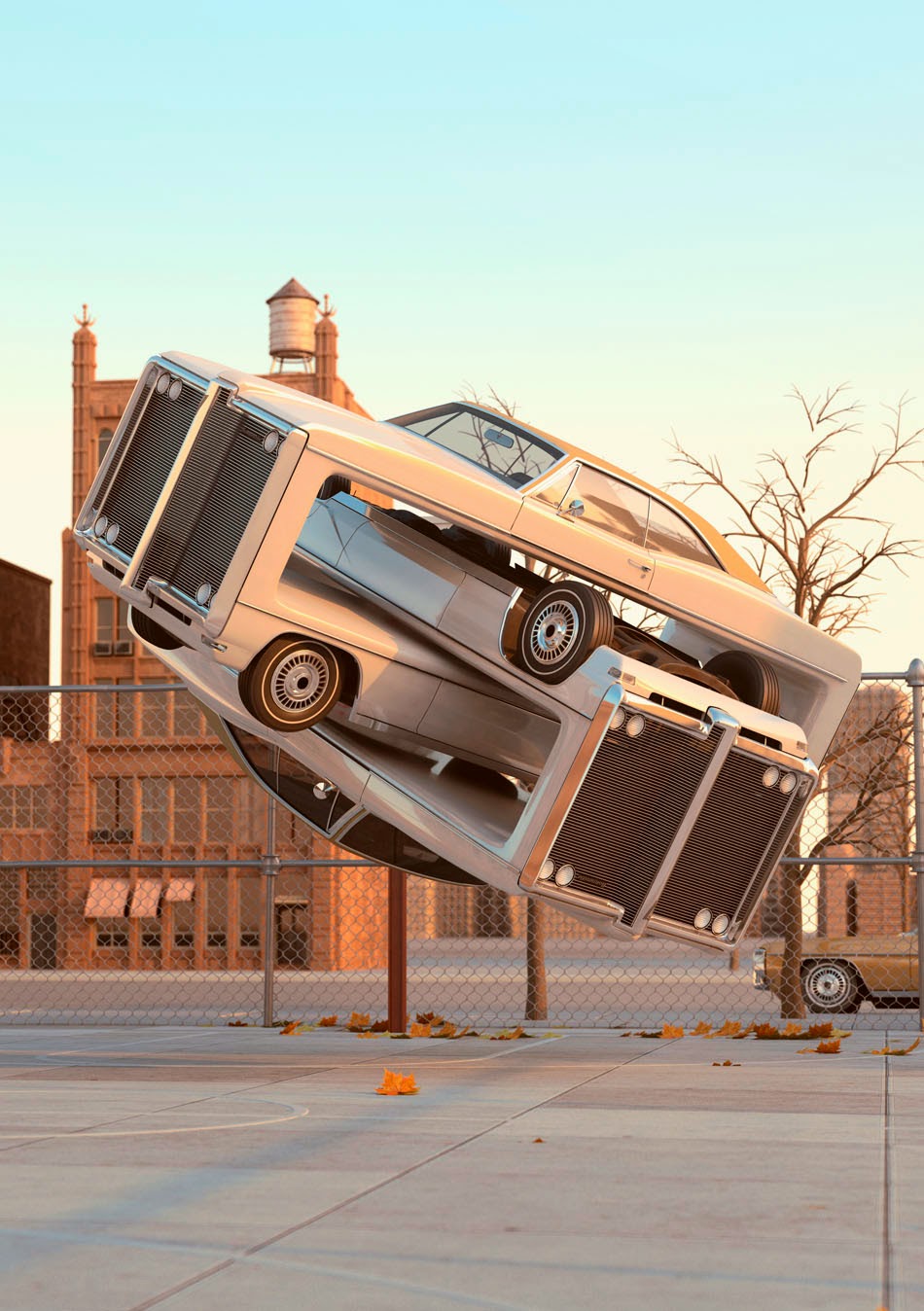
These supremely imaginative, mind-bending, physics-bending graphic images by Chris LaBrooy are stimulating a deep part of my brain. I have my own strange, object-centered daydreams in which common items morph and take on arcane shapes and uses... and these floating, box-y cars are hitting me just right. Simply incredible...
LaBrooy's images remind me of the work of Matthew Barney--they both like inventing new objects out of old ones.
... the historically relevant "Two Tribes" by then mega-super-band Frankie Goes To Hollywood.
They may be a footnote in the annals of 80s music now, but in 1984, Frankie Goes To Hollywood took the world by storm. Their song "Relax" was everywhere. And this song, "Two Tribes," was their next single. The video seems comical now, but for anyone not alive during that time period, I can't stress enough to you how immediate and frightening and imminent a war with Russia seemed. There was a palpable fear in the zeitgeist, floating in the air...a real and true possibility--no, a likelihood of two super powers going to war. The video by Godley and Creme features look-alike versions of Ronald Reagan and then-Soviet leader Konstantin Chernenko in a fighting ring, going hand to hand while the nations of the world watch. The song itself--and especially the 12" single remixes--features terrifyingly dispassionate samples from the series of twenty "Protect and Survive" public information films for British television, narrated by Patrick Allen.
It was on everyone's mind and the fear was in everyone's heart.
Then-President Ronald Reagan foolishly added to the cultural landscape of fear by making a careless remark during a microphone check before a speech. Although it was not broadcast, the clip was leaked.
He said with jocularity, "My fellow Americans, I'm pleased to tell you today that I've signed legislation that will outlaw Russia forever. We begin bombing in five minutes." Yuck yuck yuck... as we hear chuckles in the background.
According to Wikipedia, with cited sources, "...the Tokyo newspaper Yomiuri Shimbun reported in October 1984 that the Soviet Far East Army was placed on alert after word of the statement got out, and that the alert was not withdrawn until 30 minutes later. An unnamed aide to US Representative Michael Barnes (D-Md.) confirmed that the Pentagon was aware of the alert.[3]"
Jerry Harrison of The Talking Heads, Bootsy Collins of Parliament-Funkadelic, and Daniel Lazerus formed a one-off group called Bonzo Goes To Washington (a reference to Ronald Reagan's 1951 film "Bedtime For Bonzo" in which he shared billing with a chimp) to create a biting song only using the sample of Reagan's monumental gaffe which opens the track. Listen to it below.
Frankie are still around, minus vocalist Holly Johnson. They are now fronted by Ryan Molloy, who I must say does sound quite a lot like Johnson. http://www.frankiesay.com/
"Oh, By The Way" is my digital scrap book of things I like, things I would share with a close friend and say: “Oh, by the way, do you know of this artist/ clothing or interior designer/ model/ singer/ actor/ gorgeous man… or, have you seen this video/ photo/ film... or heard (or do you remember) this song/ band... or, read this book/ poem/ inspiring quote... or, visited this place/ museum/ restaurant/ famous building... or, have you heard of this amazing new scientific discovery?”
I am dedicated to posting the positive, the fascinating, the beautiful, the interesting, the moving, and the inspiring and uplifting. Sometimes I post cultural as well as personal observations, milestones, and remembrances. And just like life, all of these things may often have a bit of melancholy or even sadness in them, which is what makes our time here so lovely and bittersweet and precious.
Some of the photos, art, poetry, and prose are my own original work, credited with my initials, JEF. When it isn't, I always try to post links to the original source material, but often I find photos on the web that are not linked or other material that is not sourced. In these instances, I post them without malice since it is assumed that such things, by being globally posted on something as uncontrollable as the internet to begin with, are in the public domain. If you identify the source of an image that is not linked, please politely let me know (without accusing me of theft, please) and I will be happy to provide a link. If you are the owner of an image and would prefer it be removed, I am happy to do that as well (again, without accusing me of theft, please).
I hope to inspire and entertain my readers with things that inspire and entertain me. There is a startling amount of beauty and creativity in the world and it enriches us all to participate in it.
All-time Favorite Films
2001: A Space Odyssey (Kubrick)
After Hours (Hysterical, hair-raising ride through NYC at night)
Amelie
American Beauty (Alan Ball)
Baraka (Stunning, transcending—the "spiritus mundi" on film)
Belle et Bete (Cocteau)
Big Sleep, The (The epitome of film noir)
Bringing Up Baby (Hepburn & Grant—the epitome of screwball comedy)
Cook, The Thief, His Wife, and Her Lover, The (Greenaway)
Crash (Cronenberg—DIFFICULT subject, not for everyone)
Don’t Look Now (Nicolas Roeg—ultimate modern gothic horror)
Drowning By Numbers (Greenaway)
Easy Rider
Edward II (Derek Jarman)
Erendira (From magic realist Marquez’ brilliant short story)
Eyes Wide Shut (Kubrick's last film)
Fearless (Jeff Bridges—life and death)
Funny Bones (Leslie Caron, Jerry Lewis, and the brilliant Lee Evans)
Holiday (Hepburn & Grant)
Howard’s End (The ultimate statement of the unfairness of class systems)
Hunger, The
Ice Storm, The
Inland Empire (David Lynch)
Interiors (Woody Allen's ode to Bergman)
Jetée, La (French short that inspired Gilliam's "12 Monkeys")
Jules et Jim (Truffaut)
Juliet of the Spirits (My favorite Fellini)
Kwaidan (4 Japanese ghost stories)
L’Age d’Or (Bunuel)
Last Temptation of Christ, The (Jesus was a shaman)
Latcho Drom (Beautiful visual documentary of Romany culture around the world)
Lion in Winter, The (Hepburn!—Like “Who’s Afraid of Virginia Woolf” but circa 1183)
Living End, The
Logan's Run
Lost Highway (David Lynch)
Magnolia
Maurice (Boy gets boy, they live happily ever after!!!!!)
Men Don’t Leave (Jessica Lange’s gorgeous delicate performance)
Mirror, The (achingly beautiful stream of consciousness Tarkovsky)
Nights of Cabiria, The (Fellini)
Orlando (Tilda Swinton’s pristine performance and Sally Potter’s ravishing visuals)
Orphée (HEAVEN! Cocteau was a genius)
Pennies From Heaven (Steve Martin/ stunning Edward Hopper sets!)
Philadelphia Story, The (Hepburn)
Pillow Book, The (Greenaway)
Planet of the Apes (1968...NOT 2001!)
Postman Always Rings Twice, The (Nicholson/Lange--WOW)
Prospero’s Books (Greenaway)
Rebel Without a Cause ("I got the bullets!")
Satyricon (Fellini)
Shining, The (Kubrick)
Solaris (atmospheric, haunting Andrei Tarkovsky sci-fi)
Stalker (chilling Andrei Tarkovsky sci-fi)
Thin Red Line, The (Terrence Malick--existential poetry cleverly disguised as a war film)
Titus (Julie Taymor does Shakespeare)
Tommy (Brilliant, audacious Ken Russell film of The Who's rock opera)
Tree Of Life, The (Terrence Malick masterpiece)
Un Chien Andalou (Bunuel and Dali, need more be said?)
Wall,The (Pink Floyd)
Wings of Desire (All the feelings of the entire human race in one film)
Woman of the Year (Dated yet charming Hepburn vehicle)
Zabriskie Point (Empty, open, classic early 70s)
ZOO, A Zed and Two Noughts (Greenaway)
The Sounds My Soul Makes: Music
Annie Lennox
Brian Eno
Cocteau Twins
David Bowie
David Sylvian
Dead Can Dance
Durutti Column
Elbow
Everything But the Girl
Gang of Four
Gem Club
Goldfrapp
Joni Mitchell
José González
Junip
Kate Bush
Laurie Anderson
M83
Morrissey
Nine Inch Nails
Peter Gabriel
Peter Murphy
Rickie Lee Jones
Sigur Ros
Simple Minds
Smiths, The
Sufjan Stevens
Talk Talk
Tears For Fears
This Mortal Coil
Tori Amos
Ultravox
William Orbit
Zero 7
Important Books That Have Influenced Me
100 Years of Solitude—Gabriel Garcia Marquez
A Wrinkle in Time, A Wind in the Doorway (for young people but worth it)—Madeleine L’Engle